

Learn how to select injection molding materials by strength, heat resistance, chemical exposure, shrinkage, finish, cost and production requirements.
Common Injection Molding Material Families
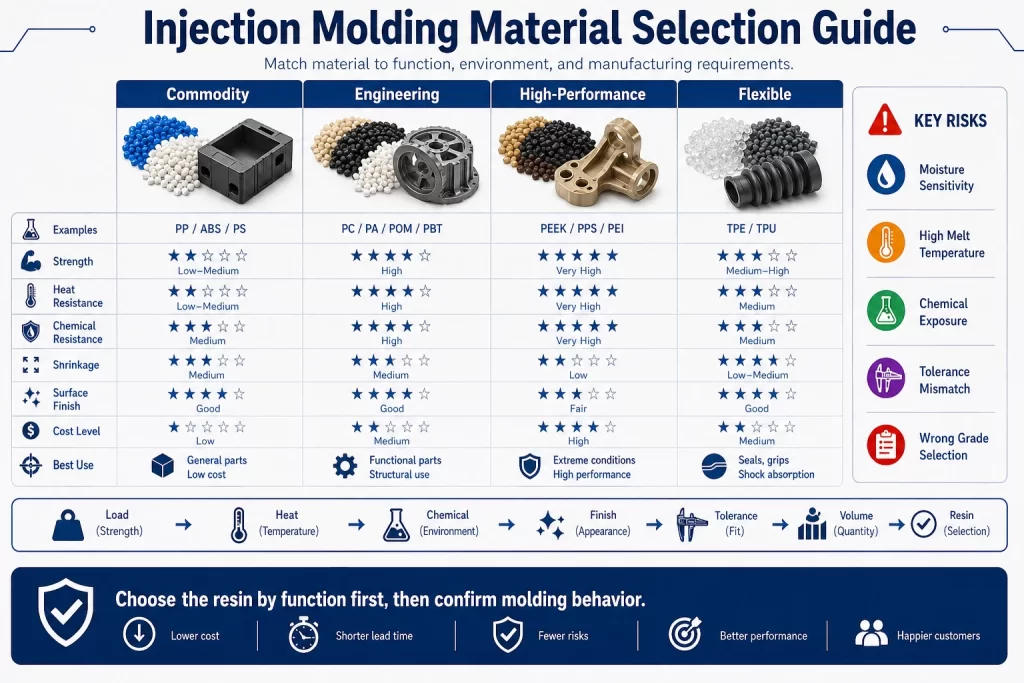
The source material guide covers ABS, PMMA, acetal, HDPE, LDPE, PA6, PA66, PBT, PC, PC-ABS, PC-PBT, PEEK, PEI, PET, PP, PPS, PS, PSU, PVC, TPE, TPU and filled grades. Each material family brings different trade-offs in strength, flow, shrinkage, heat resistance, chemical behavior and cost.
The engineering decision should start from the application environment, not from a favorite resin name.
In practical terms, common injection molding material families should be translated into drawing notes, process limits, material choices, tolerance expectations, finish requirements and inspection points before the design is released. For injection molding materials selection guide for functional plastic parts, the useful result is not just a general comparison, but a manufacturing decision that buyers, engineers and suppliers can apply consistently during quoting, prototyping and production planning. This is where a topic moves from educational guidance into a real release standard.
Commodity, Engineering and High-Performance Plastics
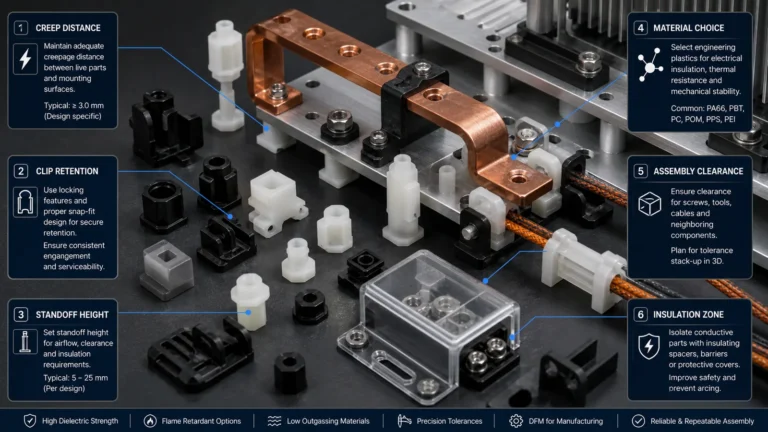
ABS and PP often support general molded products, PC and PMMA serve impact or optical needs, nylon and acetal are useful for mechanical parts, and PEEK, PPS or PEI support demanding environments. Flexible TPE and TPU grades support grips, seals and soft-touch functions.
Higher-performance materials often require tighter processing control and more careful tooling review.
In practical terms, commodity, engineering and high-performance plastics should be translated into drawing notes, process limits, material choices, tolerance expectations, finish requirements and inspection points before the design is released. For injection molding materials selection guide for functional plastic parts, the useful result is not just a general comparison, but a manufacturing decision that buyers, engineers and suppliers can apply consistently during quoting, prototyping and production planning. This is where a topic moves from educational guidance into a real release standard.
Shrinkage, Flow and Tooling Risk
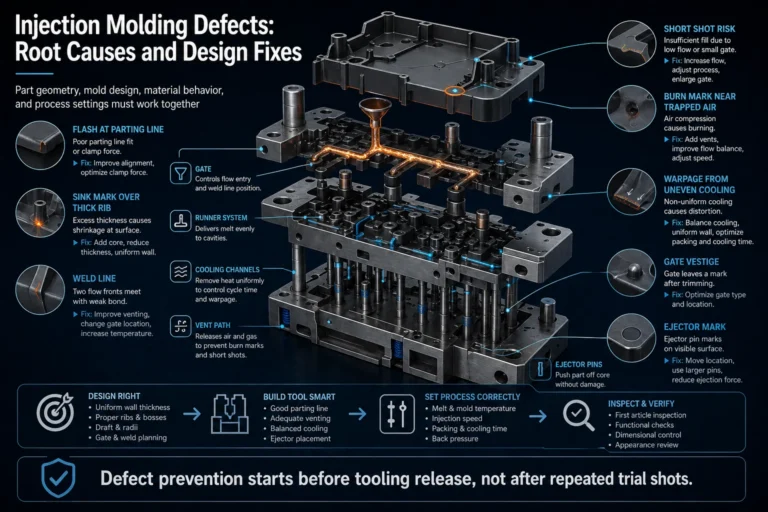
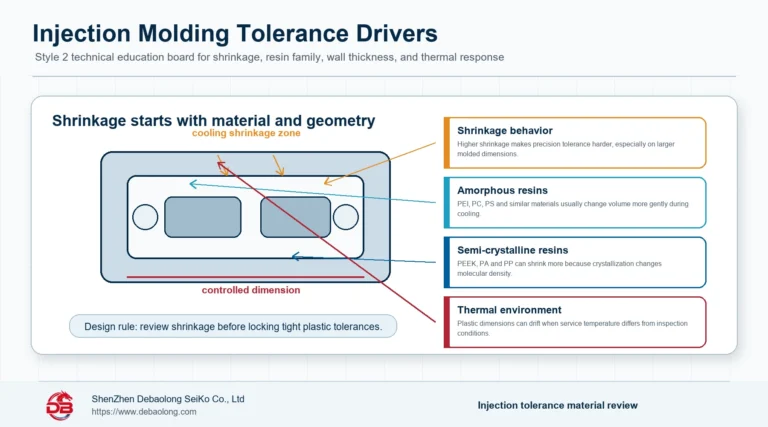
Different resins shrink and flow differently. Semi-crystalline plastics may create different warpage risks than amorphous plastics, and filled materials can behave differently along and across the flow direction.
Wall thickness, gate location, mold temperature, drying and venting must match the material.
In practical terms, shrinkage, flow and tooling risk should be translated into drawing notes, process limits, material choices, tolerance expectations, finish requirements and inspection points before the design is released. For injection molding materials selection guide for functional plastic parts, the useful result is not just a general comparison, but a manufacturing decision that buyers, engineers and suppliers can apply consistently during quoting, prototyping and production planning. This is where a topic moves from educational guidance into a real release standard.
From Resin List to Production Selection
The material list becomes useful only when it is connected to load, heat, chemicals, finish, tolerance, quantity and inspection. DEBAOLONG reviews resin choice together with part geometry so the design is easier to mold and scale.
A technically strong plastic is not automatically the best production plastic if it creates avoidable molding risk.
In practical terms, from resin list to production selection should be translated into drawing notes, process limits, material choices, tolerance expectations, finish requirements and inspection points before the design is released. For injection molding materials selection guide for functional plastic parts, the useful result is not just a general comparison, but a manufacturing decision that buyers, engineers and suppliers can apply consistently during quoting, prototyping and production planning. This is where a topic moves from educational guidance into a real release standard.
How to Match Resin Choice to Application Fit
The long source list only becomes useful when engineers translate resin names into functional requirements. Strength, stiffness, impact, heat, wear, optical clarity, flexibility, chemical resistance and regulatory needs should each be linked to the real duty of the molded part.
DEBAOLONG uses that application-first review to prevent over-specification and molding risk. The best resin is not simply the highest-performance polymer on paper, but the material that fits the mold design, processing window, service environment and total production target.
In practical terms, how to match resin choice to application fit should be translated into drawing notes, process limits, material choices, tolerance expectations, finish requirements and inspection points before the design is released. For injection molding materials selection guide for functional plastic parts, the useful result is not just a general comparison, but a manufacturing decision that buyers, engineers and suppliers can apply consistently during quoting, prototyping and production planning. This is where a topic moves from educational guidance into a real release standard.
DEBAOLONG Engineering Review
This article has been rebuilt around the source article’s actual engineering logic instead of being treated as a short summary. The purpose is to preserve the useful decision sequence: process capability, material fit, tolerance impact, finish expectations, production risk, validation steps and how the next manufacturing decision should be made.
Before release, the design team should confirm the intended application, required quantity, critical dimensions, operating environment, acceptable finish, cleaning requirements where relevant, and the inspection method that will be used to validate the part. These details turn a manufacturing article into a production-ready review standard and reduce late changes after prototyping or tooling work has already started.
For broader manufacturing planning, review the DEBAOLONG Manufacturing Engineering Knowledge Center, compare major manufacturing process options, or use DFM for prototyping to connect early design decisions with production-ready parts.
FAQ
How should engineers use this injection molding materials selection guide for functional plastic parts guide?
Use it as a practical release checklist before quoting, prototyping or production handoff. The best result is a clearer manufacturing decision, not simply a longer list of process facts.
Why does source-aligned structure matter in this topic?
Because each source section answers a different engineering question. Keeping those questions separate makes it easier to review geometry, material, cost, finish, quantity and production risk without silently collapsing useful detail.
Can DEBAOLONG help turn the review into a manufacturable plan?
Yes. DEBAOLONG can review geometry, materials, tolerances, finish requirements, visual expectations and production intent before the project moves into manufacturing.