

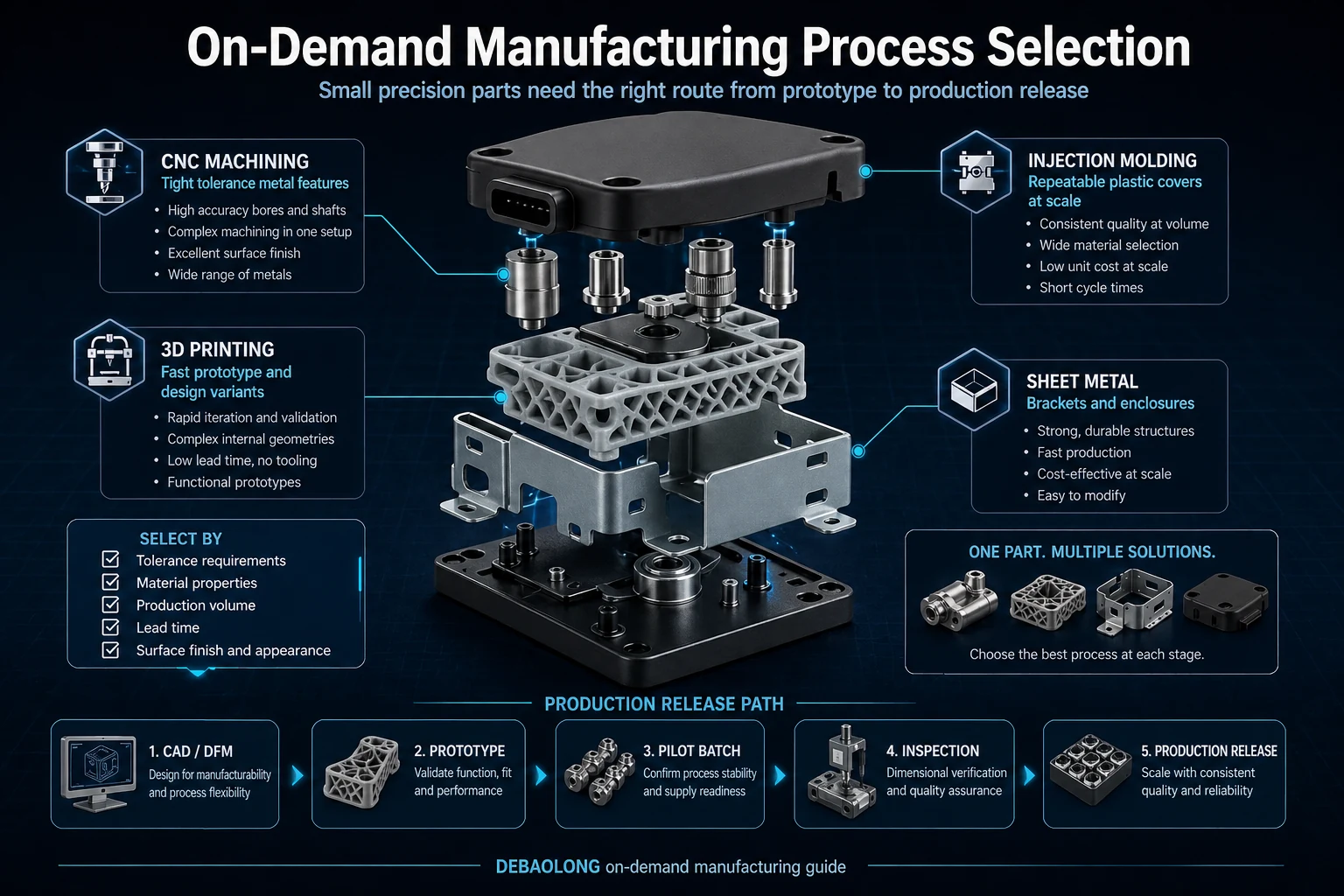
Understand on-demand manufacturing, including custom low-volume production, inventory reduction, product control, innovation, manufacturing-as-a-service and flexible capacity.
This expanded DEBAOLONG guide follows the source article’s engineering flow while rewriting the material in independent English for manufacturing buyers, designers and engineering teams. It focuses on practical decisions: when the process is useful, where risk appears, what details should be specified, and how to connect prototype evidence with production planning.
What On-Demand Manufacturing Means
On-demand manufacturing produces parts when they are needed instead of relying on large inventory or early mass production. It is useful for prototypes, spare parts, bridge production, customized products and short-run manufacturing.
The value comes from matching production capacity to real demand. This reduces inventory risk and gives engineering teams more flexibility while a product or market is still changing.
On-demand manufacturing is most useful when demand, design or product mix is still moving. It gives teams a way to produce real parts without committing too early to inventory or tooling.
The model can support prototypes, replacement parts, bridge production, test builds and customized parts, but it still depends on accurate CAD, drawings and release control.
In practice, this section should be checked against the drawing, CAD model, quantity and inspection requirement before the design is released. The same guideline can lead to different decisions for a visual prototype, a functional test part, a bridge-production batch and a repeat production component.
Drivers Behind On-Demand Manufacturing
Digital design data, faster quoting, CNC machining, sheet metal fabrication, 3D printing and flexible production networks have all made on-demand manufacturing more practical.
The model works best when CAD, drawings, material requirements, tolerances and inspection expectations are clear. Poor engineering data still creates delay even in a flexible supply chain.
Digital manufacturing data, faster quoting and flexible process access make on-demand work practical. CNC machining, sheet metal fabrication, 3D printing and molding can all participate when requirements are clear.
The weak point is often engineering information. Missing tolerances, unclear finishes, unapproved materials and revision confusion can slow an on-demand project as much as a traditional one.
In practice, this section should be checked against the drawing, CAD model, quantity and inspection requirement before the design is released. The same guideline can lead to different decisions for a visual prototype, a functional test part, a bridge-production batch and a repeat production component.
Advantages over Traditional Manufacturing
On-demand manufacturing can support customization, small batches, lower warehousing burden, tighter product control and less waste. It can also support innovation because teams can test and revise parts without committing to large production too early.
For small and medium-sized technology teams, this model can provide access to manufacturing capacity that would otherwise require more internal equipment or long-term commitments.
Lower inventory burden is valuable, but the deeper benefit is timing. Teams can delay final volume decisions until they have better demand, test or market evidence.
Customization also becomes easier. Small product variants can be produced around actual need, provided the differences are controlled and documented.
In practice, this section should be checked against the drawing, CAD model, quantity and inspection requirement before the design is released. The same guideline can lead to different decisions for a visual prototype, a functional test part, a bridge-production batch and a repeat production component.
Manufacturing as a Service and Capacity Planning
Manufacturing-as-a-service gives teams access to production capacity without owning every process internally. It can support CNC machining, sheet metal, 3D printing, molding and finishing depending on the project.
Capacity still needs engineering control. Material, process, tolerance and quality requirements must be defined before the work is released.
Manufacturing-as-a-service gives access to capability without owning every machine or process. It can help small and medium teams compete with more flexible capacity.
Capacity still needs planning. Material availability, inspection method, finishing lead time and repeat order history decide whether the model can support production reliably.
In practice, this section should be checked against the drawing, CAD model, quantity and inspection requirement before the design is released. The same guideline can lead to different decisions for a visual prototype, a functional test part, a bridge-production batch and a repeat production component.
DEBAOLONG On-Demand Manufacturing Review
DEBAOLONG supports on-demand manufacturing by connecting design review, process selection, material planning and production readiness. This helps customers move from prototype to small batch or repeat production without losing engineering control.
DEBAOLONG reviews whether a part is ready for on-demand release by checking process choice, tolerances, material, finish, quality expectations and future production intent.
This keeps flexible manufacturing connected to engineering discipline, which is what prevents fast orders from becoming expensive rework.
In practice, this section should be checked against the drawing, CAD model, quantity and inspection requirement before the design is released. The same guideline can lead to different decisions for a visual prototype, a functional test part, a bridge-production batch and a repeat production component.
Practical Release Checklist
Before publishing a design for quotation or production, confirm the intended application, annual or batch quantity, material requirement, critical dimensions, cosmetic expectations, operating environment, inspection method and acceptable lead time. These inputs make the manufacturing recommendation more reliable and prevent the article’s guidance from being used as a generic rule without project context.
For related planning, review the DEBAOLONG Manufacturing Engineering Knowledge Center, compare major manufacturing process options, or use DFM for prototyping before production release.
FAQ
How should engineers use this on-demand manufacturing: how it works and when it supports production guide?
Use it as a decision checklist before quoting, prototyping or production release. The most useful result is a clearer specification, not just a faster order.
When should the design be reviewed by a manufacturer?
Review should happen before the design is treated as frozen, especially when material, tolerance, surface finish, wall thickness, cleaning, assembly or production quantity affects the result.
Can DEBAOLONG help turn the review into a production-ready plan?
Yes. DEBAOLONG can review geometry, material selection, tolerance, finish, inspection and process choice so the project moves from prototype evidence toward a controlled manufacturing route.
Related Engineering Resources