

Introduction
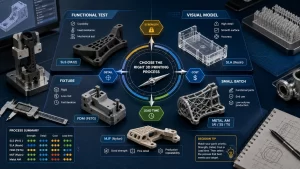
Selecting the right manufacturing process is one of the most critical decisions in product development. A poor choice can lead to unnecessary costs, production delays, and compromised product performance.
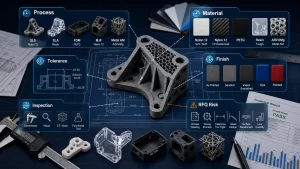
Today, three of the most widely used manufacturing methods are CNC machining, sheet metal fabrication, and 3D printing. Each process serves different engineering needs, design constraints, and production goals.
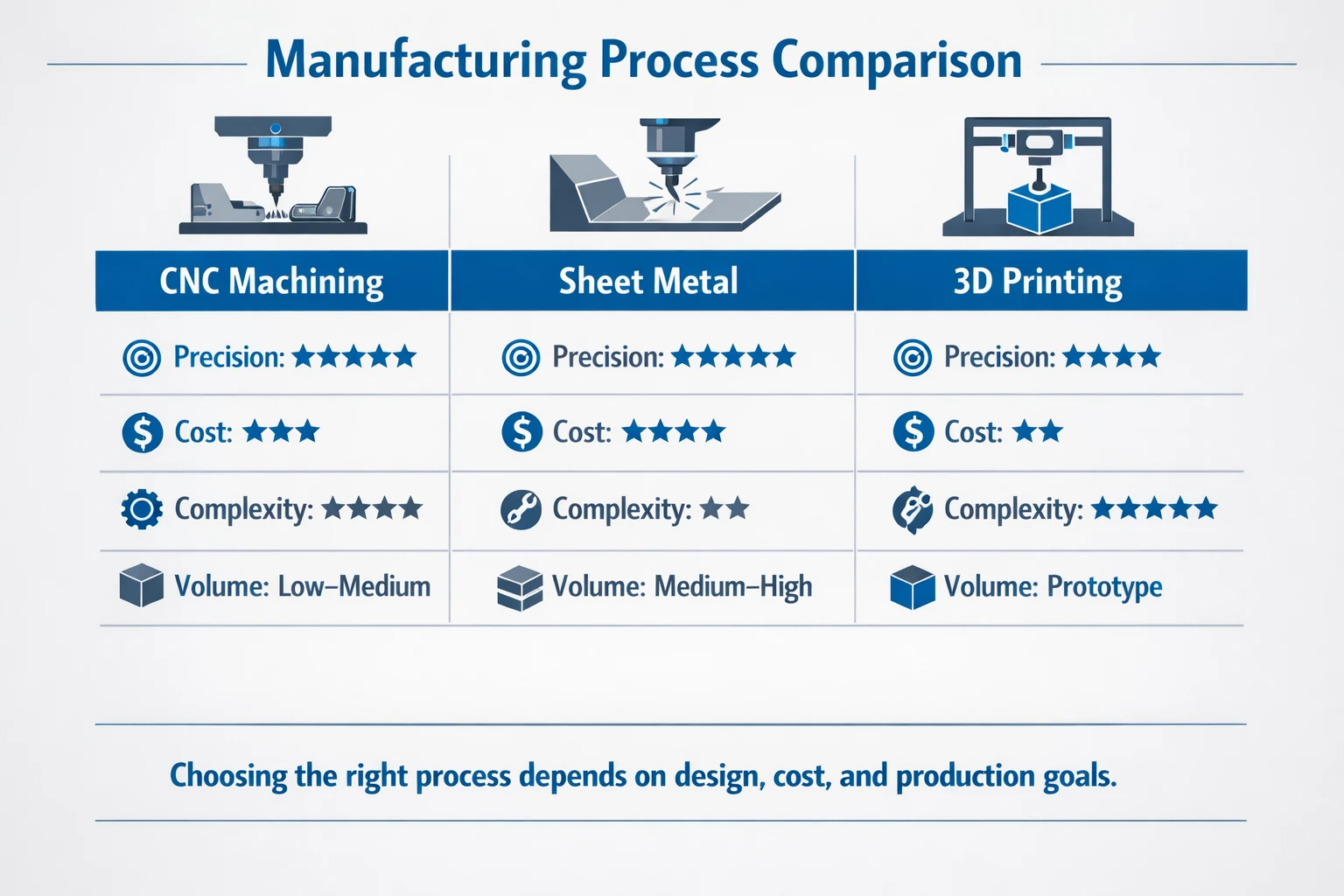
Understanding their differences is essential for engineers, designers, and sourcing professionals aiming to optimize both cost and performance.
1. CNC Machining: Precision and Performance
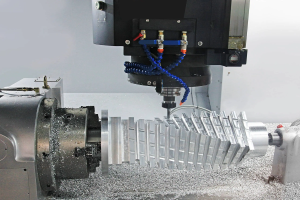
CNC machining is a subtractive manufacturing process that removes material from a solid block using computer-controlled cutting tools.
It is best suited for:
- High-precision components
- Tight tolerances
- Functional mechanical parts
CNC machining supports a wide range of materials, including aluminum, stainless steel, titanium, and engineering plastics.
👉 For a deeper understanding of CNC fundamentals, refer to our guide:
https://www.debaolong.com/cnc-machining-basic-processes-milling-turning-drilling-grindin/
👉 You can also explore advanced toolpath strategies such as:
https://www.debaolong.com/trochoidal-milling-principles-parameters-and-best-application-cases/
2. Sheet Metal Fabrication: Efficiency for Structural Parts
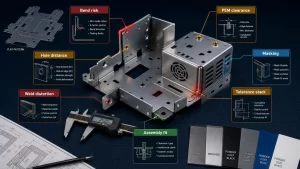
Sheet metal fabrication involves laser cutting, bending, and forming flat metal sheets into finished parts.
It is widely used for:
- Enclosures and housings
- Brackets and panels
- Structural components
Compared to CNC machining, sheet metal is more efficient for thin-walled parts and medium-to-high volume production.
3. 3D Printing: Flexibility and Rapid Prototyping
3D printing, also known as additive manufacturing, builds parts layer by layer directly from digital models.
This process excels in:
- Rapid prototyping
- Complex geometries
- Low-volume production
Unlike CNC machining, 3D printing does not require tooling or complex setup.
4. Design Flexibility Comparison
Each process has different design constraints:
- CNC machining is limited by tool access and cutting angles
- Sheet metal requires consideration of bending rules
- 3D printing allows complex internal geometries
👉 For design optimization tips, see:
https://www.debaolong.com/expert-guide-cnc-machining-manufacturing-design/
5. Cost Comparison
Cost varies depending on material, complexity, and production volume.
- CNC machining: medium to high cost, driven by machining time
- Sheet metal: cost-effective for batch production
- 3D printing: low setup cost, but higher unit cost
👉 Material choice also impacts cost significantly:
https://www.debaolong.com/cnc-machining-characteristics-and-applications-of-aluminum-and-its-alloys/
6. Material Capabilities
Material availability differs across processes:
- CNC machining: metals and engineering plastics
- Sheet metal: steel, aluminum, stainless steel
- 3D printing: plastics, resins, limited metals
Material selection directly affects strength, durability, and application suitability.
7. Strength and Functional Performance
- CNC machining provides the highest mechanical strength
- Sheet metal offers strong and lightweight structures
- 3D printing varies depending on material and process
👉 Precision and tolerance also play a key role:
https://www.debaolong.com/knowledge/introduction-to-cnc-machining-tolerance-standards/
8. Production Volume Suitability
- 3D printing: ideal for prototypes
- CNC machining: low to medium production
- Sheet metal: medium to high volume
Understanding production volume is essential for cost control.
9. Surface Finish and Precision
- CNC machining delivers superior surface finish
- Sheet metal depends on finishing processes
- 3D printing often requires post-processing
👉 Surface quality is influenced by machining parameters such as stepover:
https://www.debaolong.com/cnc-stepover-guide-understanding-its-impact-on-surface-finish-and-machining-efficiency/
10. Real-World Application Scenarios
- Prototype development → 3D printing
- Precision parts → CNC machining
- Enclosures → sheet metal fabrication
Each process has its optimal use case in real-world production.
11. Hybrid Manufacturing Strategy (Key Insight)
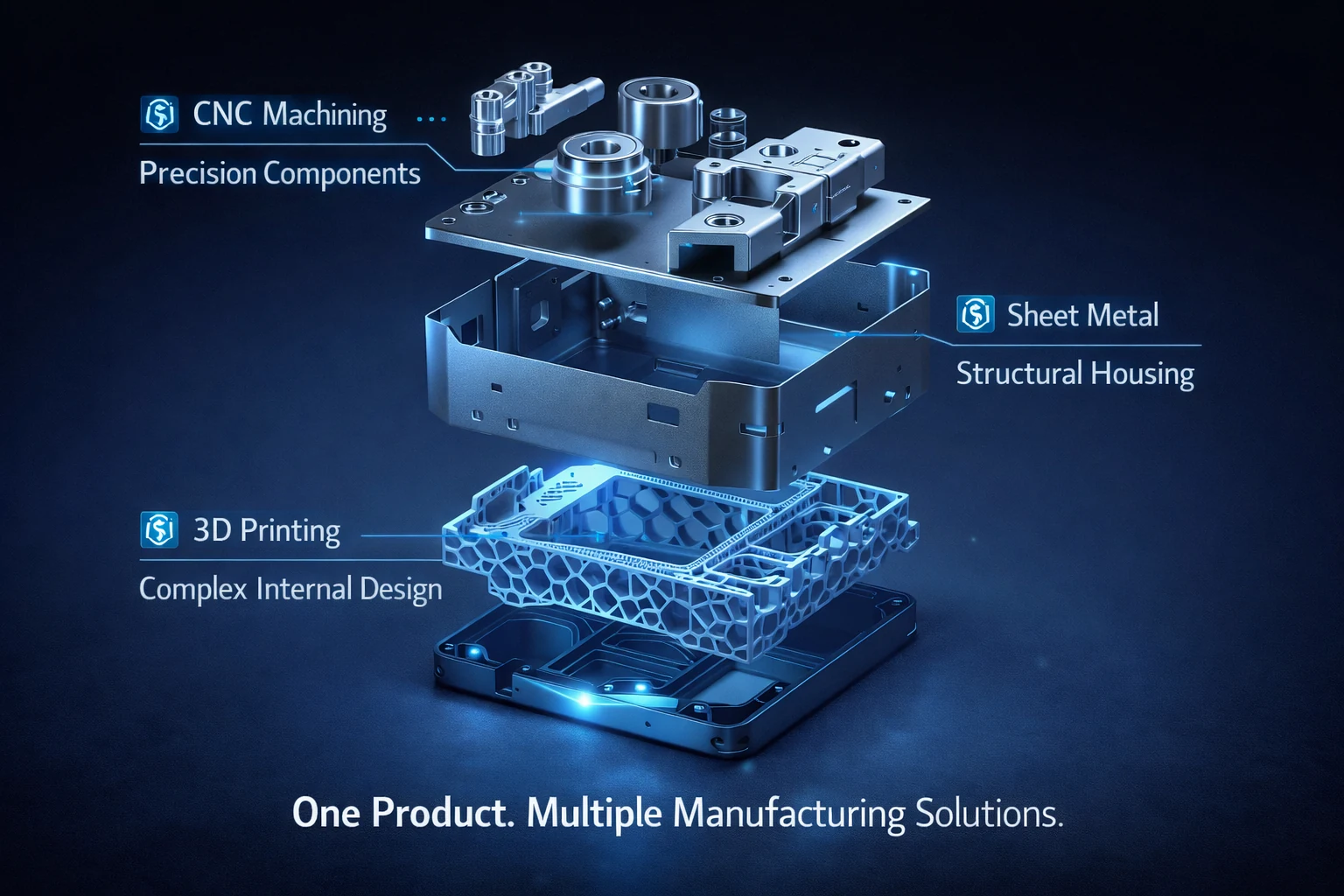
In modern manufacturing, combining processes often delivers the best results.
For example:
- 3D printing for early-stage prototypes
- CNC machining for precision components
- Sheet metal for structural assemblies
This hybrid approach:
- Reduces cost
- Improves efficiency
- Accelerates product development
12. Why Integrated Manufacturing Capability Matters
Working with a supplier that offers CNC machining, sheet metal fabrication, and 3D printing provides:
- One-stop solution
- Better engineering support
- Faster lead times
- Reduced supply chain complexity
👉 Explore more technical insights:
https://www.debaolong.com/manufacturing-engineering-knowledge-center/
Conclusion
There is no single “best” manufacturing process—only the most suitable one for your specific application.
Understanding the strengths and limitations of CNC machining, sheet metal fabrication, and 3D printing allows for better engineering decisions, cost optimization, and product performance.
In many cases, combining these technologies provides the most efficient and effective solution.
Related Engineering Resources