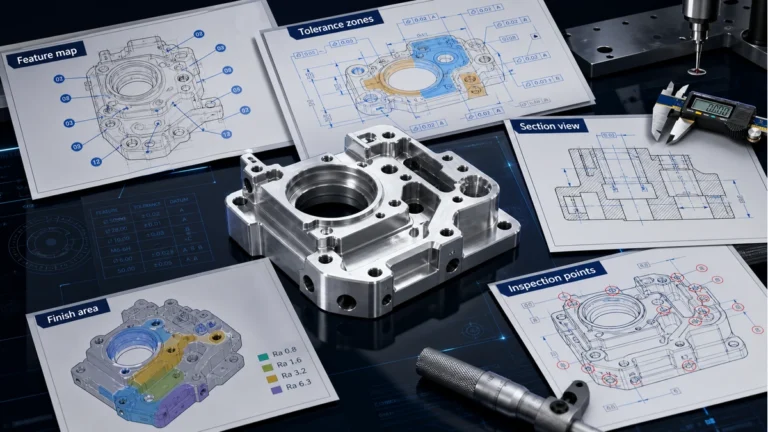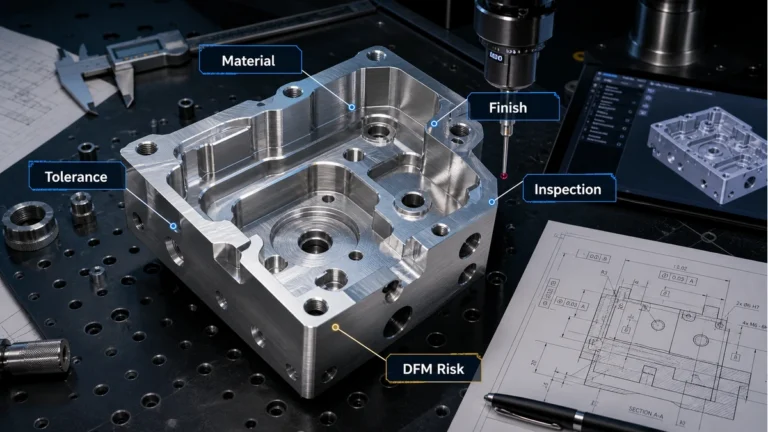

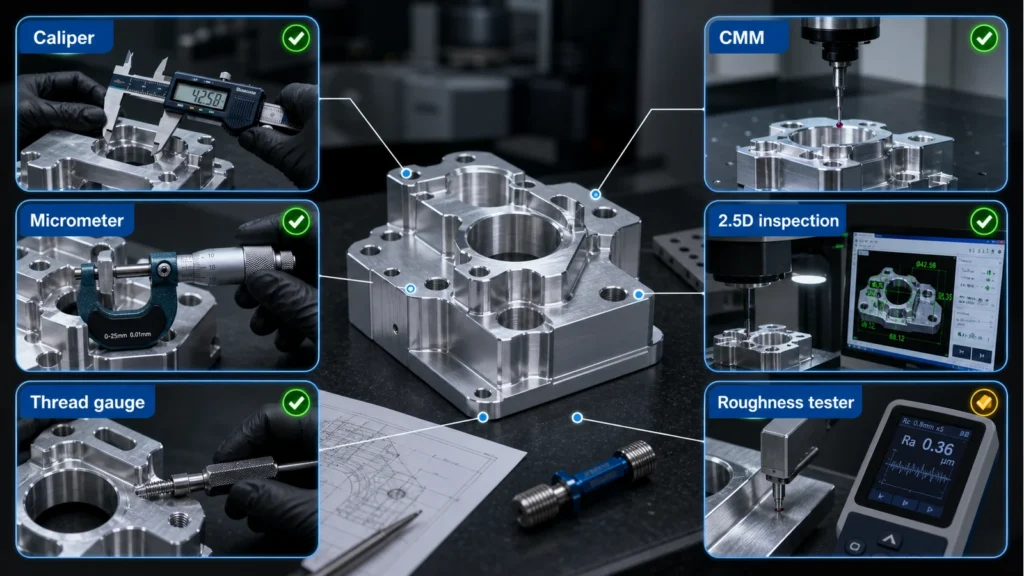

Tolerances are one of the most important decisions in a CNC machining project. They define how much a finished part may vary from the nominal CAD or drawing dimension while still performing correctly. Tolerance choices influence function, inspection effort, lead time, scrap risk, and machining cost. A drawing that is too loose may not protect the assembly. A drawing that is too tight may force unnecessary precision, longer cycle times, more inspection, and higher cost.
For that reason, engineers rarely specify every feature one by one. Instead, most technical drawings use general tolerance standards for ordinary, unmarked dimensions and then add special callouts only where the function of the part requires tighter control. In CNC machining and other subtractive manufacturing processes, ISO 2768 and ISO 286 are two of the most common systems used to organize this work.
This guide explains how those standards are used, what kinds of features they cover, and how to think about them when preparing CNC drawings for production. For related engineering context, see DEBAOLONG’s CNC Machining Tolerance Standards: ISO 2768, ISO 286 and ASME Fit Classes, CNC machining tolerances explained, and tolerance engineering handbook.
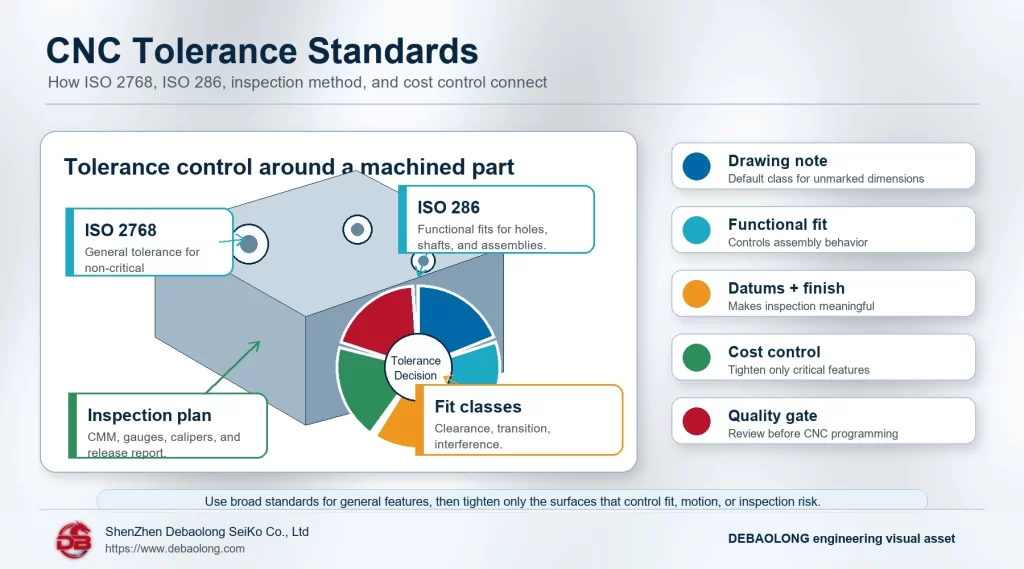
Why General Tolerance Standards Matter
Designers and engineers use tolerance notes to control angles, sizes, shapes, holes, shafts, radii, chamfers, and other manufactured features. Without a standard system, every non-critical feature would need its own tolerance note. That creates extra drawing work, makes drawings harder to read, and can lead to inconsistent manufacturing expectations.
General tolerance standards solve this problem. They provide a shared manufacturing language between design, machining, inspection, and procurement teams. When a drawing states a general standard, unmarked features can be interpreted consistently without adding a separate tolerance to every line, hole, radius, or angle.
The key point is that general tolerances are not a substitute for engineering judgment. They are a baseline. If a feature controls sealing, bearing fit, sliding motion, alignment, press fit, cosmetic location, or another functional requirement, that feature may still need an explicit tolerance or GD&T callout.
Common Standards Used for CNC Machining Tolerances
Different manufacturing processes often use different tolerance standards. For subtractive manufacturing processes such as CNC milling and turning, ISO 2768 and ISO 286 are widely used. Examples discussed below include the following classes and grades; they are not an exhaustive list and are not interchangeable:
- ISO 2768-f fine class
- ISO 2768-m medium class
- ISO 286 IT6
- ISO 286 IT7
- ISO 286 IT8
The main difference is application. ISO 2768 covers general tolerances for linear and angular dimensions when no individual tolerance is shown on the drawing. ISO 286 covers fit tolerances for cylindrical features and two parallel opposite surfaces, such as holes and shafts. If a part includes both ordinary unmarked dimensions and functional mating features, both standards can appear in the same drawing package.
| Tolerance standard | Linear general tolerances | Radius / chamfer general tolerances | Angular general tolerances or application |
|---|---|---|---|
| ISO 2768-m medium class | Linear dimensions from 0.5 to 4000 mm: nominal size +/-0.1 to +/-2.0 mm | Radii and chamfer heights from 0.5 to above 6 mm: +/-0.2 to +/-1.0 mm | Angular dimensions from 10 to above 400 mm: +/-1 degree to +/-0 degree 5 minutes |
| ISO 2768-f fine class | Linear dimensions from 0.5 to 2000 mm: nominal size +/-0.05 to +/-0.5 mm | Radii and chamfer heights from 0.5 to above 6 mm: +/-0.2 to +/-1.0 mm | Angular dimensions from 10 to above 400 mm: +/-1 degree to +/-0 degree 5 minutes |
| ISO 286 IT8 | Reference size bands up to 3150 mm: tolerance band about 0.014 to 0.330 mm | Best for less critical fits | Applies to holes, shafts and two parallel opposite surfaces |
| ISO 286 IT7 | Reference size bands up to 3150 mm: tolerance band about 0.010 to 0.210 mm | Best for more controlled fits | Applies to holes, shafts and two parallel opposite surfaces |
| ISO 286 IT6 | Reference size bands up to 3150 mm: tolerance band about 0.006 to 0.135 mm | Best for tighter functional fits | Applies to holes, shafts and two parallel opposite surfaces |
ISO 2768: General Tolerances for Unmarked Drawing Dimensions
ISO 2768 and related geometrical tolerance standards are commonly used for machined and subtractively manufactured parts. The standard is especially useful when a drawing contains many ordinary dimensions that do not require a unique special tolerance.
ISO 2768 applies only where the drawing does not already specify a separate tolerance. If a feature has a special tolerance note, the special note controls that feature instead of the general tolerance block.
Typical ISO 2768 applications include:
- linear dimensions, including external dimensions, internal dimensions, diameters, radii, distances, and chamfer heights
- angular dimensions
- linear and angular dimensions on machined assemblies where no special tolerance is otherwise stated
ISO 2768 Linear Dimensions
The table below summarizes fine and medium general linear tolerances. Use the applicable standard and drawing to resolve exact size boundaries and requirements. These values help designers understand how tolerance bands change as nominal size increases.
| Nominal size range (mm) | ISO 2768-f fine class (mm) | ISO 2768-m medium class (mm) |
|---|---|---|
| 0.5-3 | +/-0.05 | +/-0.1 |
| 3-6 | +/-0.05 | +/-0.1 |
| 6-30 | +/-0.1 | +/-0.2 |
| 30-120 | +/-0.15 | +/-0.3 |
| 120-400 | +/-0.2 | +/-0.5 |
| 400-1000 | +/-0.3 | +/-0.8 |
| 1000-2000 | +/-0.5 | +/-1.2 |
| 2000-4000 | – | +/-2.0 |
ISO 2768 Radii and Chamfer Heights
Radii and chamfer heights are often used for edge breaks, corner relief, assembly clearance, deburring, and safer handling. When they are not function-critical, ISO 2768 can provide a general tolerance range.
| Nominal radius or chamfer height (mm) | ISO 2768-f fine class (mm) | ISO 2768-m medium class (mm) |
|---|---|---|
| 0.5-3 | +/-0.2 | +/-0.2 |
| 3-6 | +/-0.5 | +/-0.5 |
| above 6 | +/-1.0 | +/-1.0 |
ISO 2768 Angular Dimensions
Angular tolerance requirements depend on the length of the relevant feature. Use the applicable drawing and standard to confirm the fine or medium angular tolerance and the relevant feature length.
| Nominal length range (mm) | ISO 2768-f fine class | ISO 2768-m medium class |
|---|---|---|
| up to 10 | +/-1 degree | +/-1 degree |
| 10-50 | +/-0 degree 30 minutes | +/-0 degree 30 minutes |
| 50-120 | +/-0 degree 20 minutes | +/-0 degree 20 minutes |
| 120-400 | +/-0 degree 10 minutes | +/-0 degree 10 minutes |
| above 400 | +/-0 degree 5 minutes | +/-0 degree 5 minutes |
ISO 286: Fit Tolerances for Holes, Shafts, and Parallel Surfaces
ISO 286 is used for linear size tolerances related to fit conditions. In practice, engineers often use it for cylindrical features, holes, shafts, pins, bushings, and two parallel opposite surfaces where functional assembly matters.
ISO 286 defines a size-tolerance and fit system for cylinders and two parallel opposite surfaces. Do not treat an IT grade alone as a complete fit specification or an automatic default for every unmarked feature. The drawing must identify the required tolerance class or limits. IT6, IT7 and IT8 describe different tolerance-band widths; the position of that band must also be defined for a functional fit.
Useful ISO 286 terms include:
- Nominal size: the design size defined by the drawing.
- Actual size: the measured size of the manufactured feature.
- Upper limit size: the maximum permitted feature size.
- Lower limit size: the minimum permitted feature size.
- Tolerance: the difference between the upper and lower limits.
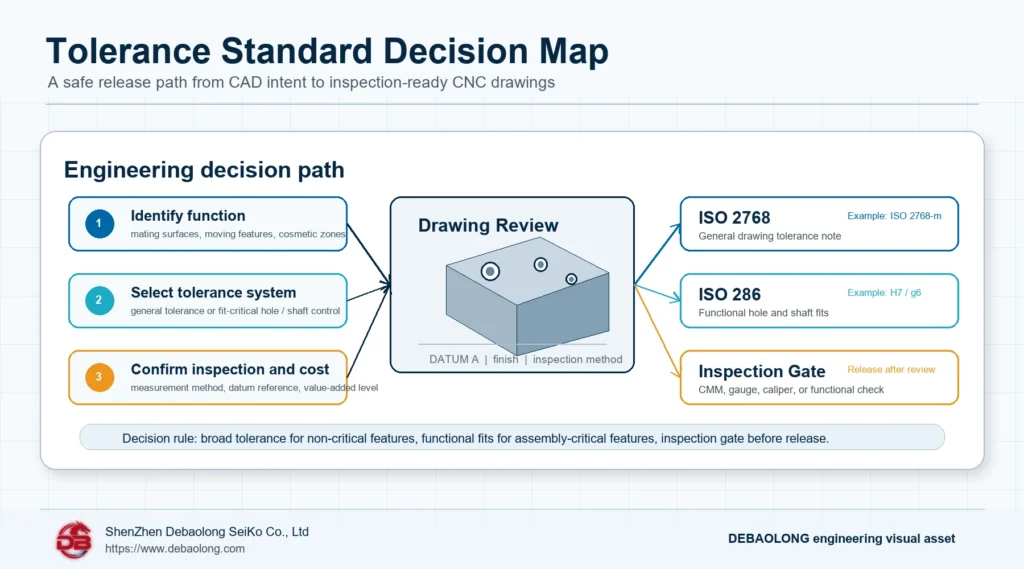
ISO 286 IT6, IT7, and IT8 Deviation Bands
The following table is a size-band reference for IT6, IT7 and IT8; confirm values and boundary conventions in the applicable ISO 286 tables before drawing release. Values are shown in millimeters and should be interpreted with the correct fit system, drawing requirement, material behavior, machining process, and inspection method.
| Nominal size range (mm) | IT6 (mm) | IT7 (mm) | IT8 (mm) |
|---|---|---|---|
| up to 3 | 0.006 | 0.010 | 0.014 |
| 3-6 | 0.008 | 0.012 | 0.018 |
| 6-10 | 0.009 | 0.015 | 0.022 |
| 10-18 | 0.011 | 0.018 | 0.027 |
| 18-30 | 0.013 | 0.021 | 0.033 |
| 30-50 | 0.016 | 0.025 | 0.039 |
| 50-80 | 0.019 | 0.030 | 0.046 |
| 80-120 | 0.022 | 0.035 | 0.054 |
| 120-180 | 0.025 | 0.040 | 0.063 |
| 180-250 | 0.029 | 0.046 | 0.072 |
| 250-315 | 0.032 | 0.052 | 0.081 |
| 315-400 | 0.036 | 0.057 | 0.089 |
| 400-500 | 0.040 | 0.063 | 0.097 |
| 500-630 | 0.044 | 0.070 | 0.110 |
| 630-800 | 0.050 | 0.080 | 0.125 |
| 800-1000 | 0.056 | 0.090 | 0.140 |
| 1000-1250 | 0.066 | 0.105 | 0.165 |
| 1250-1600 | 0.078 | 0.125 | 0.195 |
| 1600-2000 | 0.092 | 0.150 | 0.230 |
| 2000-2500 | 0.110 | 0.175 | 0.280 |
| 2500-3150 | 0.135 | 0.210 | 0.330 |
ISO and ASME fit specifications need separate review
ASME B4.1 addresses preferred limits and fits for plain cylindrical parts. Do not convert ISO IT6, IT7 or IT8 into an ASME fit by copying the grade number. State the drawing system, nominal dimensions and required mating limits, then verify the chosen fit in that system.
Publisher scope references: ISO 286-1 and ASME B4.1. The project specification controls the edition and acceptance requirements.
How to Choose the Right Tolerance Level
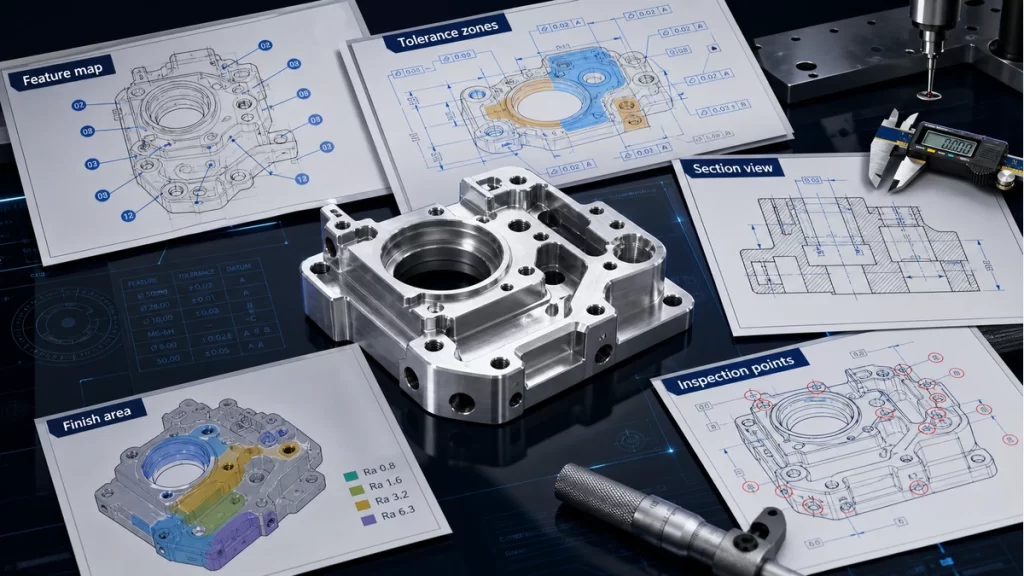
A practical tolerance strategy starts with the part function. General tolerance classes are suitable for ordinary geometry that does not drive assembly performance. Functional fits, bearing surfaces, precision alignment features, press-fit areas, sliding components, sealed interfaces, and critical inspection datums need closer review.
For CNC machining, a good drawing usually separates three categories of features. First, normal unmarked features can follow the general tolerance note. Second, functional features receive explicit dimensional tolerances, fit classes, or GD&T controls. Third, cosmetic or non-functional features are kept realistic so the project does not pay for precision that adds no value.
When in doubt, discuss tolerance intent before machining. A manufacturing partner can often suggest where tighter control is necessary, where a general tolerance is enough, and where a design change would reduce cost without weakening function.
Conclusion
ISO 2768 and ISO 286 help engineers communicate CNC machining tolerance requirements without overloading every drawing with individual notes. ISO 2768 is useful for general unmarked dimensions, angles, radii, and chamfers. ISO 286 is better suited to holes, shafts, and fit-related features where assembly performance depends on controlled deviation bands.
For production-ready parts, the best approach is not simply to choose the tightest available class. The best approach is to match tolerance control to function, inspection method, material behavior, and cost target. DEBAOLONG supports CNC machining, inspection planning, DFM review, and drawing-based manufacturing support for custom precision parts.