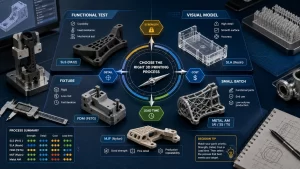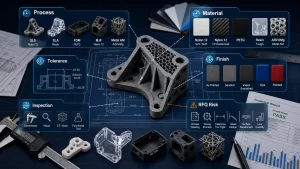


3D printing has moved well beyond its early role as a pure prototyping tool. In the right commercial and technical situation, it can support serial manufacturing, especially when the business values fast launch, geometry flexibility, customization and lower inventory exposure. That does not mean additive manufacturing replaces conventional production automatically. It means the process should be considered as a serious option when the business case supports it.
The key is to judge serial additive manufacturing against the whole product lifecycle. Design-change frequency, expected volume, inventory strategy, spare-part demand and customer variation all influence whether additive manufacturing creates an advantage or simply increases part cost.
1. Serial 3D printing is strongest when flexibility matters most
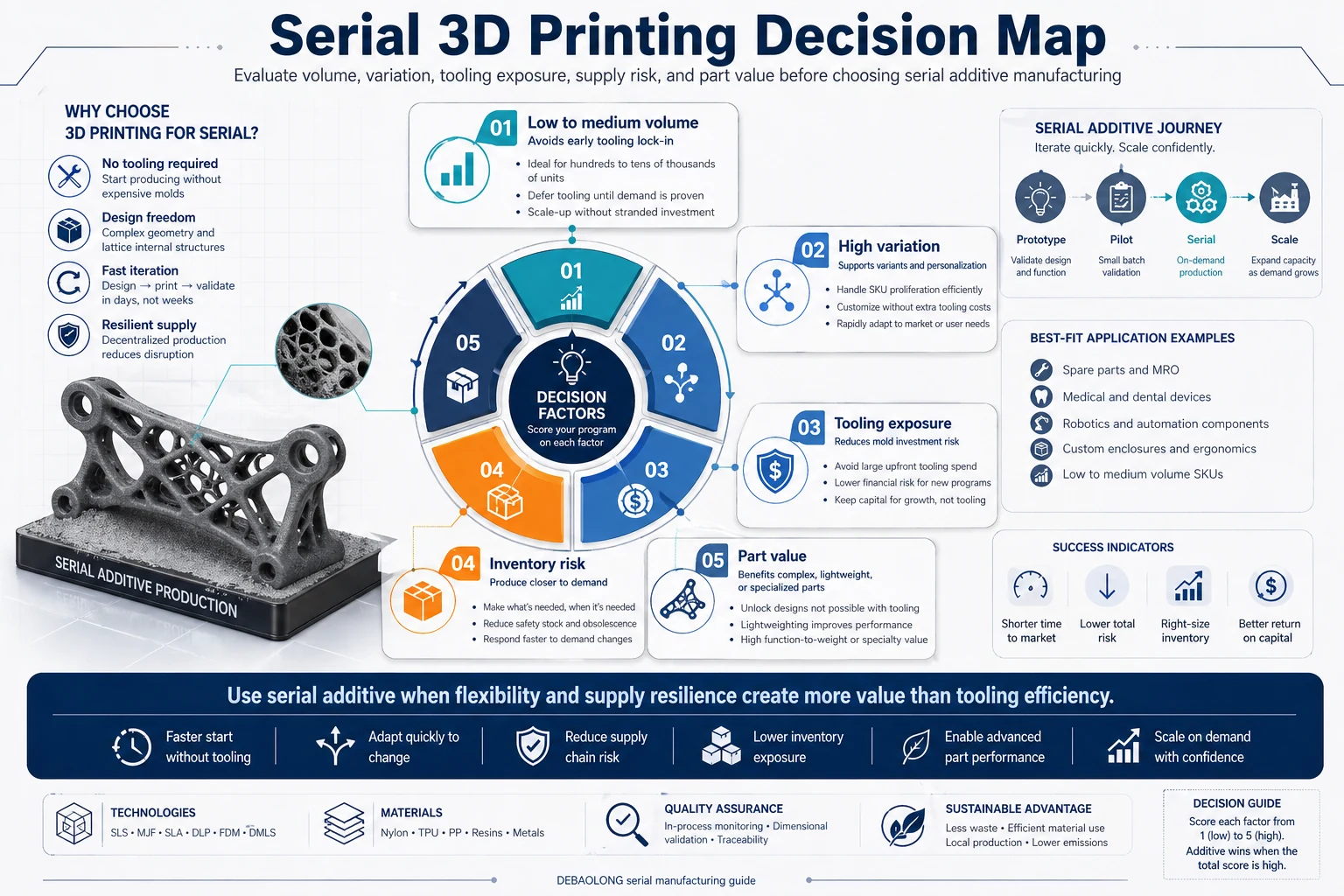
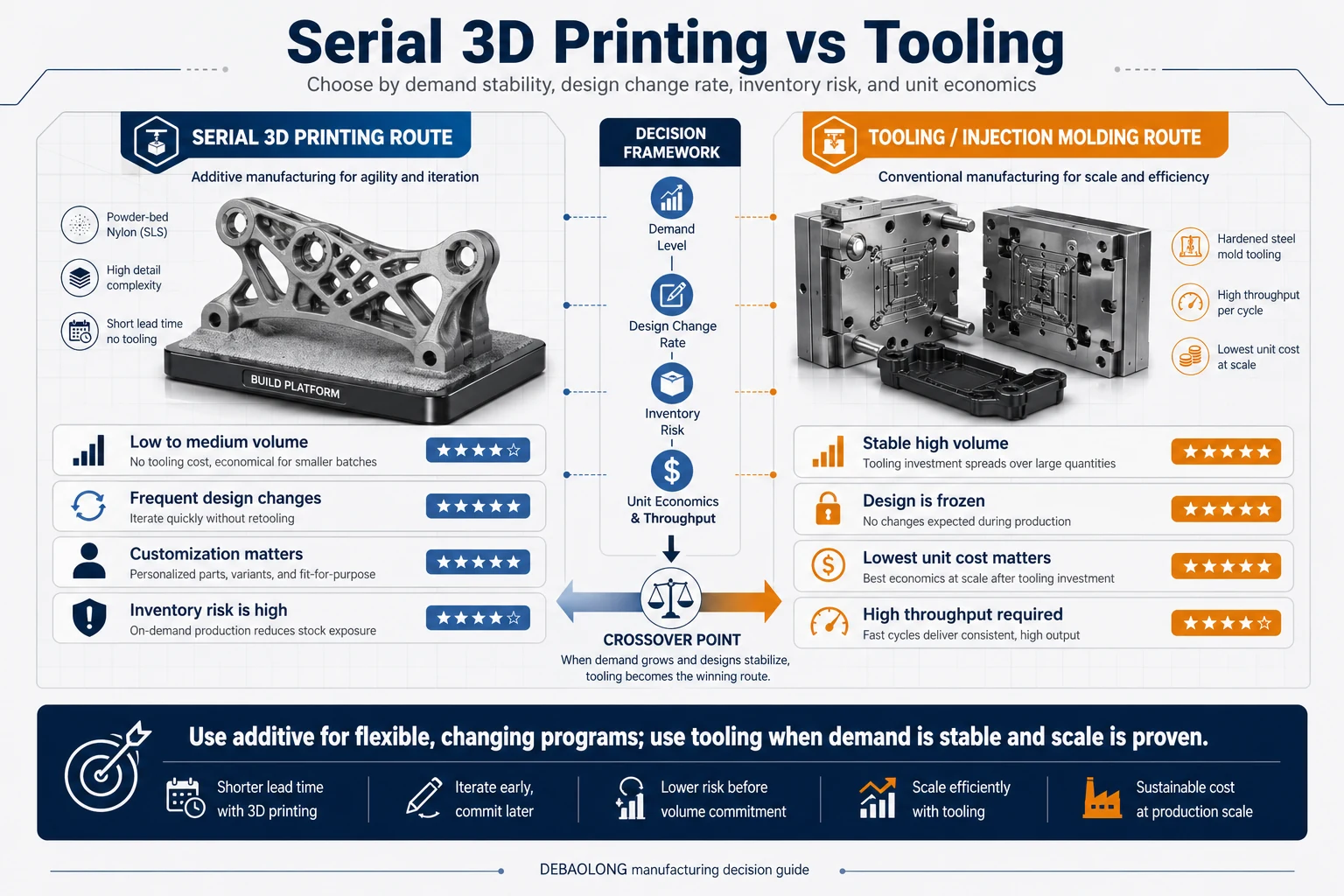
Traditional tooling-based methods become powerful when demand is stable and volume is high, but they require design freeze, investment and planning discipline. 3D printing changes that equation by allowing products to launch without hard tooling and by making design updates much easier to implement. This is valuable for bridge production, fast-evolving products, configurable designs and spare parts with uncertain demand.
It is also useful when one printed part can replace several assembled components. Part consolidation can reduce sourcing complexity and assembly effort, which sometimes matters more than the unit cost of the print alone.
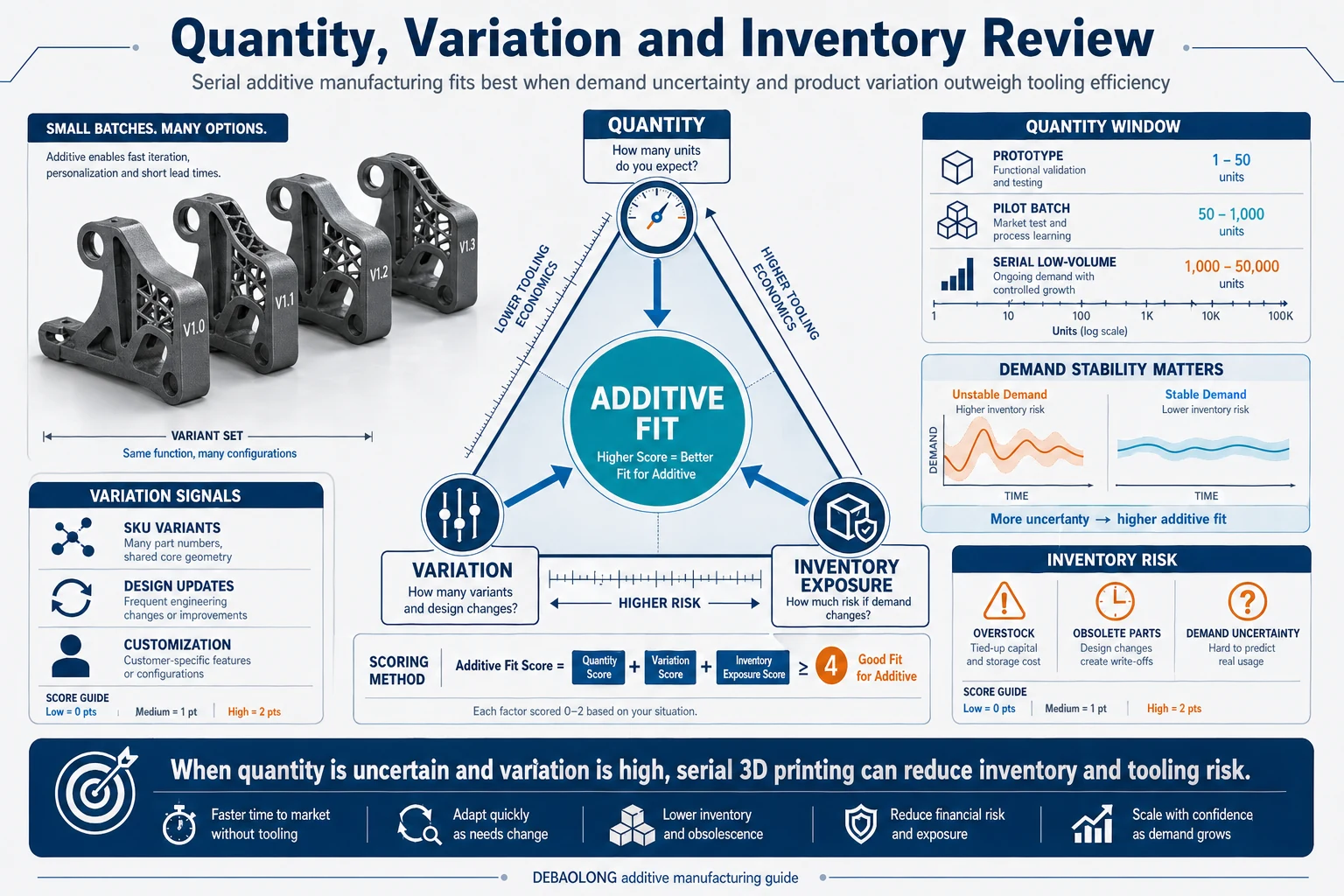
2. Evaluate quantity, variation and inventory together
The decision is rarely based on volume alone. A medium-volume part with many variants may fit additive manufacturing better than a higher-volume part with a single stable geometry. Likewise, a service-part program with unpredictable demand may benefit from on-demand printing even if molded production would be cheaper at a theoretical full-year volume. Inventory risk and product variation are central parts of the business case.
This is why additive manufacturing is particularly attractive for niche products, replacement parts, customer-specific variants and products that are still changing after launch.
3. Respect the limits of additive production
Serial 3D printing is not automatically the lowest-cost or highest-throughput method. Per-part economics, post-processing effort, build consistency, surface finish and material selection all still matter. Some geometries or cosmetic expectations are better suited to molding or machining once the design stabilizes. The best programs acknowledge these limits early rather than trying to force additive into every production scenario.
Process selection should therefore compare additive manufacturing with molding, machining and sheet-based methods across the entire product lifecycle, not just the first shipment.
4. Use additive where it creates strategic value
At DEBAOLONG, we recommend evaluating serial 3D printing with four questions: how stable is the quantity, how often will the design change, how valuable is customization, and what inventory risk is the business trying to avoid? When those answers favor agility over hard-tool efficiency, additive manufacturing becomes a strategic production method rather than only a prototype choice.
For related production planning, compare CNC machining vs 3D printing, review on-demand manufacturing, and see how different production routes compare.
Validate additive readiness before scaling
Before a product moves into serial additive manufacturing, the team should confirm that demand variability, customization value, inventory exposure and material suitability all genuinely support that choice. This review prevents additive manufacturing from being selected only because it is fast at the prototype stage.
When the checklist is used well, it becomes easier to tell whether the product should stay additive for production, shift to a hybrid model or transition fully into a conventional volume process later.
FAQ
Can 3D printing really be used for serial manufacturing?
Yes, especially when quantity is moderate and design flexibility, customization or inventory agility matters.
Is additive manufacturing always cheaper than tooling?
No. At stable high volume, tooling-based production usually becomes more economical per unit.
What products fit serial 3D printing best?
Products with changing designs, multiple variants, replacement-part demand or uncertain inventory profiles often fit best.
Related Engineering Resources