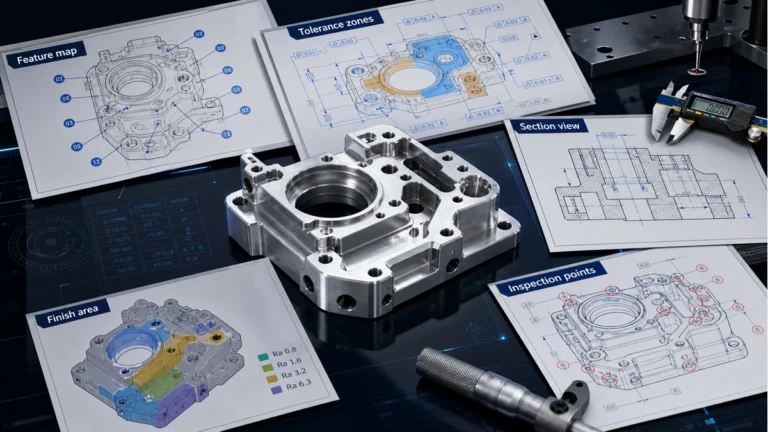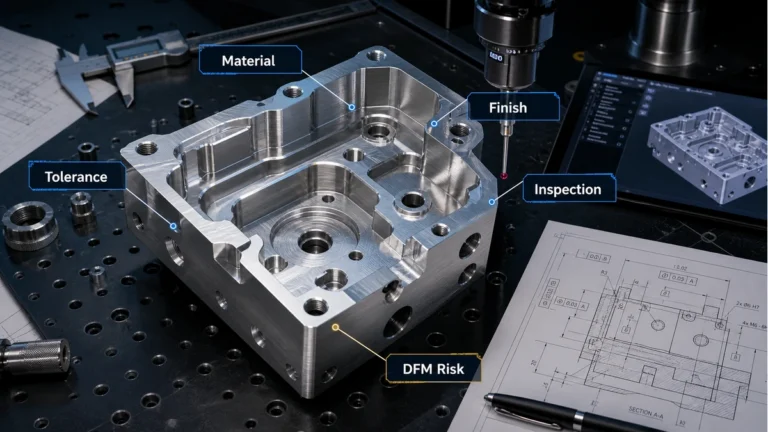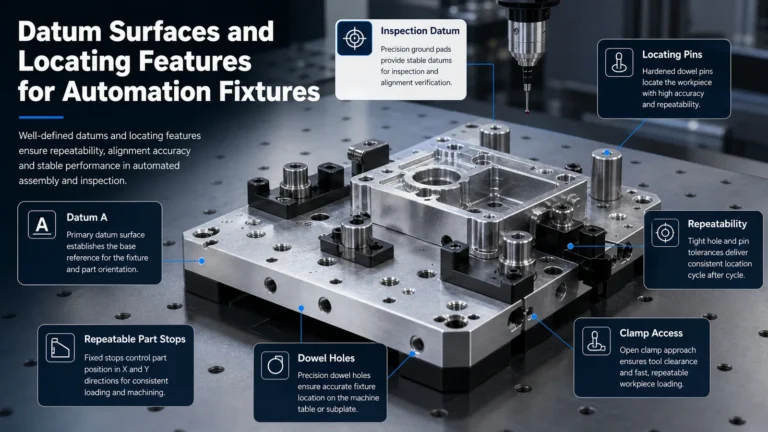

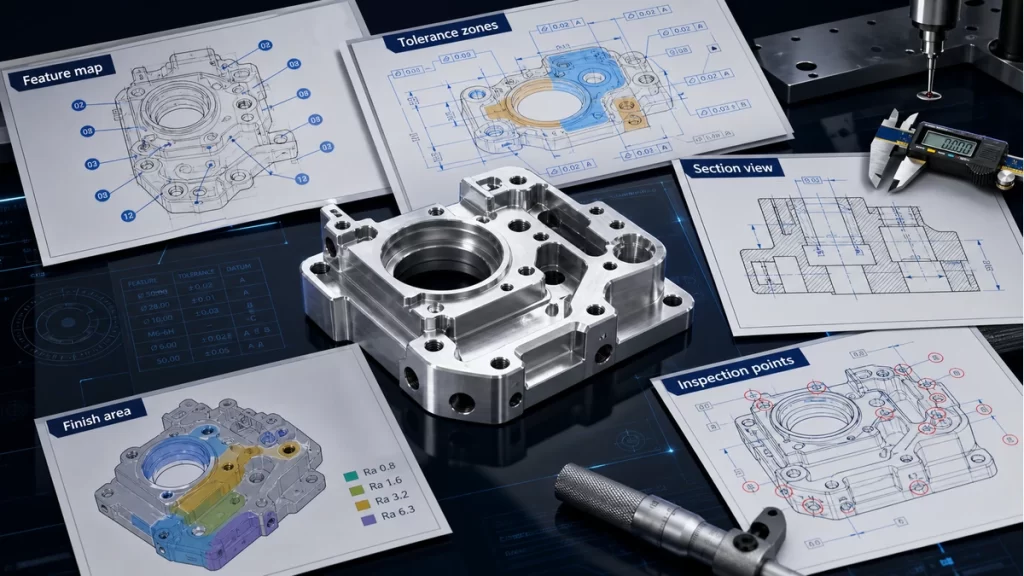

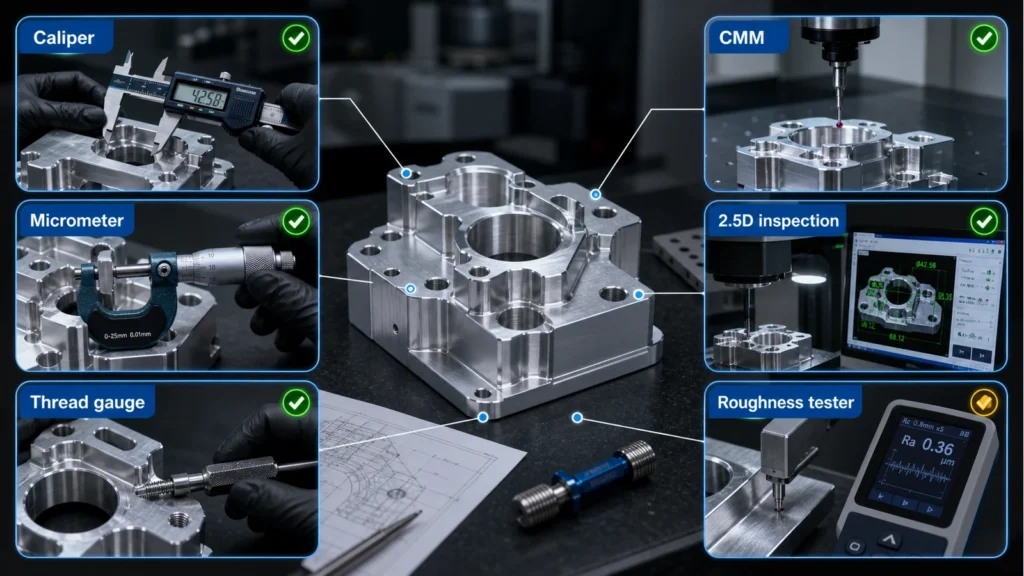

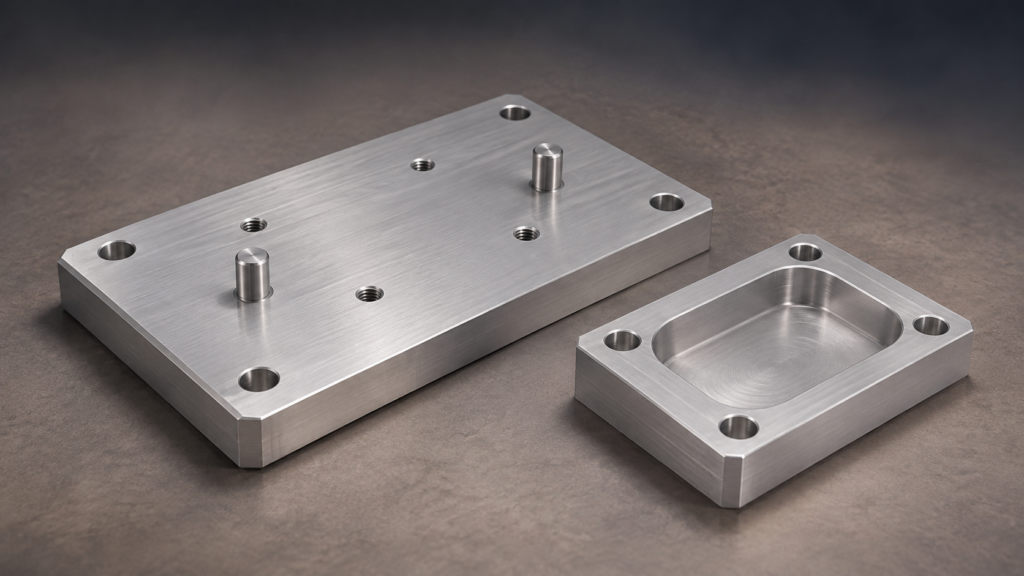
Featured image: concept illustration of fixture components, not a customer installation, validated assembly or measurement result.
A replacement fixture can match its drawing and still need adjustment when it reaches the production line. The base fits, the clamps close and the part appears seated, but the process reference has moved. The missing requirement may not be another tight dimension. It is an agreed check of what happens when the fixture is removed, reinstalled and used with representative parts.
Automation makes that distinction worth discussing early. In its November 12, 2026 update, the International Federation of Robotics reported a new high in global manufacturing robot density. That industry trend does not establish the requirements for any individual fixture. It does reinforce a practical purchasing question: what evidence will show that a replacement nest or plate is ready for its intended station?
This guide proposes a review framework for buyers and fixture designers. It is not a machine commissioning procedure or a universal repeatability specification.
Define which interface is being accepted
A fixture project can contain several separate interfaces:
- The machine or station to the base plate.
- The base plate to an interchangeable nest.
- The nest to the workpiece.
- The workpiece to a tool, probe, camera or assembly operation.
Mark them on the assembly drawing. Then identify which interface the quoted supplier actually controls. A supplier making a replacement nest cannot, from its drawing alone, validate the robot program, machine reference or condition of an existing base.
For each interface, record the locating features, revision, mating component and owner of the final check. Separate custom parts from purchased hardware. A useful quote tells you what will be inspected at the supplier and what remains for the receiving station to verify.
Do not confuse a dimensional report with a changeover result
Dimensional inspection answers whether specified features meet their requirements under the stated measurement conditions. A changeover evaluation answers a different question: does the assembled arrangement return the relevant workpiece features to an acceptable position after the intended removal and loading operations?
Both can matter. Neither should be silently substituted for the other.
Ask the responsible engineer to define the characteristic being evaluated, reference system, allowable variation and measurement method. Also record the condition of the parts, mounting hardware and equipment. Avoid a purchase-order note that says only “high repeatability.” It leaves the acceptance decision undefined.
Keep the locating design and the acceptance plan connected
The datum and locating-feature guide explains the design principles. This acceptance review starts from the released design rather than choosing a new pin arrangement.
Carr Lane’s locating and clamping guidance identifies redundant location, trapped chips and unsupported clamping as design concerns. Record the approved seating, cleaning and clamping conditions in the evaluation plan so results can be compared. If the fixture needs a design change to work, document that change before repeating the evaluation.
Agree the evaluation matrix before manufacture
The following is a purchasing framework to complete with the fixture designer and production team. It deliberately gives no universal cycle count or acceptance limit.
Does the workpiece reseat consistently?
Define the approved loading sequence, representative workpieces, measured features and repeat count.
Does the nest return after removal?
Define the exact interface being disconnected, approved reassembly method and measurement reference.
Can a replacement nest be substituted?
Identify the original and replacement, mating base condition and permitted adjustment.
Does the result depend on the operator?
Record who performs the evaluation and which steps must be controlled.
Is the measurement suitable?
Agree the method, instrument, environmental conditions and evidence that it can resolve the required variation.
What happens when a result fails?
Define stop/review criteria, responsibility for investigation and rules for retesting.
Record the actual results against the agreed criteria, including any adjustment made between trials. A pass that requires an unrecorded adjustment is not evidence of adjustment-free interchangeability.
These checks belong in a safely controlled, approved evaluation. Do not initiate automatic machine motion, defeat an interlock or improvise a loading sequence as part of an unapproved evaluation. Machine integration, guarding and release remain the responsibility of the qualified team managing the equipment.
Make replacement parts identifiable
A spare labelled “same as last time” is difficult to verify. Give replaceable nests, datum inserts and wear parts their own identifiers where appropriate. Keep the mating-interface revision with the part record, not just the outside dimensions.
The release package should explain which adjustments are allowed and which changes require engineering review. For example, a change to a locating insert should not be treated as a cosmetic substitution if it changes the mating relationship. Likewise, a drawing revision should identify whether older spares remain compatible.
This is also the place to agree how finished parts will be marked and packaged. The aim is straightforward: the receiving team should be able to identify the correct part without relying on someone’s memory of the previous build.
Ask for evidence that matches the order
Consider a hypothetical order for two interchangeable nests. One quotation includes machined parts and dimensional reports. Another includes the same parts plus a documented interchangeability evaluation on an agreed base. Those are different deliverables, even if both quotations use the word “precision.”
List the deliverables before comparing prices:
- Released part and assembly revisions.
- Purchased-component identities and any approved alternatives.
- Critical-feature inspection records.
- The agreed changeover or interchangeability evaluation, if included.
- Exceptions, remaining adjustments and receiving-site responsibilities.
- Requirements for future replacement orders.
If the supplier does not have the mating station or an approved equivalent, say so explicitly. An inspection result from a different setup should not be presented as proof of performance at the customer’s machine.
Prepare a useful fixture manufacturing brief
Debaolong’s industrial machinery and fixtures page describes fixture plates, nests and related locating hardware. The existing fixture design overview covers the broader choice of construction and manufacturing route.
For a new manufacturing review, provide the controlled CAD and drawings, intended operation, quantity, mating-interface information and the evidence required at delivery. Identify whether the request is for individual manufactured components or a larger assembled and evaluated fixture. Scope, inspection and any station-level validation must be agreed for the specific project.
The goal is not to demand a bigger inspection report. It is to order the right evidence for the interface that must work when production changes over.