
Compare injection molding and 3D printing by cost, lead time, design freedom, material behavior, tooling investment and production volume.
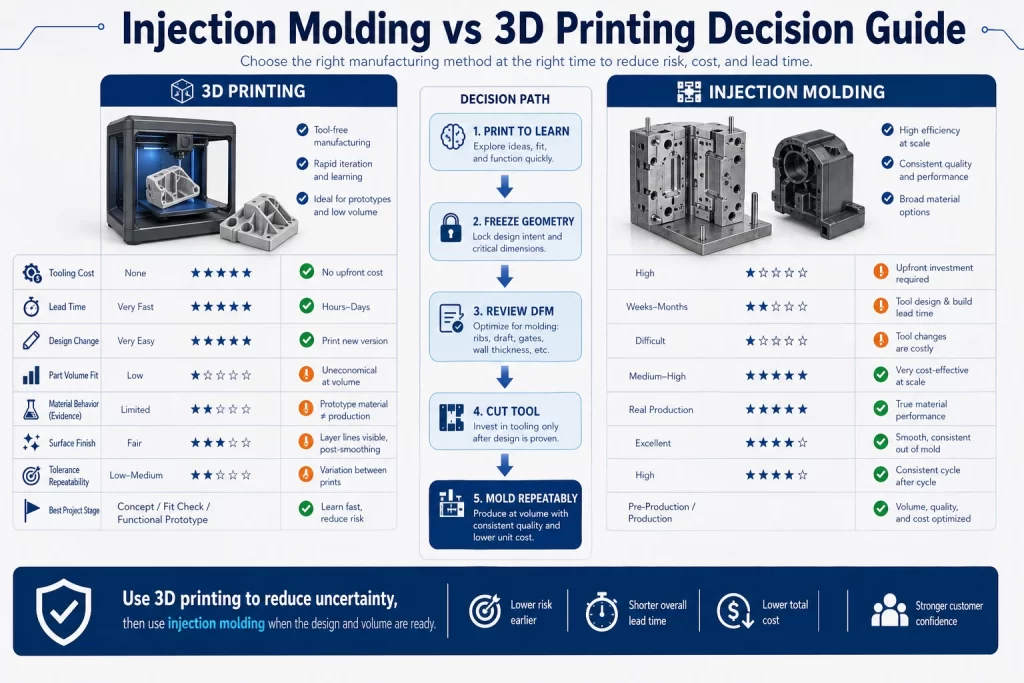
How 3D Printing and Injection Molding Differ
3D printing builds parts directly from digital geometry, making it strong for iteration, customization and low-quantity prototypes. Injection molding uses a mold, making it stronger for repeatable production when geometry is stable and volume supports tooling.
The two methods should be compared by project stage rather than by technology preference.
In practical terms, how 3d printing and injection molding differ should be translated into drawing notes, process limits, material choices, tolerance expectations, finish requirements and inspection points before the design is released. For injection molding vs 3d printing: how to choose the right manufacturing method, the useful result is not just a general comparison, but a manufacturing decision that buyers, engineers and suppliers can apply consistently during quoting, prototyping and production planning. This is where a topic moves from educational guidance into a real release standard.
Batch Size, Complexity and Iteration Time
Low quantities and frequent changes usually favor 3D printing. Higher quantities and stable designs usually favor injection molding. Complex geometry can favor printing early, but production geometry may still need moldability review.
Iteration speed is one of printing’s biggest advantages, while cycle repeatability is one of molding’s biggest advantages.
In practical terms, batch size, complexity and iteration time should be translated into drawing notes, process limits, material choices, tolerance expectations, finish requirements and inspection points before the design is released. For injection molding vs 3d printing: how to choose the right manufacturing method, the useful result is not just a general comparison, but a manufacturing decision that buyers, engineers and suppliers can apply consistently during quoting, prototyping and production planning. This is where a topic moves from educational guidance into a real release standard.
Customization, Strength and Surface Finish
3D printing supports customization without new tooling, while injection molding supports consistent material behavior and production surfaces. Printed materials may not match molded plastic strength, fatigue behavior or surface quality unless carefully selected.
Surface finish requirements should be stated early because they change both cost and process choice.
In practical terms, customization, strength and surface finish should be translated into drawing notes, process limits, material choices, tolerance expectations, finish requirements and inspection points before the design is released. For injection molding vs 3d printing: how to choose the right manufacturing method, the useful result is not just a general comparison, but a manufacturing decision that buyers, engineers and suppliers can apply consistently during quoting, prototyping and production planning. This is where a topic moves from educational guidance into a real release standard.
Using Both Methods Together
Many projects should use 3D printing first and injection molding later. Printing helps reduce uncertainty before tooling, while molding supports final repeat production.
DEBAOLONG helps teams transfer prototype evidence into mold-ready geometry before expensive tooling decisions are made.
In practical terms, using both methods together should be translated into drawing notes, process limits, material choices, tolerance expectations, finish requirements and inspection points before the design is released. For injection molding vs 3d printing: how to choose the right manufacturing method, the useful result is not just a general comparison, but a manufacturing decision that buyers, engineers and suppliers can apply consistently during quoting, prototyping and production planning. This is where a topic moves from educational guidance into a real release standard.
A Practical Selection Checklist for Real Projects
The source article turns the comparison into a checklist, and that is where the engineering value becomes practical. Teams should review volume, customization, iteration speed, material behavior, finish and risk of future tooling changes before deciding on injection molding or 3D printing.
This is also the point where prototype evidence should be connected to business timing. DEBAOLONG uses that checklist to decide whether a part should remain in additive manufacturing for development flexibility or move toward molding because geometry, quantity and repeatability are ready for tooling investment.
In practical terms, a practical selection checklist for real projects should be translated into drawing notes, process limits, material choices, tolerance expectations, finish requirements and inspection points before the design is released. For injection molding vs 3d printing: how to choose the right manufacturing method, the useful result is not just a general comparison, but a manufacturing decision that buyers, engineers and suppliers can apply consistently during quoting, prototyping and production planning. This is where a topic moves from educational guidance into a real release standard.
DEBAOLONG Engineering Review
This article has been rebuilt around the source article’s actual engineering logic instead of being treated as a short summary. The purpose is to preserve the useful decision sequence: process capability, material fit, tolerance impact, finish expectations, production risk, validation steps and how the next manufacturing decision should be made.
Before release, the design team should confirm the intended application, required quantity, critical dimensions, operating environment, acceptable finish, cleaning requirements where relevant, and the inspection method that will be used to validate the part. These details turn a manufacturing article into a production-ready review standard and reduce late changes after prototyping or tooling work has already started.
For broader manufacturing planning, review the DEBAOLONG Manufacturing Engineering Knowledge Center, compare major manufacturing process options, or use DFM for prototyping to connect early design decisions with production-ready parts.
FAQ
How should engineers use this injection molding vs 3d printing: how to choose the right manufacturing method guide?
Use it as a practical release checklist before quoting, prototyping or production handoff. The best result is a clearer manufacturing decision, not simply a longer list of process facts.
Why does source-aligned structure matter in this topic?
Because each source section answers a different engineering question. Keeping those questions separate makes it easier to review geometry, material, cost, finish, quantity and production risk without silently collapsing useful detail.
Can DEBAOLONG help turn the review into a manufacturable plan?
Yes. DEBAOLONG can review geometry, materials, tolerances, finish requirements, visual expectations and production intent before the project moves into manufacturing.