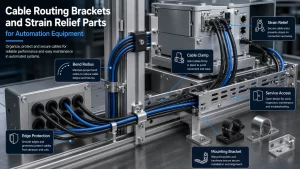


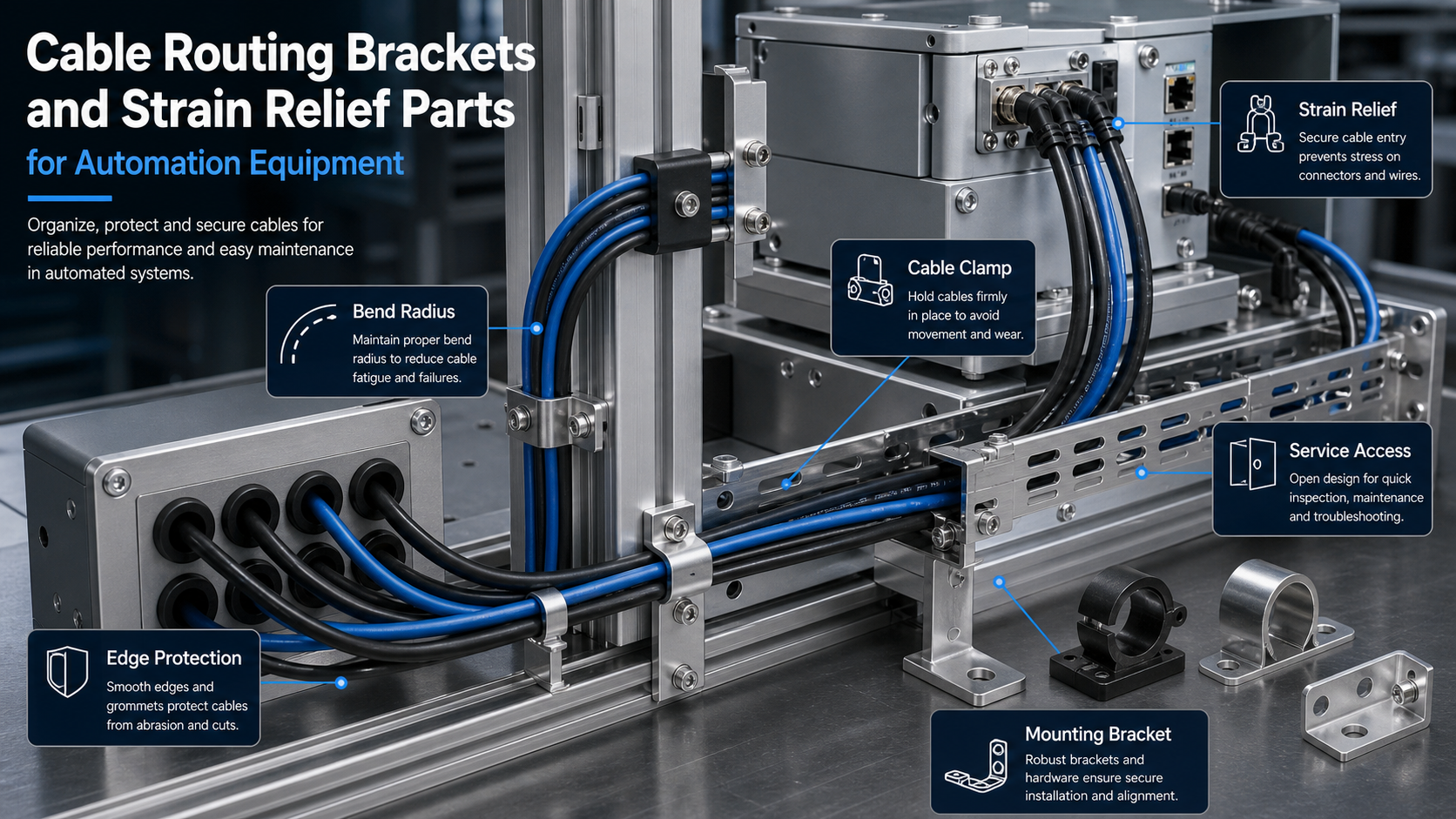
Cable routing brackets and strain relief parts are easy to underestimate in automation equipment. They rarely appear as the main mechanism, but they protect sensor cables, pneumatic lines, motor wiring and control connections from fatigue, abrasion, sharp edges and accidental pulling. A well-designed routing bracket makes an automated cell easier to assemble, easier to maintain and more reliable during repeated motion.
Why Cable Routing Hardware Matters
Robotics and automation systems often combine moving axes, sensors, cameras, grippers, solenoids, drives and control boxes in a compact space. Cables must reach these devices without being stretched, crushed, rubbed or forced into tight bends. If routing is not controlled, cable wear can lead to intermittent faults that are difficult to diagnose. Good brackets and clamps reduce movement at connectors and keep service paths clear.
Debaolong supports cable routing hardware as part of robotics and automation components, especially when assemblies combine sheet metal brackets, CNC clamp blocks, plastic holders, machine guards and sensor mounts. These small parts should be designed with the full equipment layout, not as afterthoughts added at the end.
Common Cable Routing and Strain Relief Parts
- Sheet metal routing brackets: laser-cut and bent supports for cable bundles, trays and wire paths.
- CNC machined clamp blocks: aluminum or plastic parts that hold cables, hoses or conduits in a fixed position.
- Grommet plates: panels with protected cable pass-through openings for cabinets, covers or machine frames.
- Strain relief clamps: parts that prevent pulling force from reaching connectors or terminal areas.
- Sensor cable holders: compact brackets that organize wires near cameras, proximity sensors or end effectors.
Bend Radius and Movement Clearance
Cables and hoses need enough bend radius to avoid fatigue and insulation damage. The required bend radius depends on cable type, jacket material, conductor structure and whether the cable is static or moving. Designers should avoid routing cables around sharp metal corners or through cutouts without edge protection. If the cable moves with a robot arm or slide, the bracket location should allow the cable to move naturally without twisting or rubbing.
Routing brackets should also keep cables away from hot surfaces, pinch points, cutting zones and moving hardware. For machine vision or sensor applications, cable movement can also affect alignment and repeatability. Related design concerns appear in sensor and camera mounts and sheet metal covers for automation equipment.
Sheet Metal and CNC Manufacturing Options
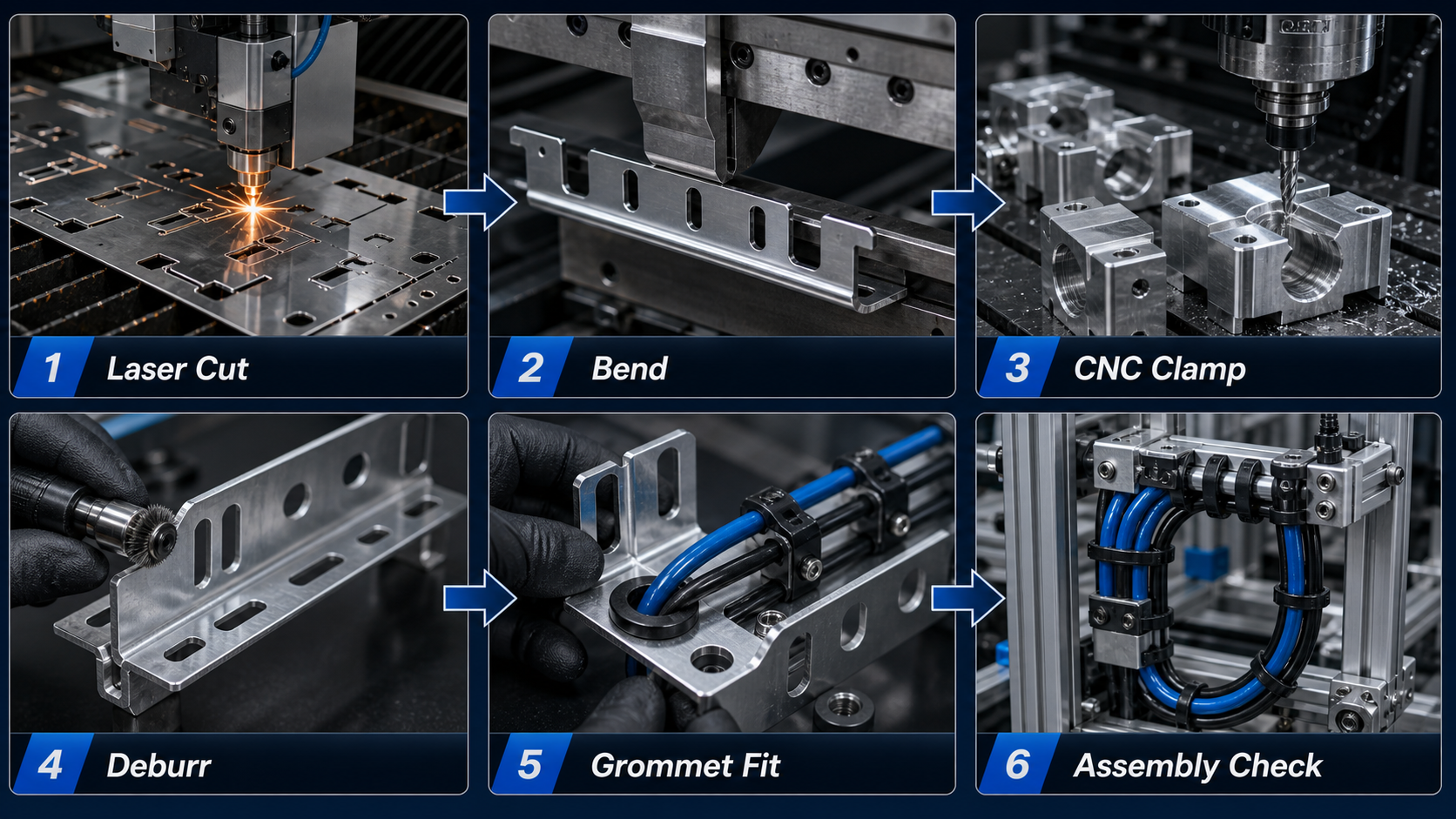
Many cable routing parts are suitable for sheet metal fabrication. Laser-cut blanks can be bent into channels, tabs, clamp bridges or protective guards. Slots can provide adjustment, while flanges add stiffness and provide mounting surfaces. For smaller clamp bodies or precise cable blocks, CNC machining can create accurate grooves, radii, threaded features and compact mounting interfaces.
Plastic clips and holders may be produced through 3D printing for prototypes or injection molding for production when volume and design stability justify tooling. The best process depends on geometry, cable load, environment, quantity and required appearance. Mixed assemblies are common: a sheet metal bracket may hold a rubber grommet, a CNC clamp block and standard fasteners in one cable-management area.
DFM Notes for Routing Brackets
- Edge protection: radius, deburr or protect openings where cables pass through metal.
- Slot design: use slots for adjustment, but keep enough material around fasteners.
- Bend relief: avoid placing slots or cable openings too close to bend lines.
- Clamp access: leave tool clearance for screws and replacement parts.
- Service loops: allow enough cable length for maintenance without uncontrolled slack.
- Vibration: use secure support points where cable movement or machine vibration is expected.
For assemblies exposed to coolant, dust, oil or outdoor environments, material and finish selection become more important. Stainless steel, aluminum, coated carbon steel and engineering plastics may all be appropriate depending on the equipment. External references such as NFPA codes and standards resources can support general electrical safety discussions, while final routing requirements should follow the customer’s equipment standards and drawings.
Inspection and Assembly Checks
Inspection should confirm hole positions, bracket angles, slot dimensions, edge quality, clamp fit and coating condition. For cable-contact edges, burr control is especially important. During assembly review, check cable bend radius, connector strain relief, service access, interference with moving parts and clearance from sharp edges. If a bracket is adjustable, the adjustment range should be realistic and not rely on forcing the cable into position.
RFQ Checklist for Cable Routing Brackets
- 2D drawings and 3D CAD files for brackets, clamps and grommet plates.
- Cable or hose diameter, bend radius notes and routing path if available.
- Material and surface finish requirements.
- Mounting hole pattern, slot dimensions and fastener details.
- Edge protection, grommet or insert requirements.
- Quantity, prototype needs and expected production volume.
- Environmental exposure such as dust, oil, coolant or outdoor use.
- Assembly notes showing connectors, sensors, covers and moving hardware.
FAQ
Should cable routing brackets be sheet metal or CNC machined?
Sheet metal is often best for trays, guards and larger routing paths. CNC machining is useful for compact clamp blocks, precise grooves, thicker mounting features and small high-strength brackets.
Why is edge deburring important for cable brackets?
Sharp edges can cut insulation, damage cable jackets or create failure points during vibration. Cable-contact areas should be deburred, radiused or protected with grommets where applicable.
Can Debaolong make mixed cable-management assemblies?
Yes. Debaolong can support sheet metal brackets, CNC clamp blocks, 3D printed validation parts and basic assembly support based on drawings and project requirements.
What information helps quote strain relief parts?
Send the bracket model, cable diameter, routing direction, mounting layout, material, finish, quantity and any environmental or service access requirements.
Need cable routing brackets or strain relief hardware for automation equipment? Send drawings, STEP files, cable routing notes, material requirements and quantity through the Debaolong contact page. The team can help evaluate a practical route from prototype to production.