
What Is Waterjet Cutting?
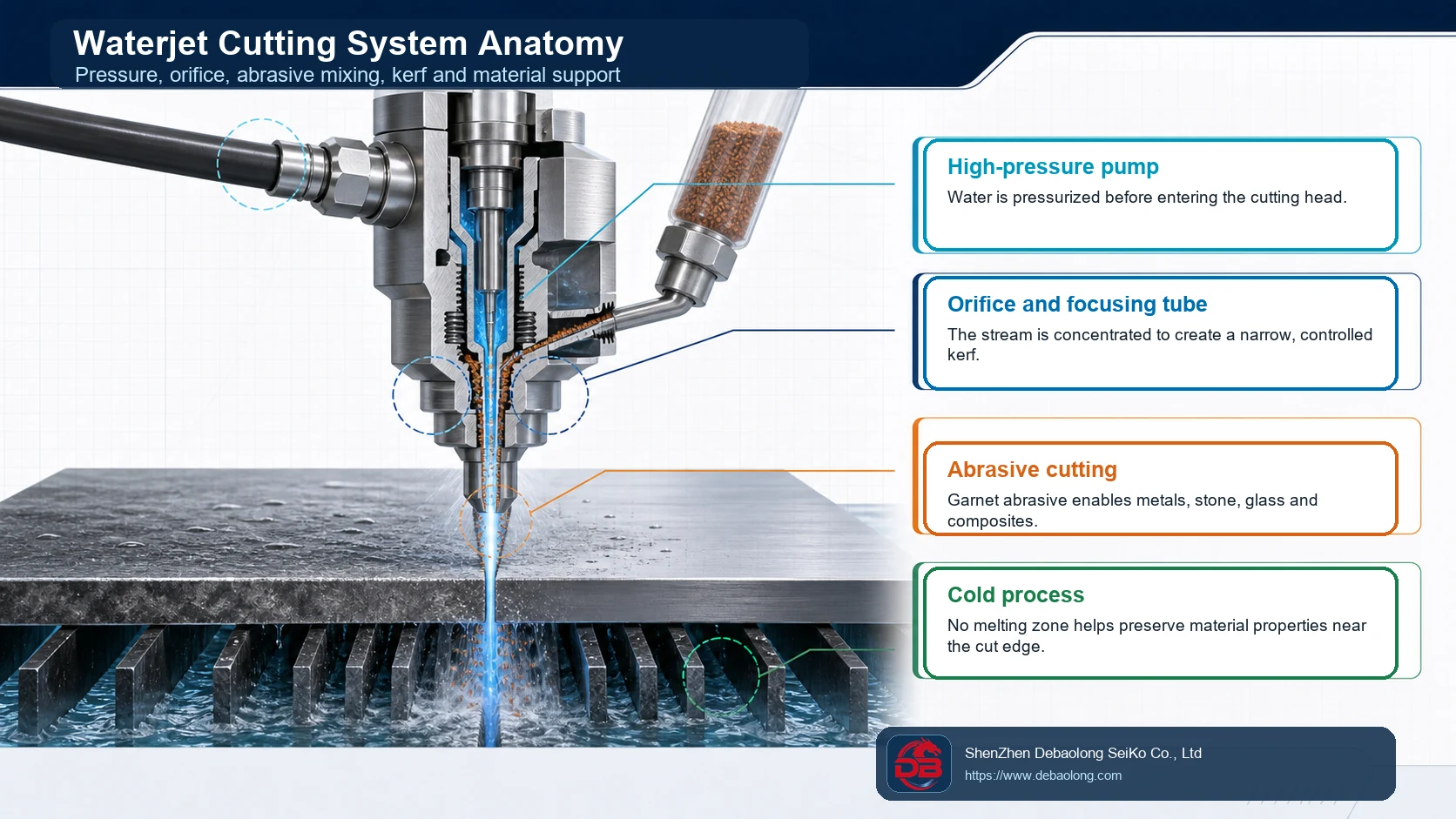
Waterjet cutting is a manufacturing process that uses a focused high-pressure stream of water to cut material. In abrasive waterjet cutting, an abrasive such as garnet is added to the stream so the process can cut harder materials including metals, stone, glass and composites. Because waterjet cutting is a cold process, it does not create the same heat-affected zone associated with laser, plasma or thermal cutting.
The source article explains waterjet cutting as a flexible process for shapes, prototypes, sheets, plates and materials that may be sensitive to heat. The engineering value comes from combining a narrow kerf, broad material compatibility and low thermal distortion.
How the Waterjet Cutting Process Works
The cutting system pressurizes water and sends it through a small orifice. The focused stream exits the cutting head at very high speed. For soft materials, pure water can be enough. For harder materials, abrasive particles are mixed into the stream before it reaches the workpiece. The moving stream erodes material along the programmed path and creates a controlled kerf.
Cut quality depends on pressure, nozzle condition, abrasive flow, stand-off distance, traverse speed, material thickness and fixturing. If the machine moves too fast, edge taper and roughness increase. If it moves too slowly, cycle time and abrasive cost rise.
Pure Waterjet and Abrasive Waterjet
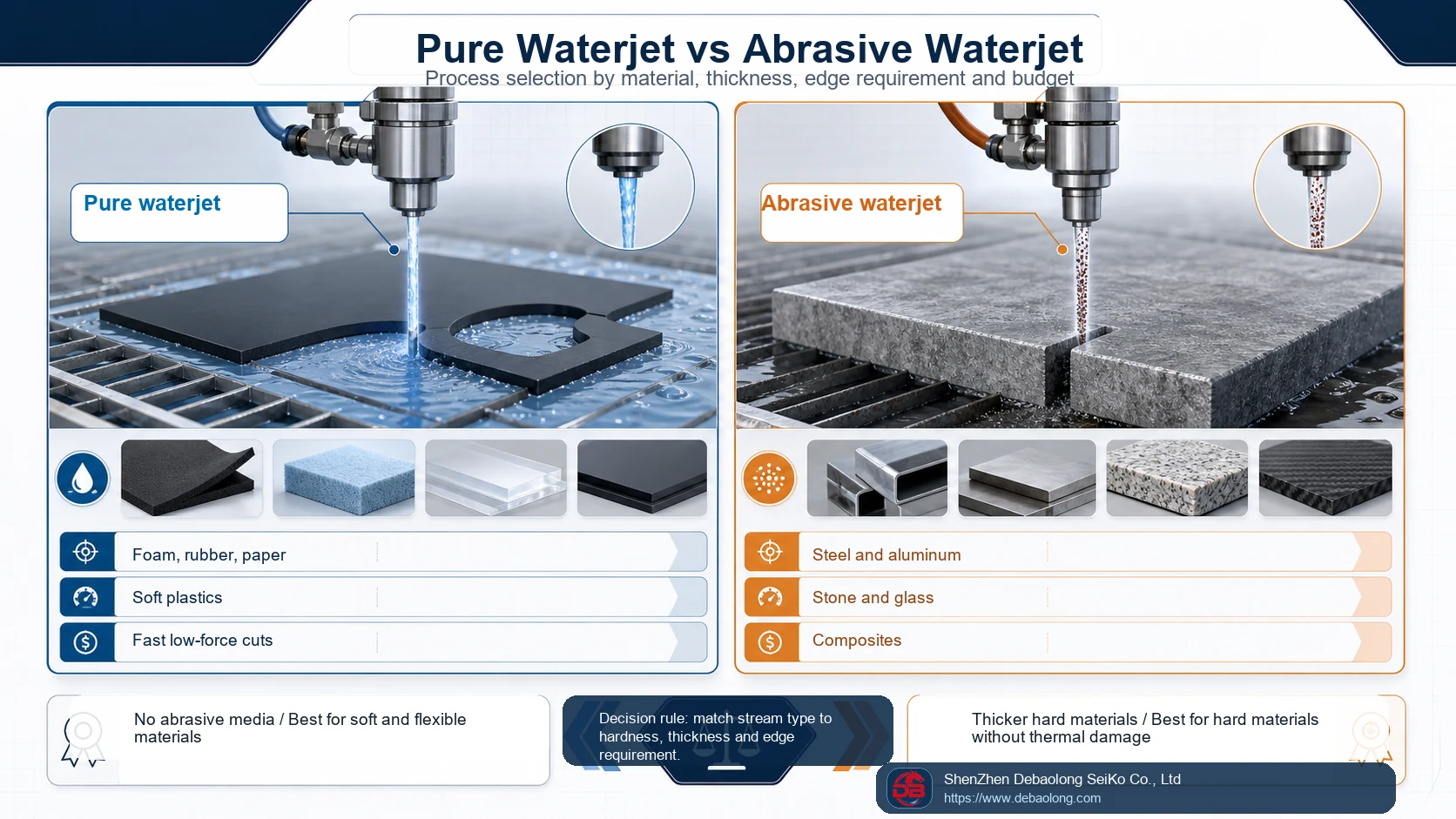
Pure waterjet cutting is generally used for softer materials such as foam, rubber, paper, textiles, insulation and some plastics. It cuts with low mechanical force and without abrasive contamination, which can be useful when the material is flexible or easily crushed.
Abrasive waterjet cutting is used for harder materials. The abrasive particles do most of the cutting work after being accelerated by the high-pressure water stream. This makes the process suitable for steel, stainless steel, aluminum, titanium, stone, ceramic, glass and many composite materials.
Materials Suitable for Waterjet Cutting
Waterjet cutting is valued because it can process many materials without thermal damage. Typical materials include aluminum, stainless steel, mild steel, copper, brass, titanium, rubber, foam, plastics, composites, glass, ceramics and stone. It can be useful when the part material would discolor, harden, melt or distort under thermal cutting.
The process is often selected for flat sheet or plate work, signs, gaskets, brackets, machine components, architectural panels, prototypes and low-volume parts. The best fit depends on material thickness, edge requirement, tolerance, budget and whether secondary finishing is acceptable.
Benefits of Waterjet Cutting
Waterjet cutting has several important advantages. It produces no heat-affected zone, reduces thermal distortion, cuts a wide range of materials and can create complex 2D profiles. Tooling cost is low compared with dedicated dies, and the process can be efficient for prototypes and mixed part batches.
Because the cutting force is relatively low, delicate materials can often be processed with less cracking or deformation than mechanical cutting. Abrasive waterjet also allows hard materials to be cut without introducing the metallurgical changes associated with thermal processes.
Limitations and Design Considerations
Waterjet cutting is not the best process for every job. Very high precision features, small holes, thick material with strict taper limits and production runs that require extremely fast cycle times may need careful review. Abrasive consumption affects operating cost, and edge taper can appear when cutting thick materials.
Designers should consider minimum feature size, hole diameter, kerf width, edge finish, tolerance, material support and lead-in/lead-out position. When parts require tight dimensions or cosmetic edges, confirm whether secondary machining, sanding or finishing will be needed.
Waterjet Cutting Compared With Laser and Plasma
Laser cutting is fast and precise for many sheet metals, but it is a thermal process. Plasma cutting is efficient for thicker conductive metals but usually produces a wider kerf and more heat. Waterjet cutting is slower in some applications, but it can cut heat-sensitive materials and thick mixed materials with less thermal distortion.
For sheet metal design strategy, DEBAOLONG’s sheet metal fabrication guide explains related processes. For process trade-offs, the manufacturing process comparison guide can help choose between cutting, machining and additive manufacturing. For release planning, see the DFM prototyping guide.
Conclusion
Waterjet cutting is a versatile cold cutting process for materials that need low thermal distortion, broad compatibility and flexible profile cutting. Pure waterjet is useful for soft materials, while abrasive waterjet expands the process to metals, stone, glass and composites. The strongest results come from matching stream type, material thickness, edge requirement, tolerance and budget before releasing the design.
Related Engineering Resources