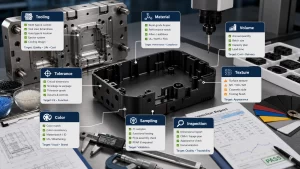


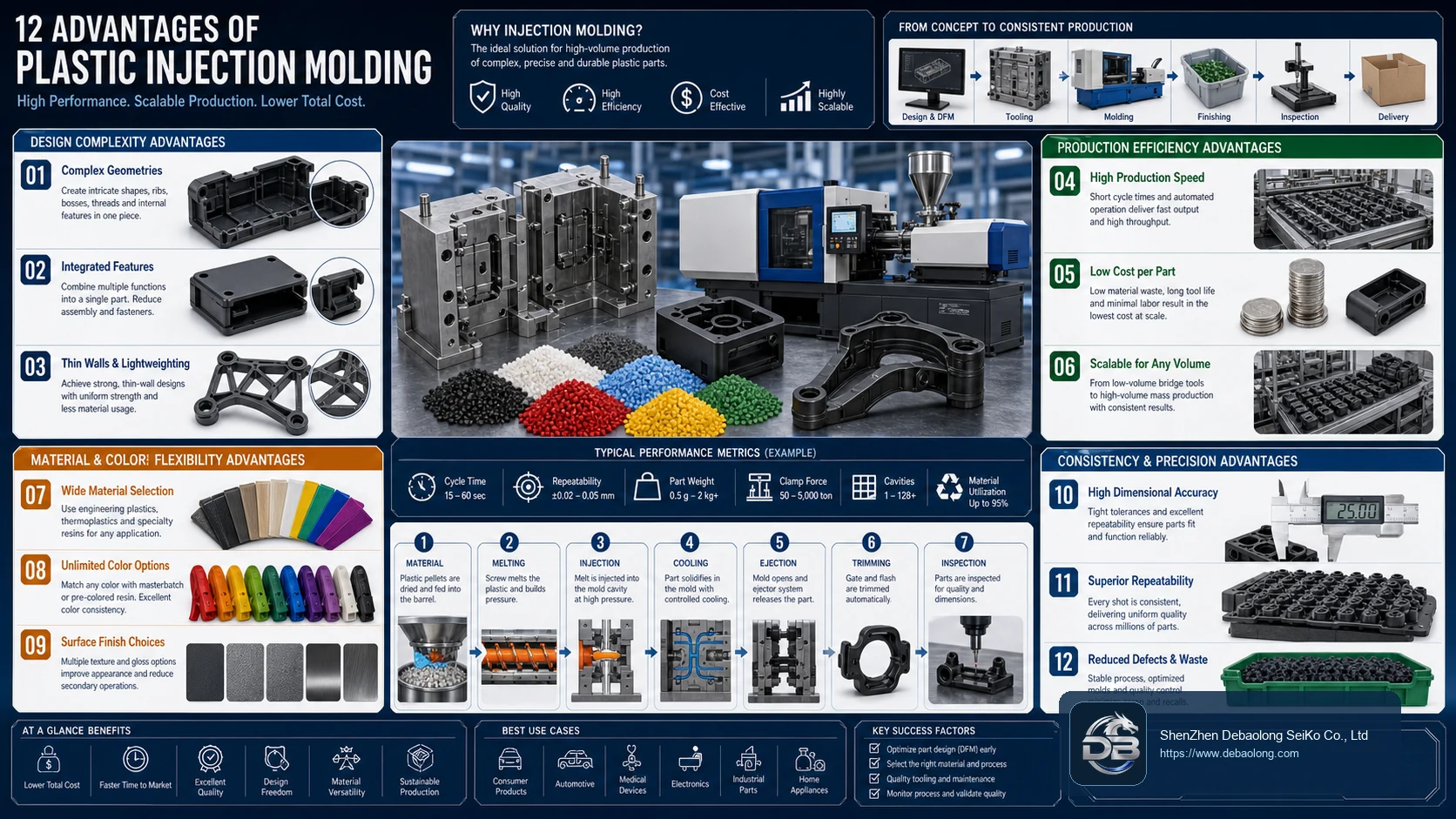
A practical guide to the advantages of plastic injection molding, including complex geometry, fast production, repeatability, material flexibility, color options, low unit cost and scalable manufacturing.
Why Injection Molding Scales
Injection molding becomes powerful when the product needs repeated plastic parts with stable geometry, consistent quality and a controlled unit cost. Tooling investment is high compared with prototype processes, but each cycle can produce parts quickly and repeatably once the mold is validated.
This is why the process is common for housings, clips, medical components, consumer products, automotive parts and industrial assemblies where volume justifies tooling.
Design Complexity and Production Speed
Molding can create ribs, bosses, clips, threads, textures and integrated features in one shot. With good design, multiple functions can be combined into one part, reducing assembly time and fasteners.
Cycle times can be short, and multi-cavity molds can multiply output. Automation can reduce handling labor, while stable process windows improve consistency across production runs.
Material, Color and Finish Flexibility
Injection molding supports many resins, fillers, colors and textures. Material selection affects shrinkage, strength, chemical resistance, heat behavior and dimensional repeatability. These choices should be paired with injection molding tolerance planning.
Surface finish can be controlled through tool texture, polishing, in-mold features and material choice. Color can be achieved through resin selection or masterbatch, which helps avoid secondary painting in many applications.
Cost and Precision
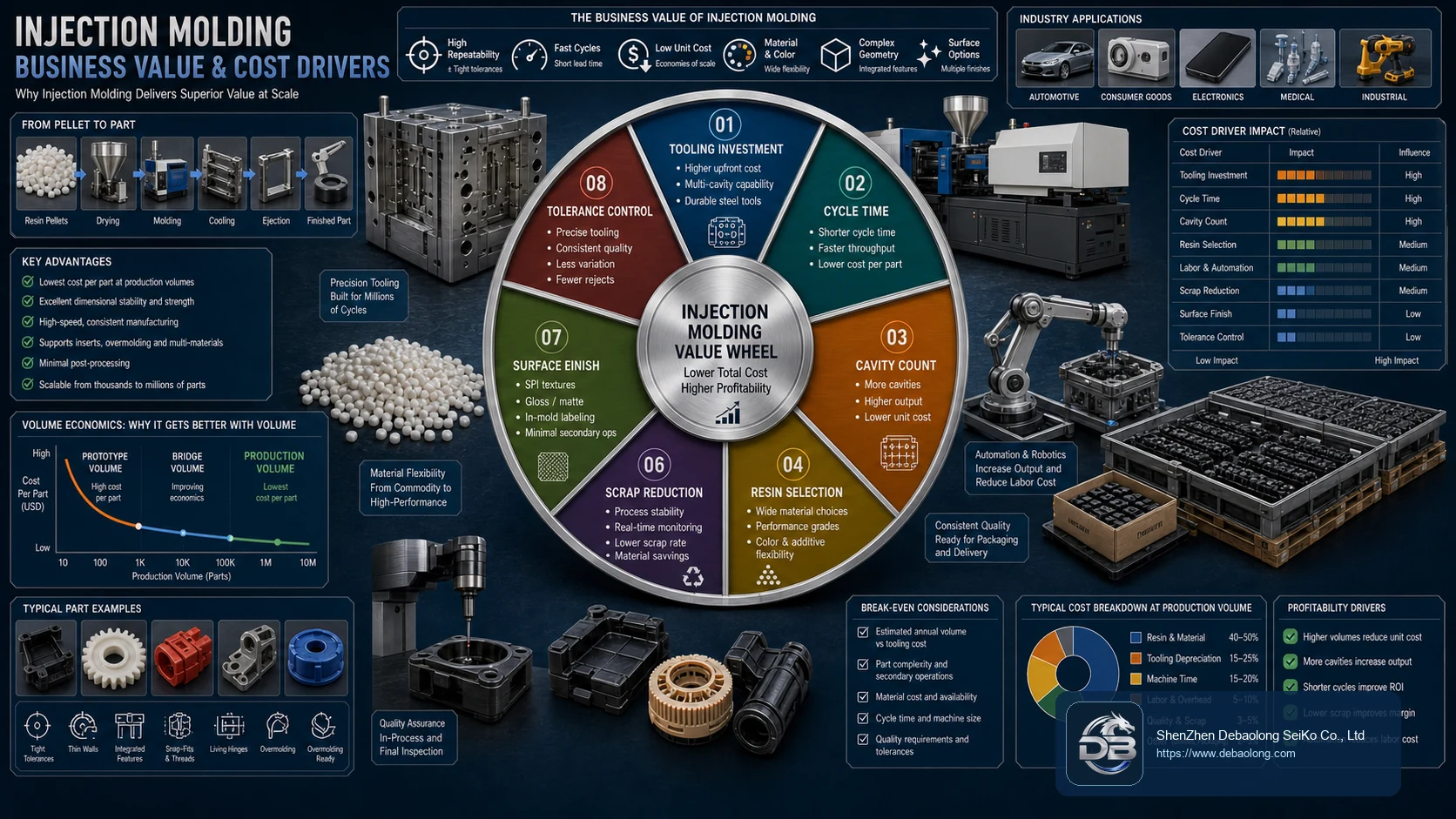
At production volume, low labor per part, reduced waste, short cycles and repeatability can create a favorable unit cost. Precision depends on tool quality, resin behavior, cooling, process control and inspection strategy.
To get these advantages, the part must be designed for molding. Draft, uniform walls, ribs, fillets and material selection should be reviewed through a full design for manufacturing workflow.
When Molding Is the Right Choice
Choose injection molding when volume, repeatability and material performance justify tooling. For lower volumes or early iteration, compare printed materials and prototype routes using DEBAOLONG’s 3D printing materials guide before committing to production tooling.
Related Engineering Resources