

Steel hardening increases hardness and wear resistance by changing the steel’s internal structure through deformation, alloying or heat treatment. The source article covers martensite, austenite and pearlite, then explains cold working, solution alloy hardening, quenching and tempering, case hardening, hardness tests and steel families that can be hardened. For DEBAOLONG’s CNC machining projects, hardening must be planned before machining and finishing because heat treatment can change dimensions, distortion risk, surface condition and final inspection requirements. In practice, the best choice is the process route that meets the real engineering requirement while keeping tolerance, finish, inspection, application risk and lead time under control before production begins.
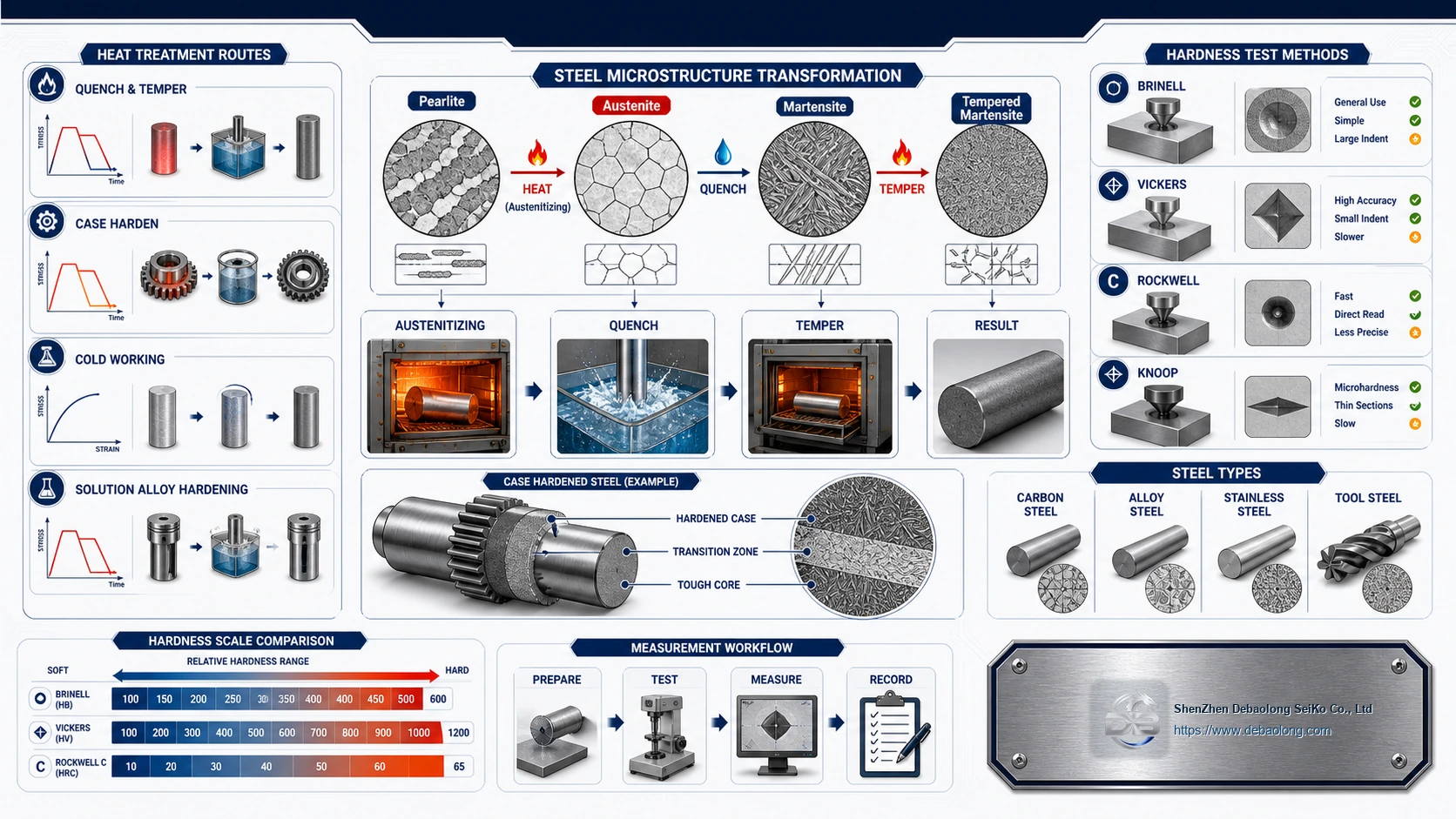
Steel Hardening Changes Microstructure and Performance
The right hardening method depends on steel grade, required core toughness, surface wear, case depth, distortion tolerance and service environment.
Microstructure: Martensite, Austenite and Pearlite
Austenite is a high-temperature phase that can transform during cooling. Martensite is hard and brittle when formed by rapid quenching. Pearlite is a layered ferrite-cementite structure with different hardness and toughness behavior.
Heat treatment controls these transformations. The final result depends on carbon content, alloying, heating temperature, hold time, cooling rate and tempering.
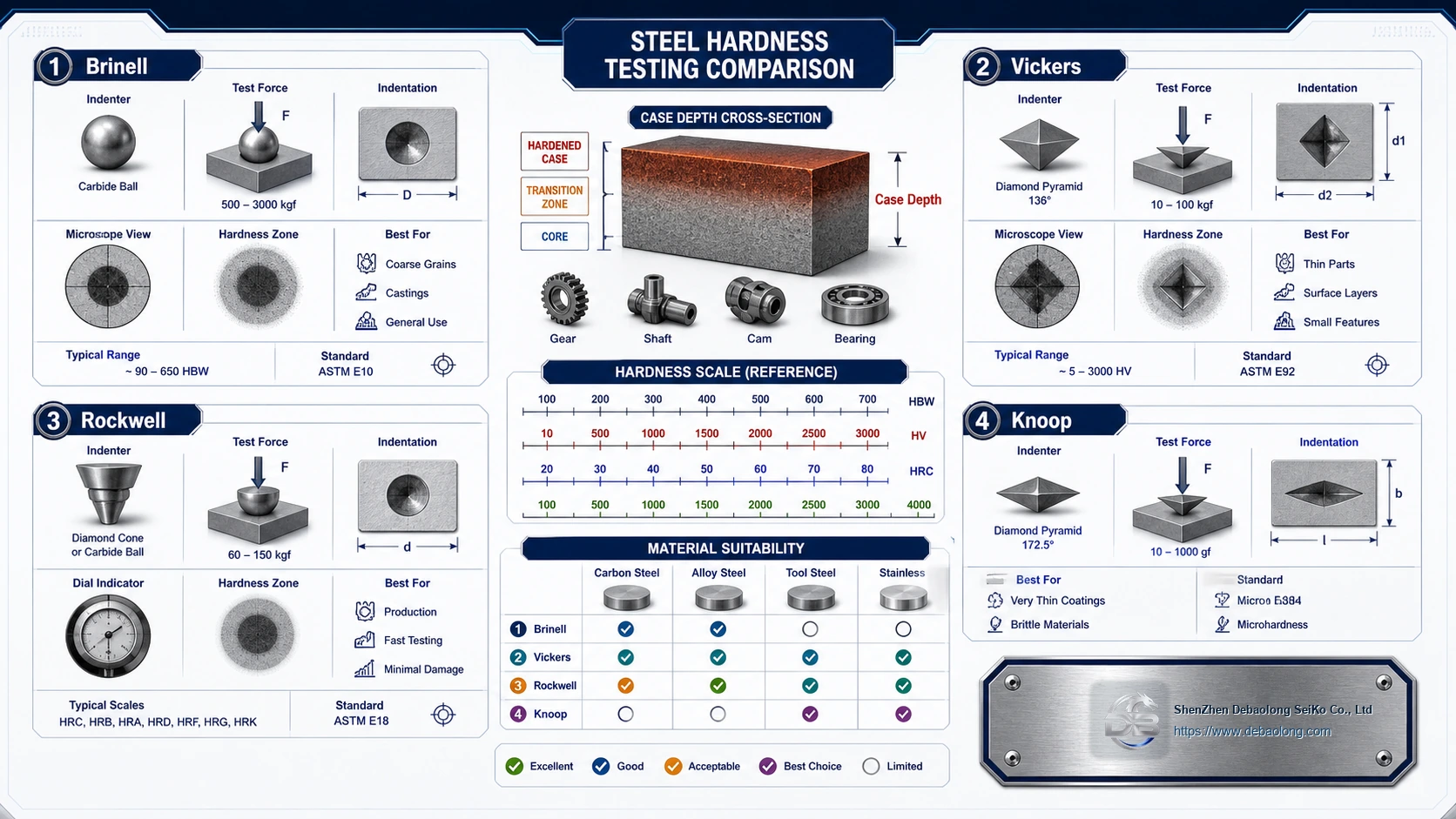
Hardening Methods
Cold working increases hardness through plastic deformation. Solution alloy hardening uses alloying and heat treatment behavior to improve strength. Quenching and tempering hardens the steel and then reduces brittleness through controlled reheating.
Case hardening creates a hard surface with a tougher core. It is useful for gears, shafts, pins and wear surfaces where the part needs both surface resistance and internal toughness.
Hardness Testing and Steel Families
Brinell, Vickers, Knoop and Rockwell tests measure hardness through different indenters and loads. The correct test depends on material, expected hardness, case depth, part size and required precision.
Carbon steel, alloy steel, stainless steel and tool steel respond differently to hardening. Material choice should be confirmed through all materials and the required heat-treatment specification.
DEBAOLONG Heat-Treatment Review
DEBAOLONG reviews hardened steel parts for material, machining allowance, heat-treatment sequence, distortion risk, surface finish and inspection. The knowledge center helps connect material choice with manufacturing process planning.
Related Services
Related DEBAOLONG capabilities include 3D printing, CNC machining, sheet metal fabrication, injection molding, material selection support and manufacturing engineering review.