

A practical guide to biodegradable and circular 3D printing materials, covering PLA, PHA, FLAM, filled bio-composites, recycled filament and design checks for reliable printed parts.
Biodegradable Does Not Mean Universal
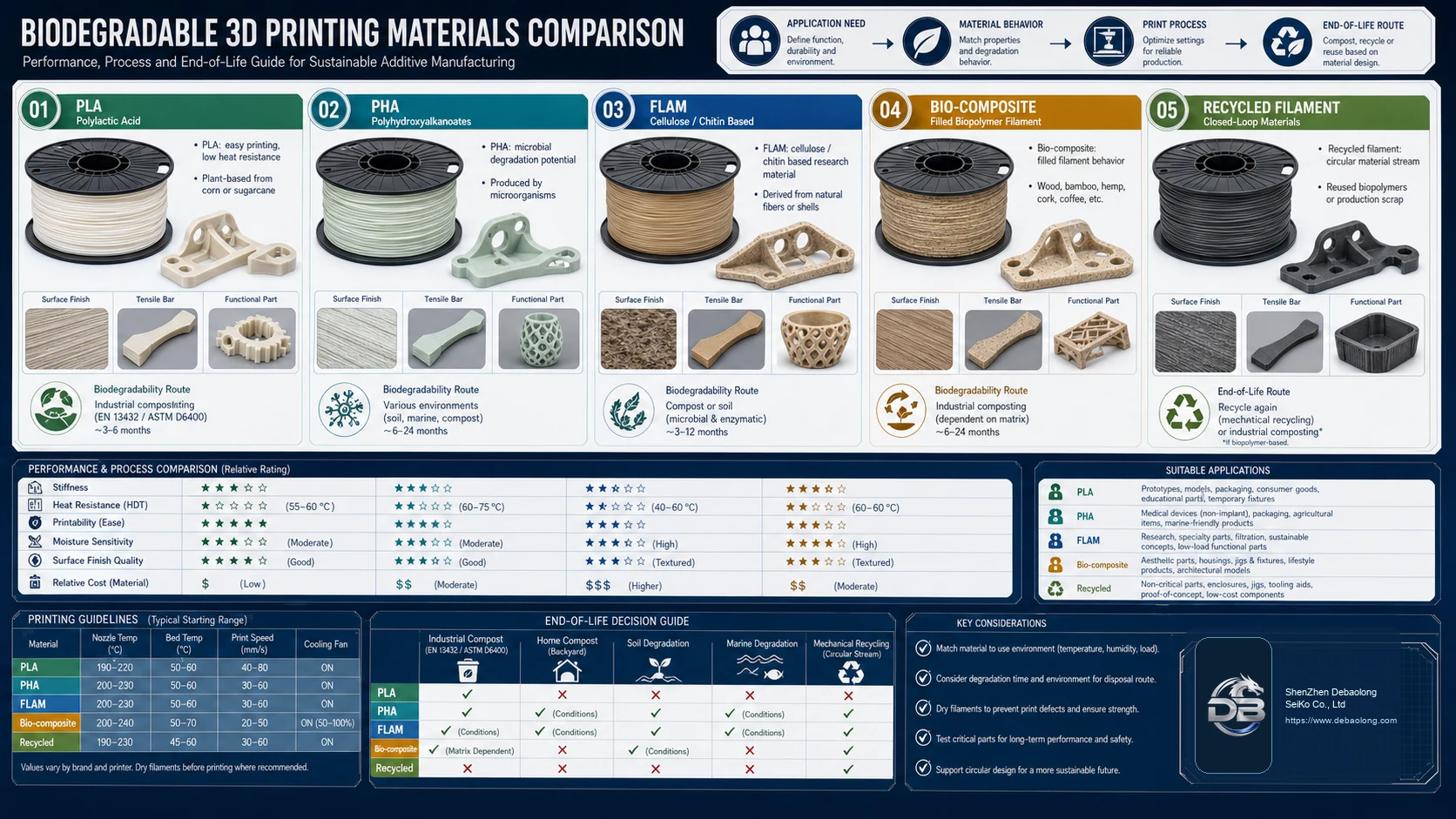
Biodegradable 3D printing materials are attractive because they connect additive manufacturing with lower-impact material strategies. The engineering reality is more specific: a material may be bio-based, biodegradable under industrial composting conditions, recyclable, filled with natural fibers, or produced from recycled polymer streams. Those are related ideas, but they are not interchangeable.
Material choice should begin with the part function, print process and end-of-life route. For functional programs, this decision belongs inside the broader 3D printing materials selection process rather than being treated as a marketing label.
PLA, PHA and Research-Stage Bio Materials
PLA is the most familiar biodegradable filament. It prints easily and is useful for visual models, fixtures, packaging prototypes and educational parts, but it softens at relatively low temperatures and can be brittle compared with engineering polymers. It is usually better for controlled indoor use than for hot, loaded or outdoor service.
PHA is a family of polyhydroxyalkanoates associated with microbial degradation potential. It can support more demanding sustainability claims in the right environment, but print behavior, sourcing and grade consistency still need review. FLAM-type materials, based on cellulose and chitin research, are interesting for low-impact manufacturing concepts but should be validated carefully before production use.
Composites and Recycled Filaments
Bio-composite filaments may include wood, bamboo, cork, coffee, hemp or other natural fillers. Fillers change texture, stiffness, moisture response and nozzle wear. A composite that looks sustainable may need thicker walls, larger nozzles and more conservative strength assumptions than an unfilled polymer.
Recycled filament supports circular material streams, but consistency depends on feedstock quality, sorting, drying and extrusion control. Recycled materials can be excellent for proof-of-concept parts, low-load covers, fixtures and noncritical components, but engineering use requires batch traceability and mechanical testing.
Design Rules for Reliable Parts
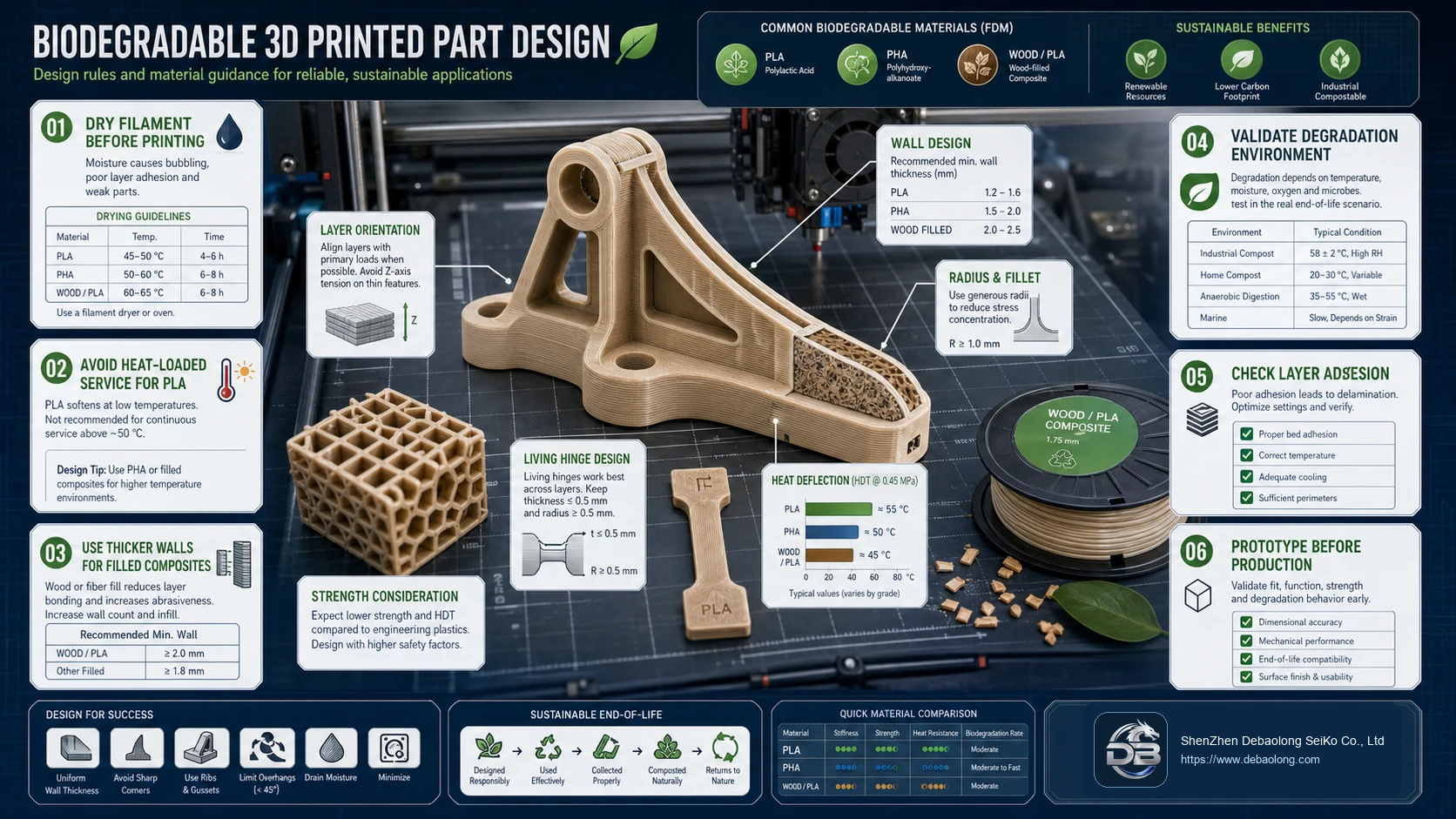
Drying, wall thickness, layer adhesion and heat exposure matter more with many biodegradable or filled materials. Moisture can create bubbling and weak layers. Thin walls can become brittle. Large heat-loaded parts may deform in service, especially when PLA is used beyond its comfort zone.
Early DFM review is useful because the sustainable material choice may force changes to geometry, infill, orientation or post-processing. The same principle applies across manufacturing workflows, as discussed in DEBAOLONG’s design for manufacturing guide.
How to Choose
Use PLA for easy prototypes and low-heat visual parts, PHA when the end-of-life route is a primary requirement, bio-composites when texture and stiffness matter, and recycled filament when circular sourcing is more important than peak material performance. For powder-bed nylon alternatives, compare the tradeoffs with MJF 3D printing design rules before choosing the final process.
Related Engineering Resources