

SLA 3D printing creates parts by curing liquid photopolymer resin with a laser or UV light source, layer by layer. The source article explains the working principle, materials, advantages and limitations: SLA offers fine detail, high accuracy, complex geometry and smooth surfaces, but material choice, mechanical performance and production volume are limited compared with some other processes. DEBAOLONG evaluates SLA within its 3D printing workflow when a project needs visual quality, fine features, clear parts or precision prototypes. In practice, the best choice is the process route that meets the real engineering requirement while keeping tolerance, finish, inspection, application risk and lead time under control before production begins.
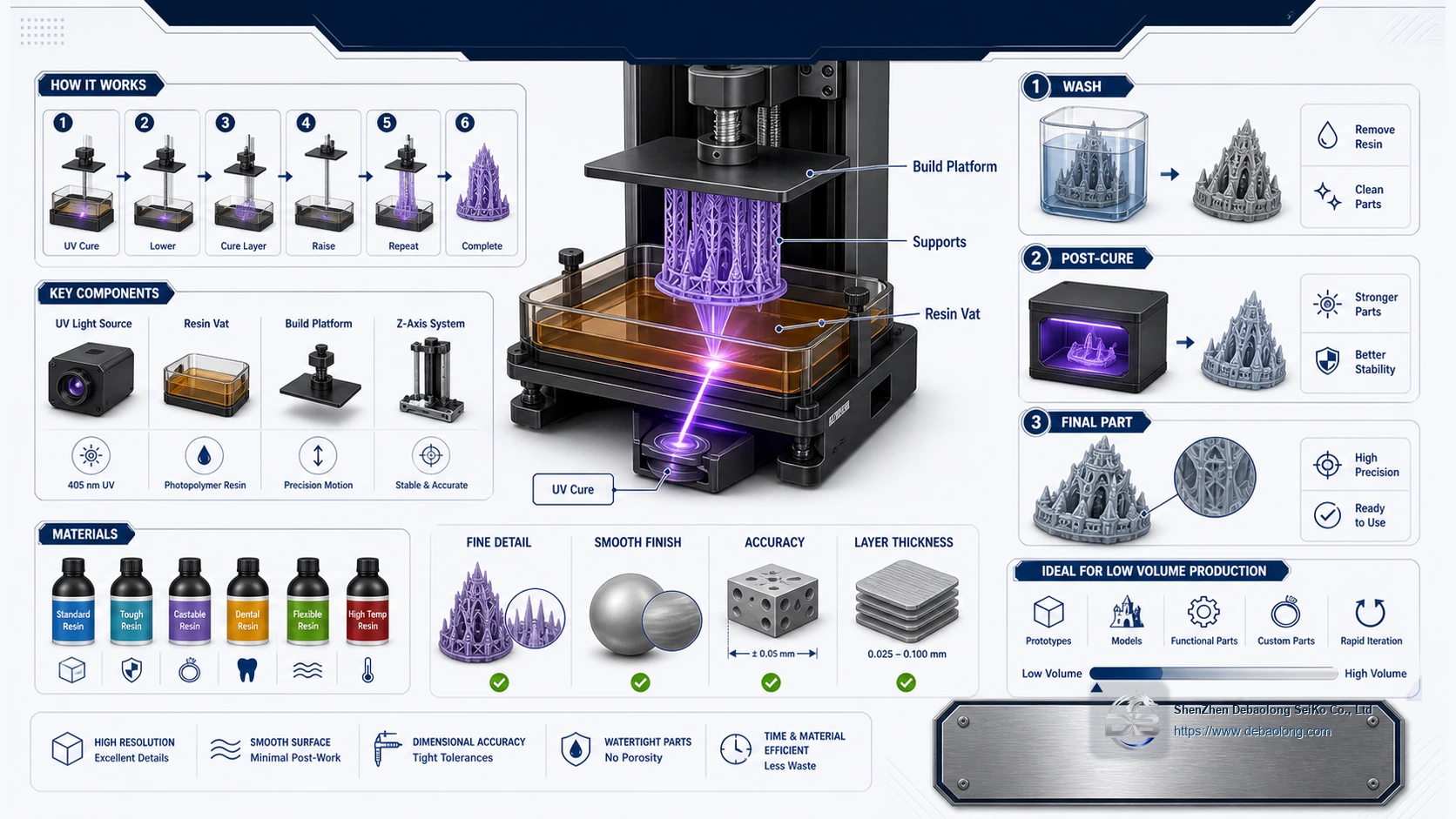
SLA Uses Light to Cure Liquid Resin
SLA is often selected for detailed models, prototypes, cosmetic samples, small housings, dental-style models, jewelry-like shapes and parts where surface finish matters more than high structural load.
Process Workflow
The build platform moves through a resin vat while light cures each layer. Support structures hold overhangs and delicate features. After printing, the part is removed, washed to clear uncured resin and UV post-cured to stabilize properties.
Orientation affects support marks, accuracy, trapped resin and cosmetic surfaces. Drain holes are needed for hollow parts to prevent uncured resin from remaining inside.
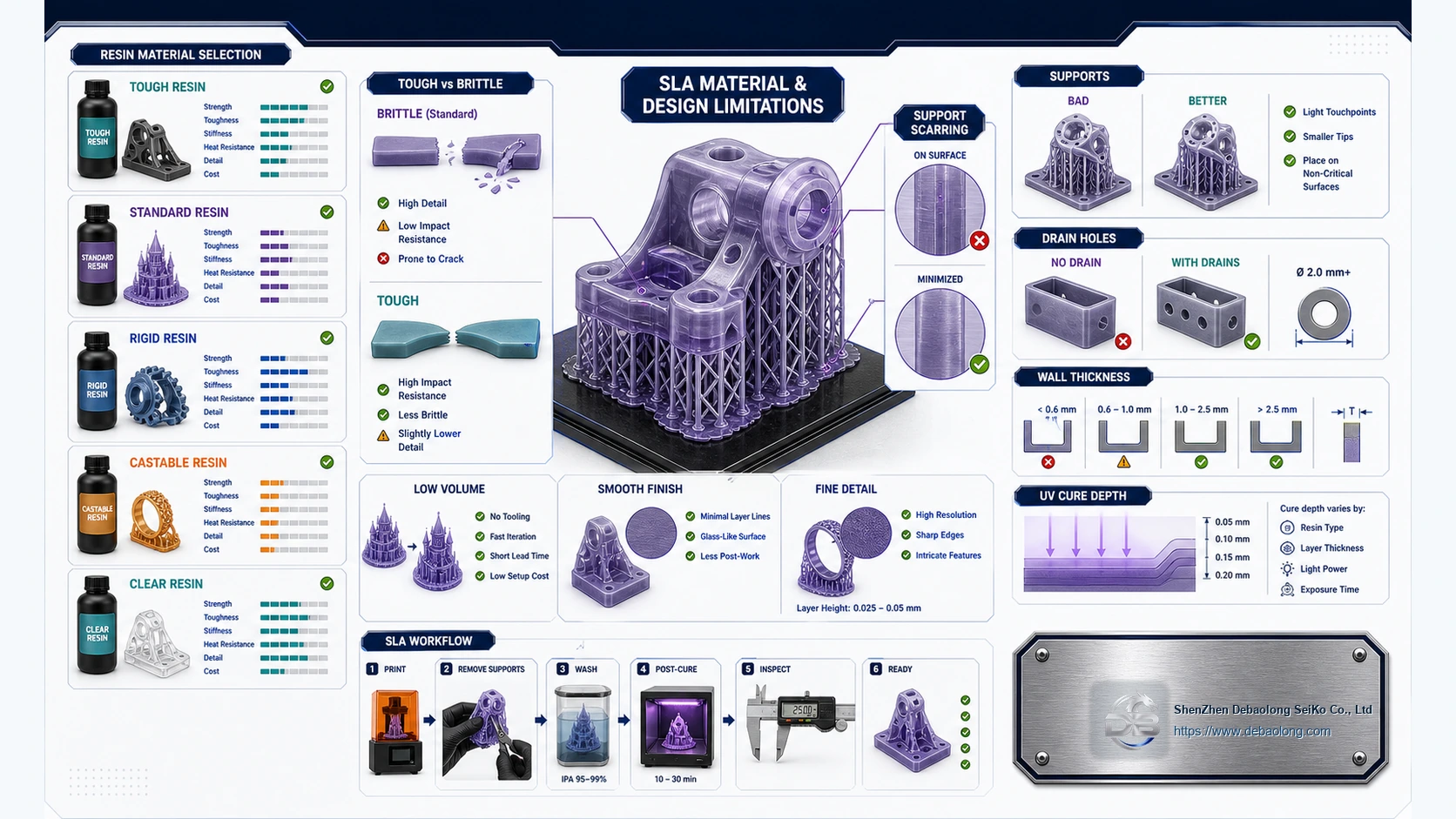
Advantages of SLA
SLA can produce fine detail and smooth surfaces that are difficult to match with many extrusion processes. It is useful for complex designs, presentation models, fit checks and low-volume parts with high visual requirements.
Resin options include standard, tough, high-temperature, clear and castable-style materials, but each family has different behavior. Review resin selection through all materials before specifying the final part.
Limitations to Plan Around
SLA materials can be more brittle than engineering thermoplastics. Support removal can leave marks. UV exposure, heat and long-term service conditions may affect performance. Larger production quantities may be better suited to molding or another process.
Dimensional accuracy is strong for many features, but post-curing and part geometry still affect tolerance. Critical interfaces should be identified before print orientation is chosen.
DEBAOLONG SLA Review
DEBAOLONG reviews SLA parts for resin, detail, wall thickness, supports, drainage, post-cure, surface finish and inspection. The knowledge center helps compare SLA with MJF, SLS, FDM, CNC machining and injection molding.
Related Services
Related DEBAOLONG capabilities include 3D printing, CNC machining, sheet metal fabrication, injection molding, material selection support and manufacturing engineering review.