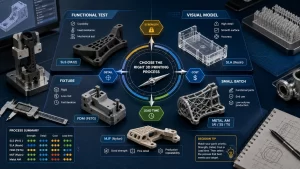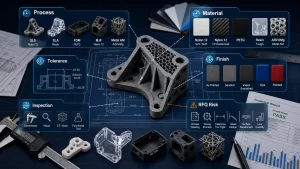

Open-source 3D printing projects are more than hobby examples; they teach how printed parts behave under load, motion, assembly, heat, vibration and real use. The source article lists challenging projects such as an OpenRC car, mechanical dragonfly, hovercraft, quadcopter, Strandbeest walking mechanism, robotic arm, self-watering planter, plotter, PiKon telescope and camera slider. For DEBAOLONG’s 3D printing customers, these examples are useful because they reveal the same design questions found in commercial prototypes: material choice, wall thickness, fasteners, bearings, tolerance, electronics packaging and testing. In practice, the best choice is the process route that meets the real engineering requirement while keeping tolerance, finish, inspection, application risk and lead time under control before production begins.
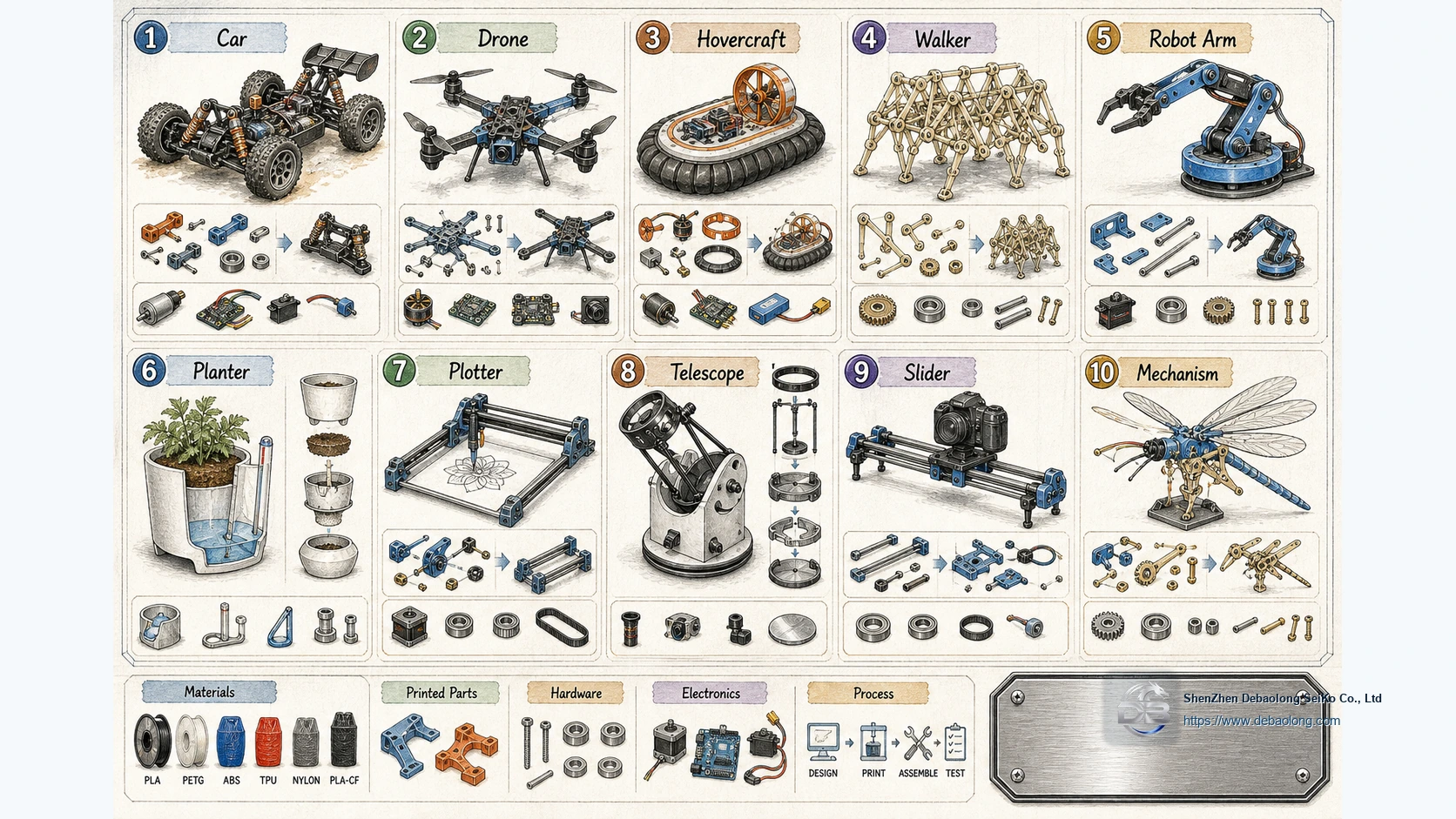
Open-Source Projects Teach Real Manufacturing Lessons
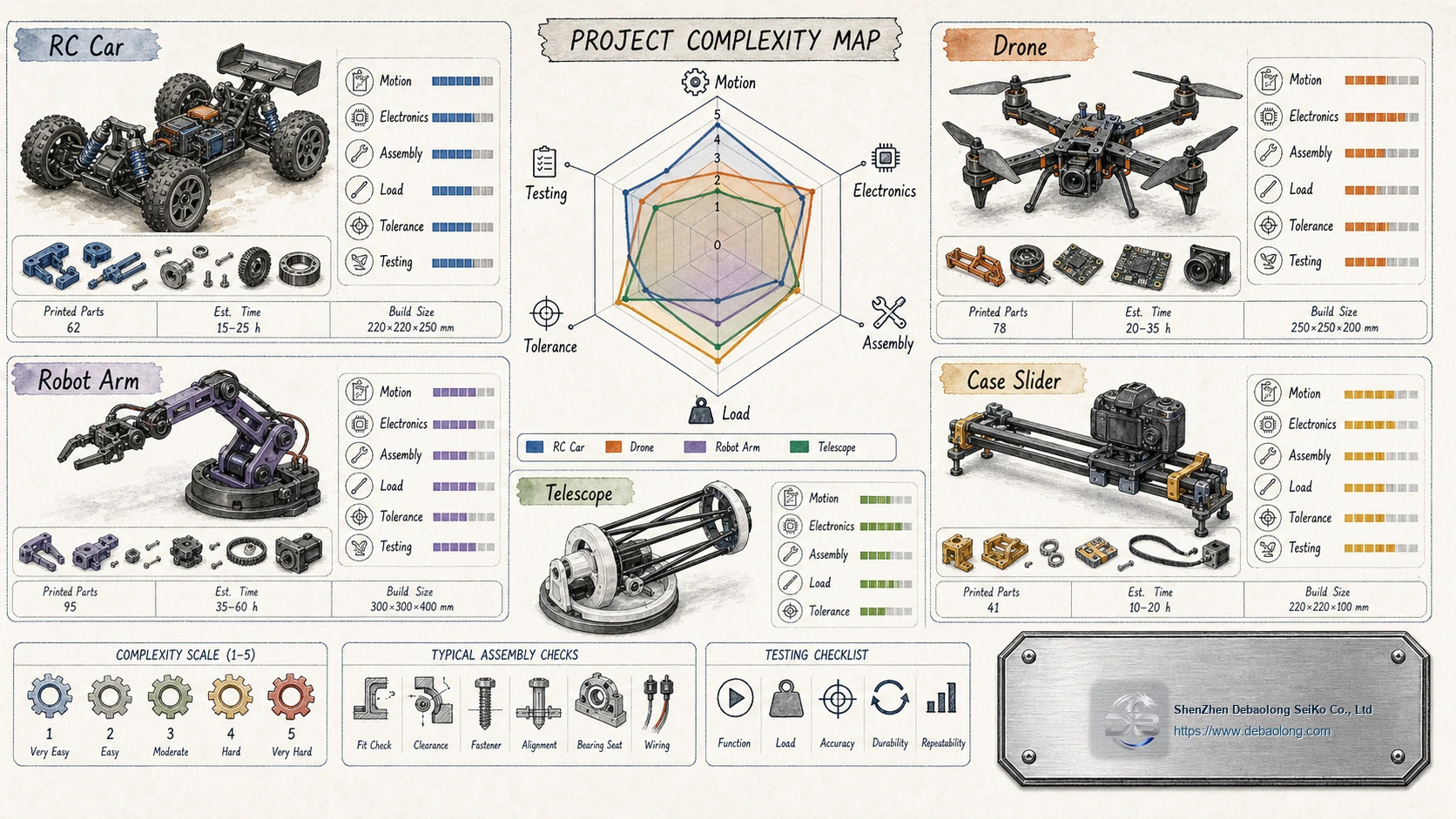
A printed project becomes difficult when it has moving parts, load paths, many fasteners, electronics or accuracy requirements. Good project design treats the printed part as an engineered component, not only as a shape.
Motion Projects Need Strength and Tolerance Control
RC cars, drones, hovercrafts and camera sliders all expose printed parts to vibration, impact, alignment and assembly load. Layer orientation, infill, wall count, fastener bosses and bearing seats must be designed for function.
A part that looks good on the build plate may fail if screw holes split, brackets flex or bearing surfaces wear. Functional projects should use conservative fillets, reinforced bosses and appropriate material.
Mechanisms and Robotics
Strandbeest mechanisms, robotic arms and plotters require repeatable linkages, smooth motion and controlled clearances. Small errors stack across assemblies, so pins, holes, joints and printed bushings need careful testing.
Material selection changes performance. PLA may be easy to print but brittle or heat-sensitive; PETG, nylon, carbon-filled nylon or resin may be better depending on the project. Compare options through all materials.
From DIY Learning to Product Development
The engineering value of open-source projects is iteration. Designers can print, assemble, test, measure and revise quickly. That same loop supports consumer product development, fixtures, jigs, robotics prototypes and proof-of-concept mechanisms.
For serious prototypes, document print orientation, material, layer height, inserts, fasteners and failure observations. That makes the next revision faster and more reliable.
DEBAOLONG Prototype Support
DEBAOLONG helps convert early printed concepts into stronger prototypes and manufacturable parts. The manufacturing engineering knowledge center can help teams compare printed prototypes with CNC machining, sheet metal or injection molding routes.
Related Services
Related DEBAOLONG capabilities include 3D printing, CNC machining, sheet metal fabrication, injection molding, material selection support and manufacturing engineering review.