

End-of-arm tooling parts connect the robot to the actual work. Gripper fingers, adapter plates, mounting blocks, vacuum interfaces and tool-changing components must be light enough for motion control and strong enough for repeated operation. Manufacturing choices affect payload, cycle time, precision, wear and maintenance.
Common EOAT Part Types
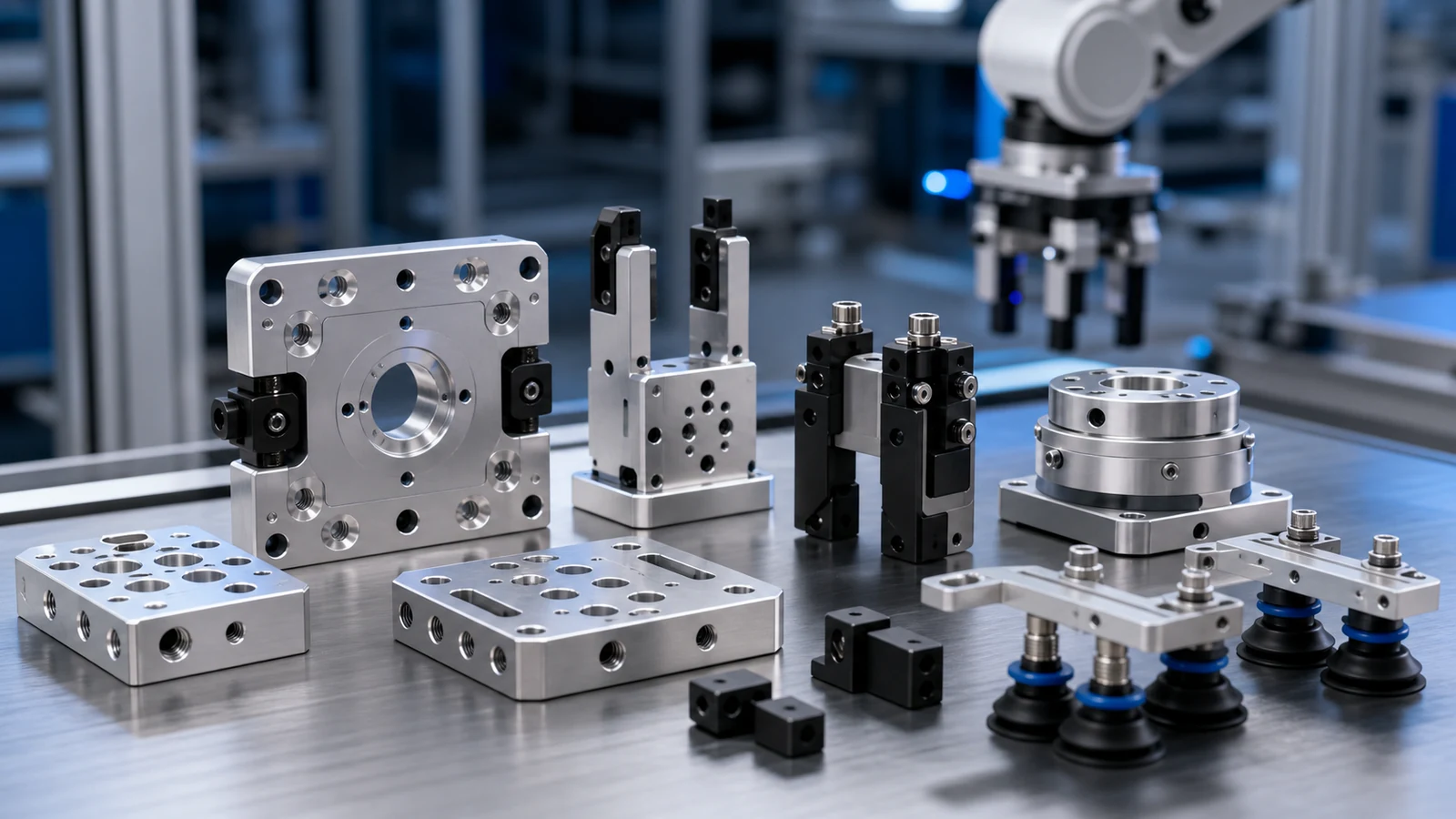
Typical parts include gripper fingers, adapter plates, lightweight mounting blocks, sensor brackets, vacuum cup holders, pneumatic brackets and custom tooling interfaces. These parts often combine CNC machining, 3D printing, inserts, surface finishing and assembly checks.
CNC Machined Adapters and Mounting Blocks
CNC machining is suitable for accurate mounting holes, rigid interfaces, metal gripper parts and repeatable adapter blocks. Aluminum is common for weight reduction, while steel or stainless steel may be selected for wear surfaces or stronger interfaces. Thread depth, counterbores and alignment pins should be specified clearly.
3D Printed Gripper Prototypes
3D printing can help verify finger shape, clearance, part contact and cable routing before machining final hardware. Printed prototypes are useful when the gripper geometry changes quickly or when several gripping surfaces must be compared. For production tooling, material strength, wear and temperature should be reviewed again.
Material Selection for Weight and Stiffness
EOAT parts should be designed around payload, acceleration and gripping force. Aluminum reduces mass, engineering plastics may protect handled parts, and steel inserts may improve wear. Lightweight pockets can help, but thin sections may flex or vibrate during high-speed motion.
Tolerance and Assembly Considerations
Tooling interfaces often need repeatable location. Dowel holes, datum faces, threaded holes and adjustment slots should be identified. If the EOAT will be assembled with sensors, pneumatic fittings or soft pads, the drawing should show the complete stack-up where possible.
Surface Finish and Wear
Gripping surfaces may need polishing, coating, inserts or replaceable pads. Metal parts may require anodizing, hard anodizing, passivation or plating depending on wear and environment. Edges that contact customer products should be free from sharp burrs.
Prototype to Production Path
A practical EOAT project may begin with printed geometry, move to CNC functional prototypes, then settle into production parts with confirmed material, finish and inspection points. Debaolong can support this path with machining, printing and basic assembly support.
Design Details That Affect Tool Life
EOAT parts often repeat the same motion thousands of times. Designers should review gripping edges, replaceable wear pads, contact inserts and fastener access. If a gripper finger contacts customer parts directly, the contact area may need a softer material, polished edge or replaceable pad. If the adapter plate carries a heavy tool, the mounting pattern and thickness should be checked for deflection.
Balancing Adjustment and Repeatability
Slots and adjustable holes are useful during setup, but too much adjustment can make maintenance harder. A good EOAT design uses controlled datum surfaces for repeatable position and adjustment features only where the process needs them. Dowel pins, hard stops and clear reference edges can make tool replacement faster.
Manufacturing Review Before RFQ
Before quotation, review whether the EOAT part is intended for a first prototype, validation tooling or production operation. This affects material, finish, tolerance and inspection expectations. Sharing the robot interface, handled part weight, contact surfaces and expected operating environment helps Debaolong evaluate a realistic manufacturing route.
EOAT Failure Points to Review
End-of-arm tooling parts can fail through bending, loose fasteners, worn contact surfaces or poor alignment after tool changes. Designers should review the highest load areas, the screw pattern, the direction of gripping force and whether the part will see impact during operation. Replaceable contact pads or inserts can make maintenance easier when the gripper touches abrasive or irregular parts.
Inspection Notes for Tooling Interfaces
For EOAT parts, the inspection plan should focus on mounting patterns, dowel holes, adapter faces and any surfaces that control gripper position. Cosmetic surfaces usually do not need the same level of control. If the tool will be exchanged often, repeatability between batches becomes more important than appearance.
RFQ Checklist
- Robot model or interface details
- 2D drawings and 3D CAD files
- Payload, gripping force or contact notes
- Material and surface finish requirements
- Thread and dowel requirements
- Prototype and production quantity
FAQ
Should EOAT prototypes be 3D printed or machined?
Printed prototypes are good for early fit checks. CNC prototypes are better when strength, threads and final material behavior matter.
How can EOAT weight be reduced?
Use aluminum, pockets, ribs and simplified geometry while protecting stiffness and tool access.
Can gripper fingers use plastic?
Yes, engineering plastics can protect handled parts or reduce weight, depending on force and wear requirements.
Can Debaolong support both prototypes and production tooling parts?
Yes. Debaolong can support printed prototypes, CNC tooling components and production-ready EOAT parts.
Need custom end-of-arm tooling parts? Send drawings and application notes through the Robotics & Automation Components page.
Related Engineering Resources