

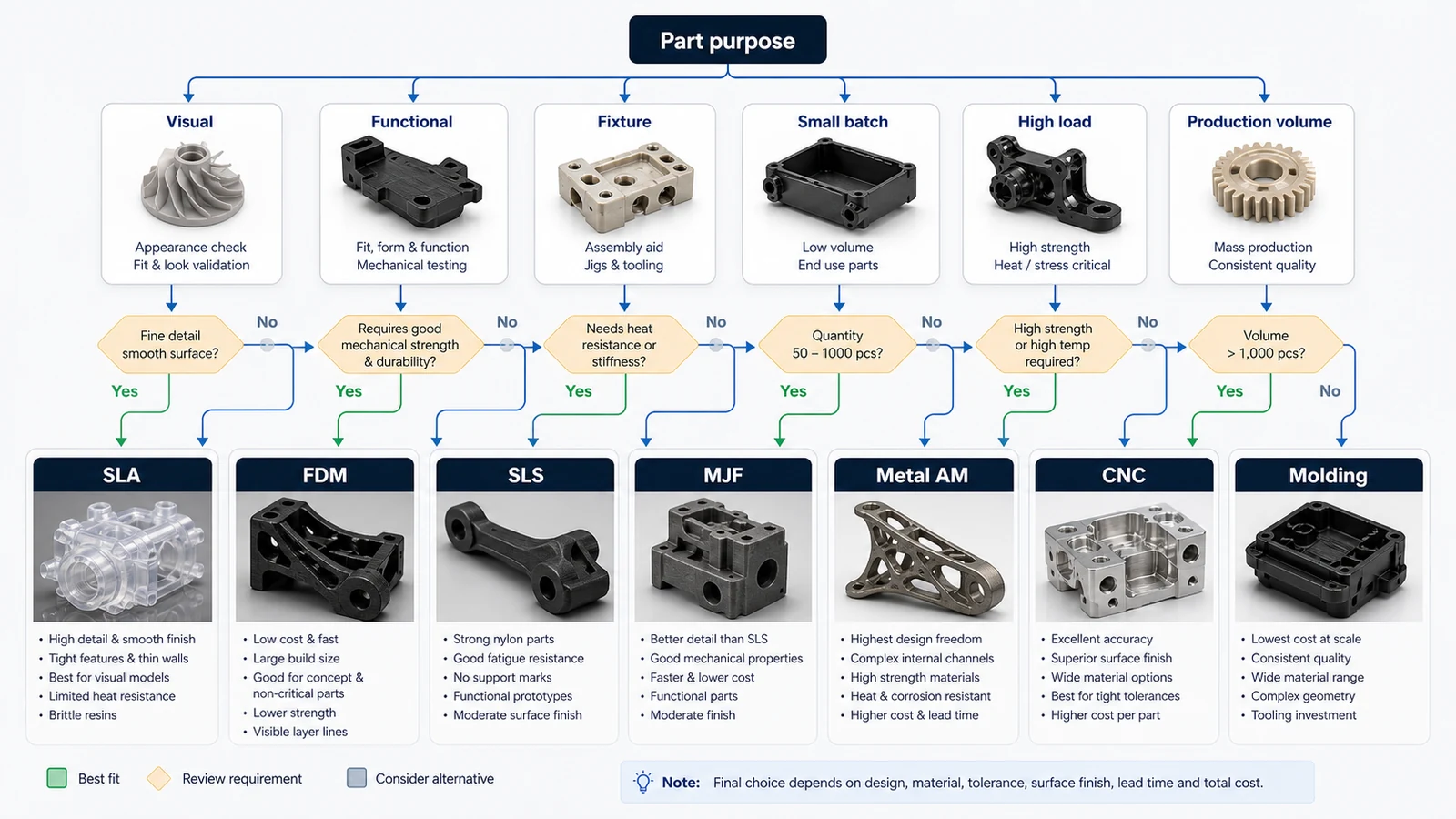
The right 3D printing process depends on what the prototype must prove: appearance, fit, strength, heat resistance, assembly behavior, fixture use or low-volume production. SLS, SLA, FDM, MJF and metal additive manufacturing are not interchangeable price options. Each process creates different surface texture, accuracy, layer behavior, material performance, finishing effort and inspection risk. Procurement engineers should define the engineering purpose first, then select the process that answers that purpose with acceptable cost and lead time. This guide explains how to choose a process before sending an RFQ to Shenzhen Debaolong Seiko Co., Ltd.
Useful related resources include custom 3D printing services, precision CNC machining, injection molding support, manufacturing material options, and manufacturing engineering knowledge center.
Executive Summary for Procurement Engineers
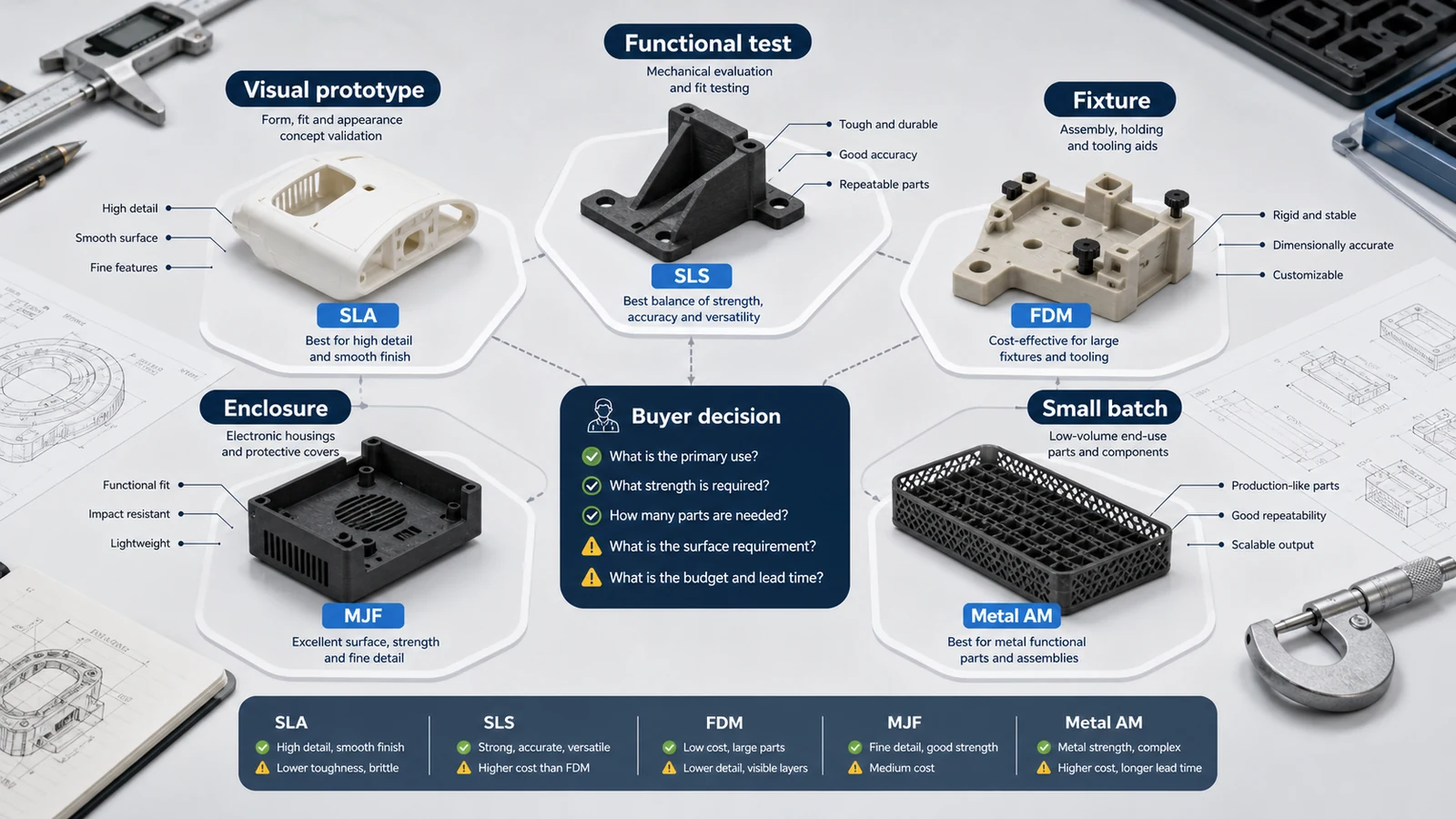
Process selection should start with the question the prototype must answer. A visual presentation sample, a snap-fit test, a large assembly fixture, a nylon enclosure and a metal cooling bracket do not need the same technology even if the CAD file looks similar.
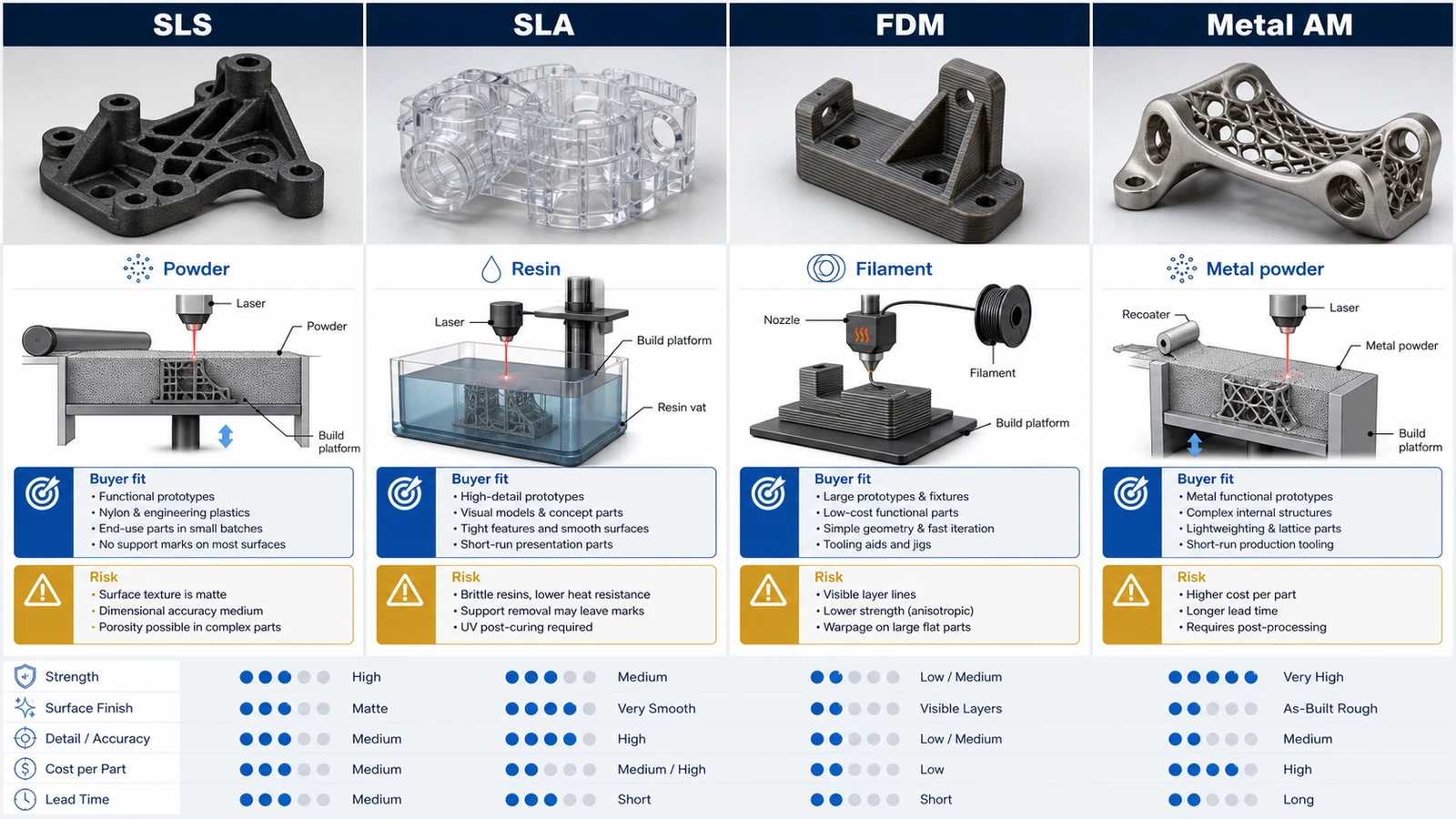
SLS and MJF are often useful for nylon functional prototypes and small batches because they can produce durable parts without support structures in the same way as many resin processes. SLA is often stronger for fine detail and visual appearance, but material behavior must be checked carefully. FDM is practical for larger, simpler fixtures and early functional checks where layer texture is acceptable.
Metal 3D printing should be treated as an engineering option, not a default replacement for machining. It can support complex internal channels or shapes, but surface roughness, heat treatment, machining allowance and inspection cost need early review.
A buyer should not compare processes only by quoted unit price. Build orientation, support removal, finishing, tolerance, post-machining, painting, insert installation and inspection can change the real cost and the reliability of the result.
A good RFQ tells the supplier what the part is supposed to prove, the quantity, the material target, the critical dimensions, the surface expectation and the possible production path after prototype approval.
Key Decision Checklist
- Define prototype purpose before selecting process: visual model, functional test, fixture, enclosure, small-batch part or production bridge.
- Match material to environment: nylon for durable functional checks, resin for detail, PETG or ABS-like FDM for large simple tools, and metal additive only when geometry justifies it.
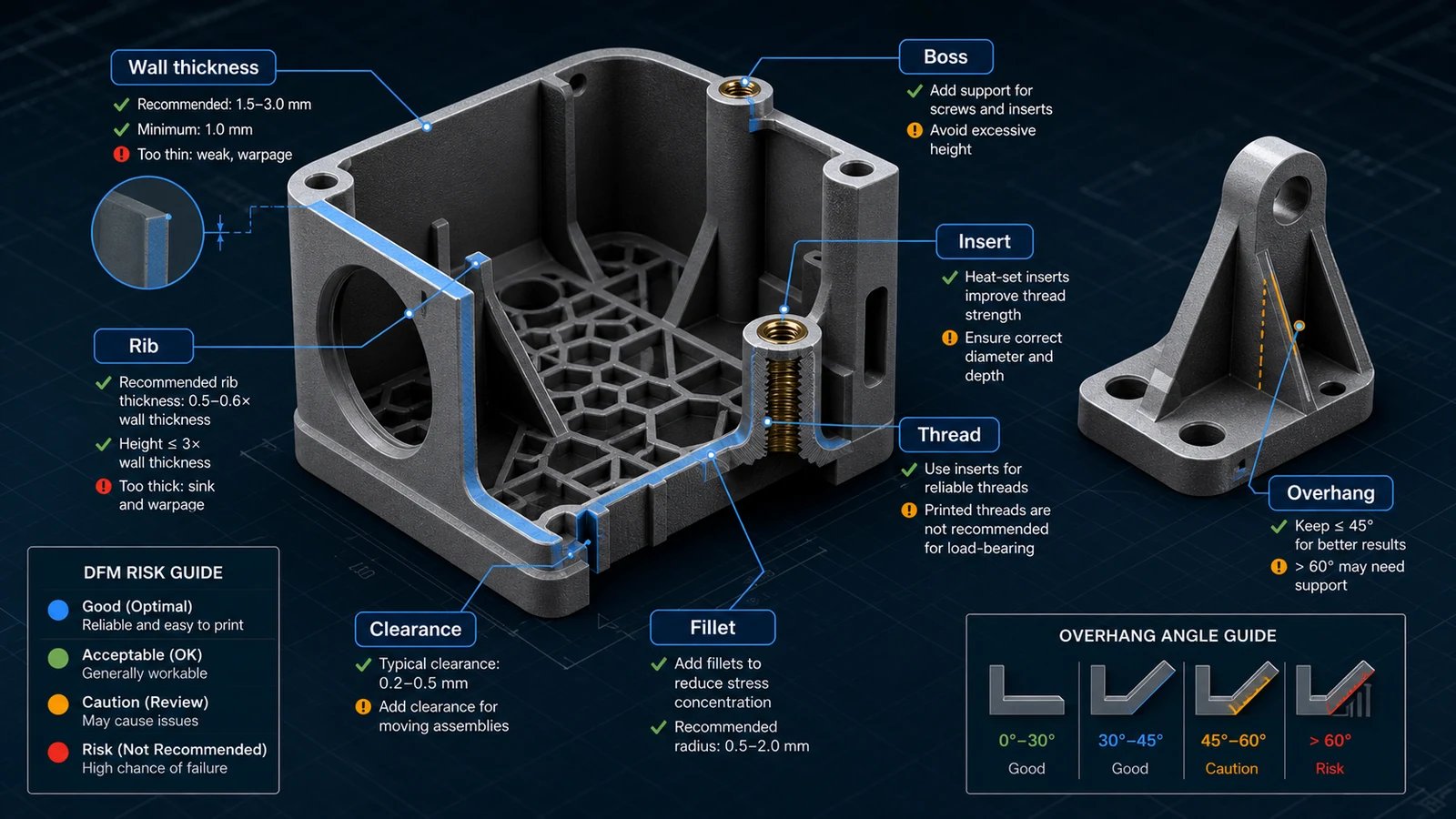
- Review feature design: wall thickness, ribs, holes, bosses, threads, inserts, snap fits and assembly clearances.
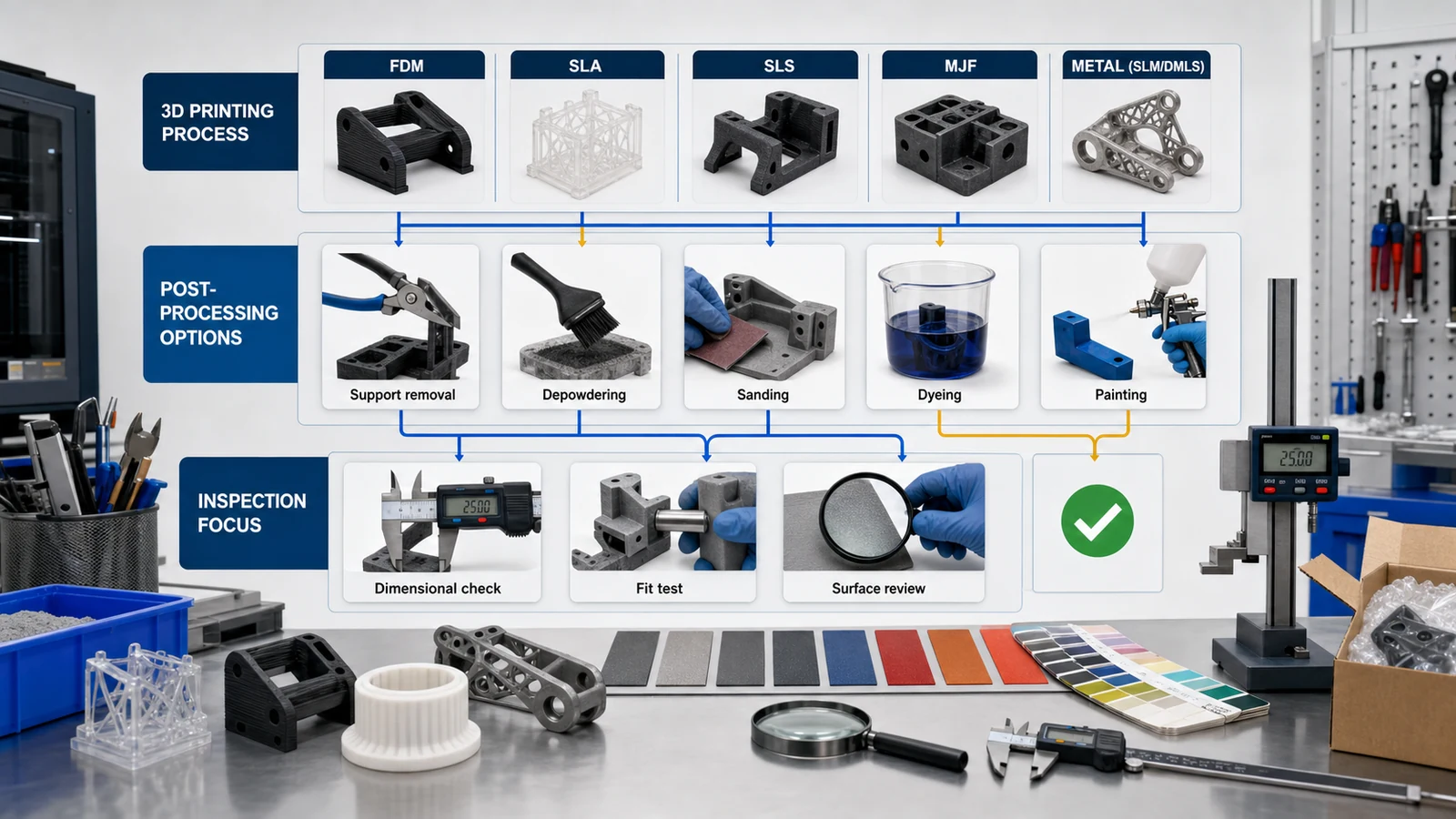
- Confirm surface finish expectations before quoting because sanding, dyeing, painting and coating may become major cost drivers.
- Check when 3D printing is not the right process and whether CNC machining, sheet metal fabrication or injection molding should be evaluated.
- Ask the supplier which assumptions were used for tolerance, finish, inspection, packing and lead time.
| RFQ item | Recommended detail | Why it affects the quote |
|---|---|---|
| Prototype purpose | State the decision the part should support | Process selection changes when the goal is appearance, strength or assembly fit |
| Material environment | Heat, load, moisture, chemical contact and cosmetic expectation | Prevents choosing a material that only looks correct |
| Feature risk | Wall thickness, holes, inserts, ribs, snap fits and threads | Identifies areas that may need redesign or post-machining |
| Quantity path | One prototype, design iterations, low-volume bridge or repeat production | Can change the best process and finishing setup |
| Finish | Raw, smoothed, dyed, painted, coated or machined | Controls surface quality, cost and final dimensions |
| Next process | CNC machining, injection molding, sheet metal or continued printing | Keeps prototype choices aligned with production intent |
Process Selection Changes Strength, Cost and Lead Time
A 3D printing process is not only a machine choice. It controls how the part is built, how heat affects the material, how surfaces are supported, how features shrink or warp, and how much post-processing is required. For buyers, the important question is not which process is most advanced. The better question is which process gives the engineering team useful evidence without adding unnecessary cost.
SLS nylon can be a strong candidate when the part needs durability, complex geometry and functional handling. SLA can be useful when the engineering team needs sharp detail, smooth surfaces, transparent models or visual presentation. FDM can be suitable when the part is large, simple or used as a quick fixture, especially when visible layers are acceptable. MJF, when available and suitable, can support repeatable nylon batches. Metal additive manufacturing should be used only when conventional machining cannot meet the geometry or when the value of design freedom is worth the cost.
The procurement trap is to ask several suppliers for the same CAD file without defining purpose. Each supplier may choose a different process and the buyer receives prices that cannot be compared. A disciplined process selection table in the RFQ can solve this. It shows the expected function, material target, finish and inspection need, so suppliers can explain their chosen route.
| Part purpose | Likely process direction | Main advantage | Main caution |
|---|---|---|---|
| Visual presentation model | SLA resin or finished FDM depending on size | Smooth appearance and fine details | Mechanical behavior may not represent production material |
| Functional nylon prototype | SLS or MJF nylon | Durable, support-free geometry for many features | Surface texture and hole accuracy require review |
| Large fixture or jig | FDM PETG, ABS-like material or CNC depending on load | Economical for large simple geometry | Layer direction and heat exposure must be checked |
| Small-batch end-use parts | SLS, MJF, CNC machining or molding depending on quantity | Avoids tooling at early quantities | Repeatability, finish and inspection must be planned |
| Complex metal prototype | Metal AM plus machining where needed | Can produce shapes difficult to machine | High cost, rough surfaces and post-processing requirements |
Buyer-Side Process Selection Checks
CAD model quality and file preparation
Procurement review for cad model quality and file preparation starts before the supplier calculates price. The buyer should confirm whether the STEP, STL or 3MF file represents the final geometry, has correct units, and separates parts that should not be printed as one body. This is not paperwork for its own sake; it tells the manufacturing team which features carry function, which features are cosmetic, and which assumptions must be clarified before material is ordered or production time is reserved.
The engineering reason is simple: mesh gaps, reversed normals, tiny features and wrong units can change a quote more than the selected printer. When the RFQ leaves this detail open, two suppliers can quote the same model with completely different assumptions. One may quote a fast, low-cost route that cannot meet the application, while another may add unnecessary inspection or finishing cost. A disciplined RFQ makes the quote easier to compare and reduces changes after the purchase order.
The common risk is receiving a quick quote for a geometry that later needs repair, resizing, splitting or support redesign. A small design choice can change build orientation, tooling access, fixture design, inspection method, surface protection, or packing. Buyers should avoid treating every dimension as equally critical. It is better to define the few features that control assembly, sealing, movement, or appearance, then allow standard manufacturing tolerance on non-critical areas.
For a useful supplier review, provide native CAD when possible, an exported mesh, a 2D drawing for critical dimensions, and notes on which features are functional. Debaolong 3D printing process selection support can then review the data for manufacturability, flag cost drivers, and suggest a production route that matches function instead of only matching the CAD geometry. This is especially important when a prototype must later transition into CNC machining, sheet metal fabrication, injection molding, or a repeatable small-batch process.
Build orientation and support strategy
Procurement review for build orientation and support strategy starts before the supplier calculates price. The buyer should confirm which faces are cosmetic, which holes or mating faces require accuracy, and which side can accept support marks. This is not paperwork for its own sake; it tells the manufacturing team which features carry function, which features are cosmetic, and which assumptions must be clarified before material is ordered or production time is reserved.
The engineering reason is simple: orientation changes strength direction, surface texture, support removal time, dimensional accuracy and part cost. When the RFQ leaves this detail open, two suppliers can quote the same model with completely different assumptions. One may quote a fast, low-cost route that cannot meet the application, while another may add unnecessary inspection or finishing cost. A disciplined RFQ makes the quote easier to compare and reduces changes after the purchase order.
The common risk is a part that looks correct in CAD but has visible support scars, weak layers, oval holes or warped thin walls. A small design choice can change build orientation, tooling access, fixture design, inspection method, surface protection, or packing. Buyers should avoid treating every dimension as equally critical. It is better to define the few features that control assembly, sealing, movement, or appearance, then allow standard manufacturing tolerance on non-critical areas.
For a useful supplier review, provide cosmetic side notes, assembly direction, expected load direction and any areas that cannot be sanded or trimmed. Debaolong 3D printing process selection support can then review the data for manufacturability, flag cost drivers, and suggest a production route that matches function instead of only matching the CAD geometry. This is especially important when a prototype must later transition into CNC machining, sheet metal fabrication, injection molding, or a repeatable small-batch process.
Material selection by application environment
Procurement review for material selection by application environment starts before the supplier calculates price. The buyer should confirm whether the part needs impact resistance, heat resistance, flexibility, stiffness, transparency, chemical resistance or threaded inserts. This is not paperwork for its own sake; it tells the manufacturing team which features carry function, which features are cosmetic, and which assumptions must be clarified before material is ordered or production time is reserved.
The engineering reason is simple: 3D printing materials with similar names can behave very differently after post-processing and during use. When the RFQ leaves this detail open, two suppliers can quote the same model with completely different assumptions. One may quote a fast, low-cost route that cannot meet the application, while another may add unnecessary inspection or finishing cost. A disciplined RFQ makes the quote easier to compare and reduces changes after the purchase order.
The common risk is choosing the cheapest or fastest material and then discovering that the part softens, cracks, creeps or fails in assembly. A small design choice can change build orientation, tooling access, fixture design, inspection method, surface protection, or packing. Buyers should avoid treating every dimension as equally critical. It is better to define the few features that control assembly, sealing, movement, or appearance, then allow standard manufacturing tolerance on non-critical areas.
For a useful supplier review, provide application temperature, load type, contact chemicals, cosmetic expectations, flame or insulation requirements if applicable, and prototype purpose. Debaolong 3D printing process selection support can then review the data for manufacturability, flag cost drivers, and suggest a production route that matches function instead of only matching the CAD geometry. This is especially important when a prototype must later transition into CNC machining, sheet metal fabrication, injection molding, or a repeatable small-batch process.
Tolerance expectations and critical dimensions
Procurement review for tolerance expectations and critical dimensions starts before the supplier calculates price. The buyer should confirm which dimensions control fit, which holes need drilling or tapping after printing, and which surfaces need secondary machining. This is not paperwork for its own sake; it tells the manufacturing team which features carry function, which features are cosmetic, and which assumptions must be clarified before material is ordered or production time is reserved.
The engineering reason is simple: printed geometry can shrink, warp or show stair-stepping, so blanket tight tolerances are usually expensive and sometimes unrealistic. When the RFQ leaves this detail open, two suppliers can quote the same model with completely different assumptions. One may quote a fast, low-cost route that cannot meet the application, while another may add unnecessary inspection or finishing cost. A disciplined RFQ makes the quote easier to compare and reduces changes after the purchase order.
The common risk is over-specifying every dimension or under-specifying the few dimensions that actually control assembly. A small design choice can change build orientation, tooling access, fixture design, inspection method, surface protection, or packing. Buyers should avoid treating every dimension as equally critical. It is better to define the few features that control assembly, sealing, movement, or appearance, then allow standard manufacturing tolerance on non-critical areas.
For a useful supplier review, provide a 2D drawing with critical-to-function dimensions, mating part data, thread standards, and inspection priority. Debaolong 3D printing process selection support can then review the data for manufacturability, flag cost drivers, and suggest a production route that matches function instead of only matching the CAD geometry. This is especially important when a prototype must later transition into CNC machining, sheet metal fabrication, injection molding, or a repeatable small-batch process.
Surface finish and cosmetic requirement
Procurement review for surface finish and cosmetic requirement starts before the supplier calculates price. The buyer should confirm whether the buyer expects raw printed texture, bead blasting, sanding, painting, dyeing, coating or transparent polishing. This is not paperwork for its own sake; it tells the manufacturing team which features carry function, which features are cosmetic, and which assumptions must be clarified before material is ordered or production time is reserved.
The engineering reason is simple: surface finishing can change edge sharpness, hole size, color match, lead time and inspection requirements. When the RFQ leaves this detail open, two suppliers can quote the same model with completely different assumptions. One may quote a fast, low-cost route that cannot meet the application, while another may add unnecessary inspection or finishing cost. A disciplined RFQ makes the quote easier to compare and reduces changes after the purchase order.
The common risk is a prototype that is dimensionally acceptable but visually unacceptable, or a painted part that no longer fits because the coating was not considered. A small design choice can change build orientation, tooling access, fixture design, inspection method, surface protection, or packing. Buyers should avoid treating every dimension as equally critical. It is better to define the few features that control assembly, sealing, movement, or appearance, then allow standard manufacturing tolerance on non-critical areas.
For a useful supplier review, provide color target, texture requirement, visible surface definition, masking areas, and acceptable sample reference when available. Debaolong 3D printing process selection support can then review the data for manufacturability, flag cost drivers, and suggest a production route that matches function instead of only matching the CAD geometry. This is especially important when a prototype must later transition into CNC machining, sheet metal fabrication, injection molding, or a repeatable small-batch process.
Strength, heat and functional testing
Procurement review for strength, heat and functional testing starts before the supplier calculates price. The buyer should confirm whether the part is a visual model, ergonomic sample, fixture, snap-fit test, fluid path mockup, thermal test piece or loaded functional part. This is not paperwork for its own sake; it tells the manufacturing team which features carry function, which features are cosmetic, and which assumptions must be clarified before material is ordered or production time is reserved.
The engineering reason is simple: a part printed for appearance does not prove the same risk as a part printed for mechanical validation. When the RFQ leaves this detail open, two suppliers can quote the same model with completely different assumptions. One may quote a fast, low-cost route that cannot meet the application, while another may add unnecessary inspection or finishing cost. A disciplined RFQ makes the quote easier to compare and reduces changes after the purchase order.
The common risk is approving a design based on a visual sample and later finding that the production material, load path or heat exposure behaves differently. A small design choice can change build orientation, tooling access, fixture design, inspection method, surface protection, or packing. Buyers should avoid treating every dimension as equally critical. It is better to define the few features that control assembly, sealing, movement, or appearance, then allow standard manufacturing tolerance on non-critical areas.
For a useful supplier review, provide test method, load direction, temperature range, assembly cycle count, and any pass or fail conditions. Debaolong 3D printing process selection support can then review the data for manufacturability, flag cost drivers, and suggest a production route that matches function instead of only matching the CAD geometry. This is especially important when a prototype must later transition into CNC machining, sheet metal fabrication, injection molding, or a repeatable small-batch process.
Quantity, repeatability and small-batch strategy
Procurement review for quantity, repeatability and small-batch strategy starts before the supplier calculates price. The buyer should confirm whether the RFQ is for one prototype, several design iterations, bridge production or repeat small-batch supply. This is not paperwork for its own sake; it tells the manufacturing team which features carry function, which features are cosmetic, and which assumptions must be clarified before material is ordered or production time is reserved.
The engineering reason is simple: quantity affects nesting, inspection sampling, finishing batch setup and whether another process becomes more economical. When the RFQ leaves this detail open, two suppliers can quote the same model with completely different assumptions. One may quote a fast, low-cost route that cannot meet the application, while another may add unnecessary inspection or finishing cost. A disciplined RFQ makes the quote easier to compare and reduces changes after the purchase order.
The common risk is using a prototype quote as a production benchmark even though the cost drivers change at higher quantity. A small design choice can change build orientation, tooling access, fixture design, inspection method, surface protection, or packing. Buyers should avoid treating every dimension as equally critical. It is better to define the few features that control assembly, sealing, movement, or appearance, then allow standard manufacturing tolerance on non-critical areas.
For a useful supplier review, provide prototype quantity, expected annual demand, delivery batches, revision control method and whether tooling may follow. Debaolong 3D printing process selection support can then review the data for manufacturability, flag cost drivers, and suggest a production route that matches function instead of only matching the CAD geometry. This is especially important when a prototype must later transition into CNC machining, sheet metal fabrication, injection molding, or a repeatable small-batch process.
Transition path to CNC machining or molding
Procurement review for transition path to cnc machining or molding starts before the supplier calculates price. The buyer should confirm whether the printed part is only a development step or may become a production component later. This is not paperwork for its own sake; it tells the manufacturing team which features carry function, which features are cosmetic, and which assumptions must be clarified before material is ordered or production time is reserved.
The engineering reason is simple: features that print easily can be difficult to machine or mold, while features designed for molding may not need to be printed at full detail. When the RFQ leaves this detail open, two suppliers can quote the same model with completely different assumptions. One may quote a fast, low-cost route that cannot meet the application, while another may add unnecessary inspection or finishing cost. A disciplined RFQ makes the quote easier to compare and reduces changes after the purchase order.
The common risk is validating a geometry that cannot transition cleanly to the intended production process. A small design choice can change build orientation, tooling access, fixture design, inspection method, surface protection, or packing. Buyers should avoid treating every dimension as equally critical. It is better to define the few features that control assembly, sealing, movement, or appearance, then allow standard manufacturing tolerance on non-critical areas.
For a useful supplier review, provide intended next process, target production quantity, material expectations and features that can be simplified during prototype review. Debaolong 3D printing process selection support can then review the data for manufacturability, flag cost drivers, and suggest a production route that matches function instead of only matching the CAD geometry. This is especially important when a prototype must later transition into CNC machining, sheet metal fabrication, injection molding, or a repeatable small-batch process.
Packaging and delivery protection
Procurement review for packaging and delivery protection starts before the supplier calculates price. The buyer should confirm whether thin ribs, long slender features, polished surfaces or painted faces need individual packing. This is not paperwork for its own sake; it tells the manufacturing team which features carry function, which features are cosmetic, and which assumptions must be clarified before material is ordered or production time is reserved.
The engineering reason is simple: printed parts can be damaged by vibration, rubbing, moisture or compression during shipment. When the RFQ leaves this detail open, two suppliers can quote the same model with completely different assumptions. One may quote a fast, low-cost route that cannot meet the application, while another may add unnecessary inspection or finishing cost. A disciplined RFQ makes the quote easier to compare and reduces changes after the purchase order.
The common risk is good parts arriving with cracked details, rubbed surfaces or bent thin features. A small design choice can change build orientation, tooling access, fixture design, inspection method, surface protection, or packing. Buyers should avoid treating every dimension as equally critical. It is better to define the few features that control assembly, sealing, movement, or appearance, then allow standard manufacturing tolerance on non-critical areas.
For a useful supplier review, provide fragile areas, cosmetic acceptance criteria, shipping method and whether the parts need labels by revision or assembly location. Debaolong 3D printing process selection support can then review the data for manufacturability, flag cost drivers, and suggest a production route that matches function instead of only matching the CAD geometry. This is especially important when a prototype must later transition into CNC machining, sheet metal fabrication, injection molding, or a repeatable small-batch process.
Cost, Lead Time and Quote Comparison Logic
Process choice affects cost through material usage, build time, machine capacity, support removal, finishing labor and inspection effort. A process that looks more expensive per part may reduce risk if it matches the application. A lower unit price can be poor value if the part must be reprinted because it was too brittle, too rough, too warped or unsuitable for assembly testing.
For functional prototypes, buyers should compare total quote scope. Does the quote include support removal, sanding, dyeing, painting, drilling, tapping, inserts, dimensional checks and packing? If not, the unit price is incomplete. A quote that openly lists assumptions is more useful than a cheap quote that hides them.
Lead time is also process-dependent. Machine build time may be short, but curing, cleaning, finishing, post-machining, inspection and packing can drive the schedule. When a product development team needs a prototype for a design review, the buyer should ask what can ship quickly and what finish or inspection steps need additional time.
| RFQ area | Buyer should confirm | Typical risk | Useful supplier input |
|---|---|---|---|
| CAD model quality and file preparation | whether the STEP, STL or 3MF file represents the final geometry, has correct units, and separates parts that should not be printed as one body | receiving a quick quote for a geometry that later needs repair, resizing, splitting or support redesign | native CAD when possible, an exported mesh, a 2D drawing for critical dimensions, and notes on which features are functional |
| Build orientation and support strategy | which faces are cosmetic, which holes or mating faces require accuracy, and which side can accept support marks | a part that looks correct in CAD but has visible support scars, weak layers, oval holes or warped thin walls | cosmetic side notes, assembly direction, expected load direction and any areas that cannot be sanded or trimmed |
| Material selection by application environment | whether the part needs impact resistance, heat resistance, flexibility, stiffness, transparency, chemical resistance or threaded inserts | choosing the cheapest or fastest material and then discovering that the part softens, cracks, creeps or fails in assembly | application temperature, load type, contact chemicals, cosmetic expectations, flame or insulation requirements if applicable, and prototype purpose |
| Tolerance expectations and critical dimensions | which dimensions control fit, which holes need drilling or tapping after printing, and which surfaces need secondary machining | over-specifying every dimension or under-specifying the few dimensions that actually control assembly | a 2D drawing with critical-to-function dimensions, mating part data, thread standards, and inspection priority |
| Surface finish and cosmetic requirement | whether the buyer expects raw printed texture, bead blasting, sanding, painting, dyeing, coating or transparent polishing | a prototype that is dimensionally acceptable but visually unacceptable, or a painted part that no longer fits because the coating was not considered | color target, texture requirement, visible surface definition, masking areas, and acceptable sample reference when available |
| Strength, heat and functional testing | whether the part is a visual model, ergonomic sample, fixture, snap-fit test, fluid path mockup, thermal test piece or loaded functional part | approving a design based on a visual sample and later finding that the production material, load path or heat exposure behaves differently | test method, load direction, temperature range, assembly cycle count, and any pass or fail conditions |
| Quantity, repeatability and small-batch strategy | whether the RFQ is for one prototype, several design iterations, bridge production or repeat small-batch supply | using a prototype quote as a production benchmark even though the cost drivers change at higher quantity | prototype quantity, expected annual demand, delivery batches, revision control method and whether tooling may follow |
| Transition path to CNC machining or molding | whether the printed part is only a development step or may become a production component later | validating a geometry that cannot transition cleanly to the intended production process | intended next process, target production quantity, material expectations and features that can be simplified during prototype review |
Inspection, Packing and Delivery Expectations
Inspection should confirm the reason the process was selected. For a visual model, surface quality, color and cosmetic faces matter. For a functional nylon part, hole location, inserts, thickness, snap-fit behavior and strength direction may matter. For a fixture, flatness, datum faces and repeatable location features may be more important than cosmetic texture.
A useful process selection RFQ includes acceptance criteria. If the part is for ergonomic review, the criteria may be appearance and hand feel. If it is for assembly validation, the criteria may be bolt fit, clearance, thread engagement and mating surface location. If it is for a load test, the criteria should include load direction and test conditions.
| Inspection or review point | Why it matters | What to provide |
|---|---|---|
| Visual prototype review | Confirms cosmetic intent and surface expectations | Visible face definition, color, texture and sample references |
| Functional fit check | Confirms assembly before tooling or machining investment | Mating part data, critical holes and tolerance notes |
| Fixture validation | Controls repeatability and location accuracy | Datum surfaces, flatness need and load direction |
| Low-volume supply | Requires repeatable production and packing method | Batch size, inspection sampling and revision control |
| Process transition review | Prevents printed geometry from becoming a production trap | Expected CNC or molding route and target volume |
Practical Procurement Scenarios
Scenario 1: Early Design Validation
In early design validation, the procurement engineer should use cad model quality and file preparation as a decision point rather than a checklist item. The practical question is whether the supplier has enough information to judge whether the STEP, STL or 3MF file represents the final geometry, has correct units, and separates parts that should not be printed as one body. When this is unclear, the quote may look complete, but the manufacturing route can still contain hidden assumptions about tolerance, fixture access, finishing, inspection or later production conversion.
The buyer can reduce risk by asking the supplier to explain the manufacturing consequence of the requirement. For this area, the reason is that mesh gaps, reversed normals, tiny features and wrong units can change a quote more than the selected printer. If the supplier identifies receiving a quick quote for a geometry that later needs repair, resizing, splitting or support redesign, the buyer should not treat it as a sales objection. It is a signal that the RFQ needs clearer engineering boundaries before cost and lead time are reliable.
A strong RFQ response should convert the concern into an action: confirm the drawing note, adjust a non-critical feature, separate cosmetic and functional surfaces, define the inspection method, or approve a manufacturable alternative. The most useful buyer input is native CAD when possible, an exported mesh, a 2D drawing for critical dimensions, and notes on which features are functional. This keeps the conversation focused on fit, function, repeatability and delivery, not only on unit price.
Scenario 2: Buyer-Side Quote Comparison
In buyer-side quote comparison, the procurement engineer should use build orientation and support strategy as a decision point rather than a checklist item. The practical question is whether the supplier has enough information to judge which faces are cosmetic, which holes or mating faces require accuracy, and which side can accept support marks. When this is unclear, the quote may look complete, but the manufacturing route can still contain hidden assumptions about tolerance, fixture access, finishing, inspection or later production conversion.
The buyer can reduce risk by asking the supplier to explain the manufacturing consequence of the requirement. For this area, the reason is that orientation changes strength direction, surface texture, support removal time, dimensional accuracy and part cost. If the supplier identifies a part that looks correct in CAD but has visible support scars, weak layers, oval holes or warped thin walls, the buyer should not treat it as a sales objection. It is a signal that the RFQ needs clearer engineering boundaries before cost and lead time are reliable.
A strong RFQ response should convert the concern into an action: confirm the drawing note, adjust a non-critical feature, separate cosmetic and functional surfaces, define the inspection method, or approve a manufacturable alternative. The most useful buyer input is cosmetic side notes, assembly direction, expected load direction and any areas that cannot be sanded or trimmed. This keeps the conversation focused on fit, function, repeatability and delivery, not only on unit price.
Scenario 3: Small-Batch Launch Support
In small-batch launch support, the procurement engineer should use material selection by application environment as a decision point rather than a checklist item. The practical question is whether the supplier has enough information to judge whether the part needs impact resistance, heat resistance, flexibility, stiffness, transparency, chemical resistance or threaded inserts. When this is unclear, the quote may look complete, but the manufacturing route can still contain hidden assumptions about tolerance, fixture access, finishing, inspection or later production conversion.
The buyer can reduce risk by asking the supplier to explain the manufacturing consequence of the requirement. For this area, the reason is that 3D printing materials with similar names can behave very differently after post-processing and during use. If the supplier identifies choosing the cheapest or fastest material and then discovering that the part softens, cracks, creeps or fails in assembly, the buyer should not treat it as a sales objection. It is a signal that the RFQ needs clearer engineering boundaries before cost and lead time are reliable.
A strong RFQ response should convert the concern into an action: confirm the drawing note, adjust a non-critical feature, separate cosmetic and functional surfaces, define the inspection method, or approve a manufacturable alternative. The most useful buyer input is application temperature, load type, contact chemicals, cosmetic expectations, flame or insulation requirements if applicable, and prototype purpose. This keeps the conversation focused on fit, function, repeatability and delivery, not only on unit price.
Scenario 4: Production Transition Review
In production transition review, the procurement engineer should use tolerance expectations and critical dimensions as a decision point rather than a checklist item. The practical question is whether the supplier has enough information to judge which dimensions control fit, which holes need drilling or tapping after printing, and which surfaces need secondary machining. When this is unclear, the quote may look complete, but the manufacturing route can still contain hidden assumptions about tolerance, fixture access, finishing, inspection or later production conversion.
The buyer can reduce risk by asking the supplier to explain the manufacturing consequence of the requirement. For this area, the reason is that printed geometry can shrink, warp or show stair-stepping, so blanket tight tolerances are usually expensive and sometimes unrealistic. If the supplier identifies over-specifying every dimension or under-specifying the few dimensions that actually control assembly, the buyer should not treat it as a sales objection. It is a signal that the RFQ needs clearer engineering boundaries before cost and lead time are reliable.
A strong RFQ response should convert the concern into an action: confirm the drawing note, adjust a non-critical feature, separate cosmetic and functional surfaces, define the inspection method, or approve a manufacturable alternative. The most useful buyer input is a 2D drawing with critical-to-function dimensions, mating part data, thread standards, and inspection priority. This keeps the conversation focused on fit, function, repeatability and delivery, not only on unit price.
Scenario 5: Incoming Inspection Planning
In incoming inspection planning, the procurement engineer should use surface finish and cosmetic requirement as a decision point rather than a checklist item. The practical question is whether the supplier has enough information to judge whether the buyer expects raw printed texture, bead blasting, sanding, painting, dyeing, coating or transparent polishing. When this is unclear, the quote may look complete, but the manufacturing route can still contain hidden assumptions about tolerance, fixture access, finishing, inspection or later production conversion.
The buyer can reduce risk by asking the supplier to explain the manufacturing consequence of the requirement. For this area, the reason is that surface finishing can change edge sharpness, hole size, color match, lead time and inspection requirements. If the supplier identifies a prototype that is dimensionally acceptable but visually unacceptable, or a painted part that no longer fits because the coating was not considered, the buyer should not treat it as a sales objection. It is a signal that the RFQ needs clearer engineering boundaries before cost and lead time are reliable.
A strong RFQ response should convert the concern into an action: confirm the drawing note, adjust a non-critical feature, separate cosmetic and functional surfaces, define the inspection method, or approve a manufacturable alternative. The most useful buyer input is color target, texture requirement, visible surface definition, masking areas, and acceptable sample reference when available. This keeps the conversation focused on fit, function, repeatability and delivery, not only on unit price.
Common RFQ Mistakes That Create Rework
Selecting the process before defining the prototype purpose
A process cannot be chosen intelligently until the buyer knows whether the part must look right, fit right, hold load, survive heat or support a temporary production need.
Assuming a smooth prototype is a functional prototype
Smooth resin surfaces can be valuable, but they do not automatically prove impact resistance, snap-fit life or heat stability. The process must match the test.
Ignoring wall thickness and feature rules
Thin ribs, deep holes, unsupported overhangs and long flat walls can fail differently in each process. Early design review is cheaper than reprinting.
Forgetting the next manufacturing process
A feature that prints easily may be hard to machine or mold. If production will move to CNC machining or injection molding, prototype design should consider that transition.
Comparing quotes with different finishing assumptions
Raw, dyed, sanded and painted parts are not equivalent. Buyers should ask suppliers to state finish assumptions clearly.
How to Communicate With a Manufacturing Supplier
A procurement engineer can improve supplier communication by asking for a process recommendation with reasons. The response should mention material suitability, tolerance risk, surface finish, post-processing and cost drivers. A supplier that explains trade-offs gives the engineering team better information than a supplier that only returns a number.
When the project is uncertain, ask for options. One option may be fast and economical for a first fit check. Another may be more expensive but better for functional testing. A third may prepare the design for CNC machining or injection molding. Presenting options helps engineering and procurement make a joint decision.
The RFQ should also ask what the supplier needs before production release. Missing data might include exact material grade, color target, thread standard, insert type, tolerance priority, packing method or inspection report format. Clarifying these questions early protects both schedule and technical confidence.
Debaolong Engineering Note
Debaolong can help buyers compare 3D printing processes against part function, quantity, tolerance needs and future production route. For product development teams, this review can prevent a prototype from answering the wrong engineering question or becoming difficult to convert into CNC machined, molded or fabricated production parts.
FAQ
Which 3D printing process is best for functional prototypes?
There is no universal best process. SLS or MJF nylon is often suitable for durable functional parts, FDM can work for larger simple fixtures, and SLA is useful for detail and cosmetic review. The application decides.
When should I choose SLA instead of SLS?
Choose SLA when fine detail, smooth surface, transparent appearance or visual presentation matters more than nylon toughness. Choose SLS when functional handling and stronger nylon behavior are more important.
Is FDM suitable for production parts?
FDM can support fixtures, jigs and some low-volume parts, but layer direction, surface texture, heat exposure and repeatability must be accepted. Higher-volume or cosmetic parts may need another process.
When is metal 3D printing worth considering?
Metal additive manufacturing is worth reviewing when the geometry cannot be made efficiently by machining or when internal channels and lightweight structures justify higher cost and post-processing.
How do I compare quotes from different 3D printing suppliers?
Compare process, material, finish, tolerance assumptions, inspection scope, packing and lead time. Do not compare unit price alone if the quoted scope differs.
Can Debaolong advise when 3D printing should transition to CNC or molding?
Yes. Debaolong can review prototype geometry, expected quantity and functional requirements, then suggest whether continued printing, CNC machining or injection molding is more appropriate.
Request a Manufacturing Quote
Send drawings, CAD files, material requirements, quantity, surface finish, tolerance notes, inspection requirements and application context. Shenzhen Debaolong Seiko Co., Ltd. can review manufacturability and support prototypes, small batches and production-ready custom manufacturing for overseas engineering and procurement teams.