

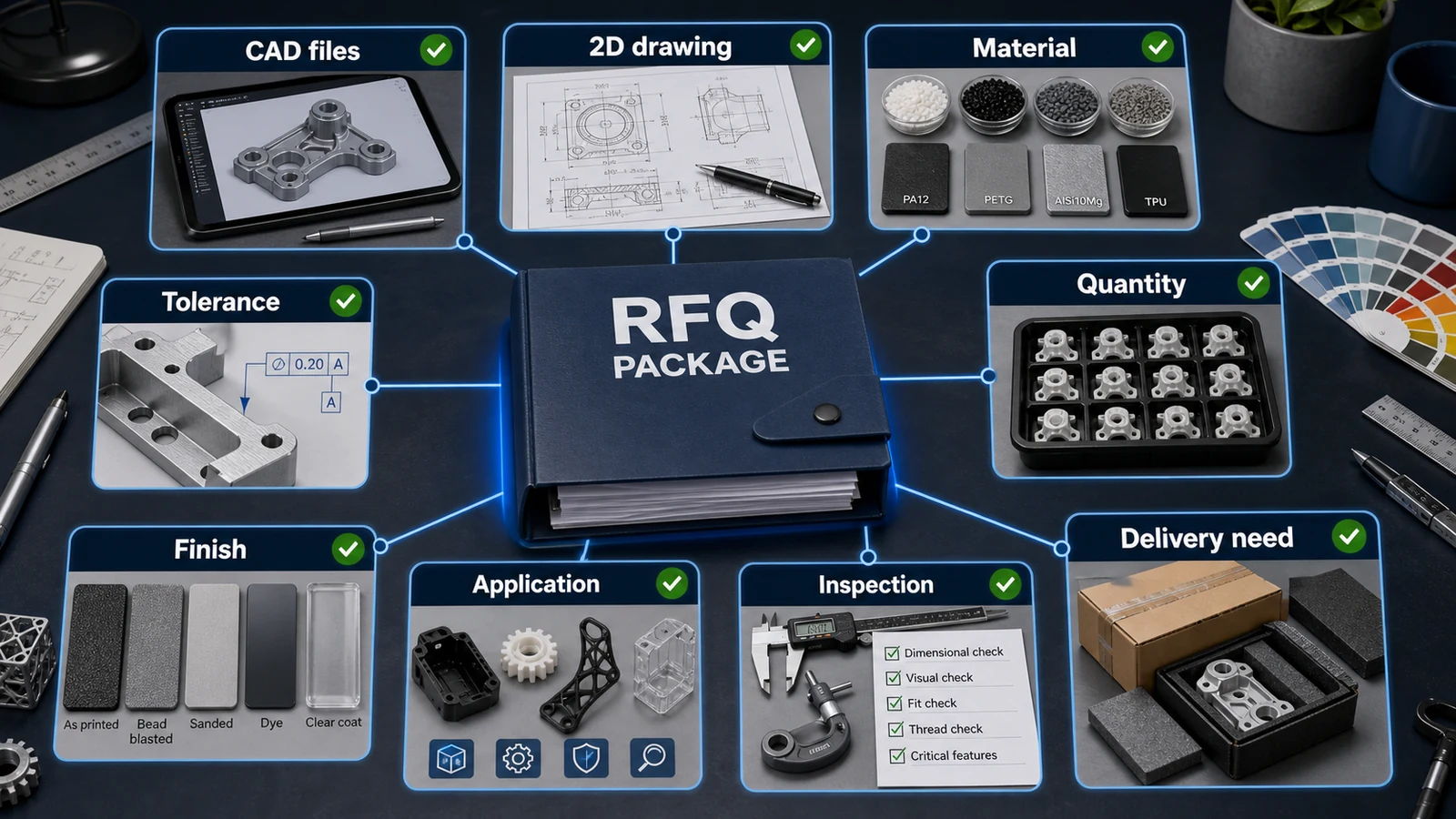
Procurement engineers should check more than price and lead time before ordering 3D printed parts. A reliable RFQ needs the CAD file condition, intended use, printing process, material, tolerance, surface finish, post-processing, inspection method, quantity and delivery expectation. Without those details, the supplier must guess whether the part is a visual model, a functional prototype, a fixture, a bridge-production component or a design validation sample. This guide explains the buyer-side checks that reduce quotation errors, prevent wrong material choices and help Shenzhen Debaolong Seiko Co., Ltd. review custom 3D printed parts before manufacturing.
Useful related resources include custom 3D printing services, precision CNC machining, injection molding support, manufacturing material options, and manufacturing engineering knowledge center.
Executive Summary for Procurement Engineers
A 3D printing quote is most useful when the supplier understands the part function. The same geometry can be printed as a fast visual model, a stronger nylon functional part, a transparent resin sample, a large FDM fixture, or a metal additive prototype. Each option changes price, lead time, tolerance, surface texture and test value.
Buyers should send both 3D data and clear engineering notes. A mesh file may be enough for a basic model, but an accurate RFQ for functional parts usually needs a 2D drawing that marks critical dimensions, thread standards, mating surfaces, cosmetic sides, inspection points and post-processing requirements.
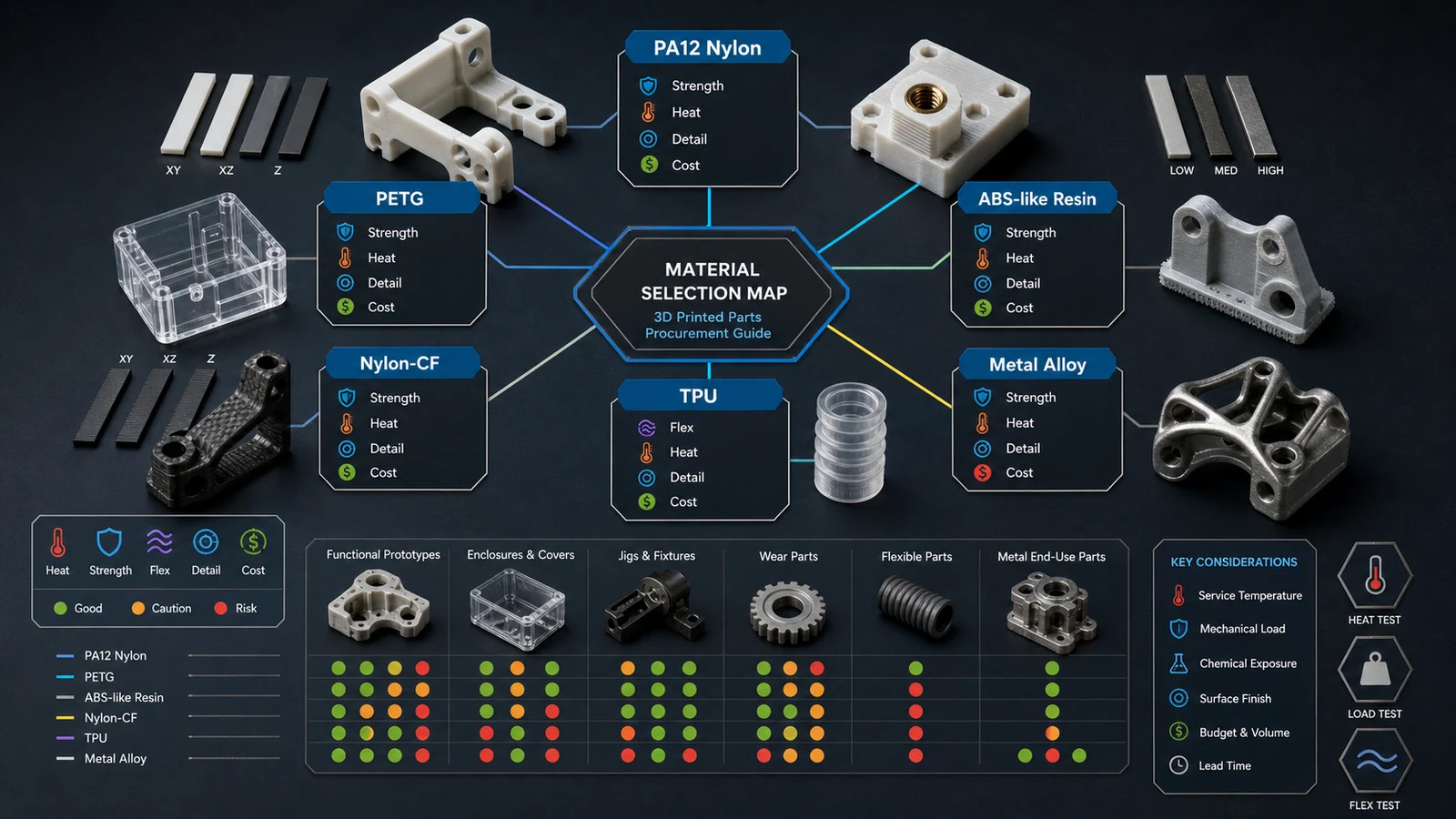
Material choice should be driven by application environment rather than a familiar material name. Nylon, resin, PETG, ABS-like photopolymer, carbon-filled materials and metal printed materials all have different limits in heat, stiffness, impact, moisture, surface finish and dimensional stability.
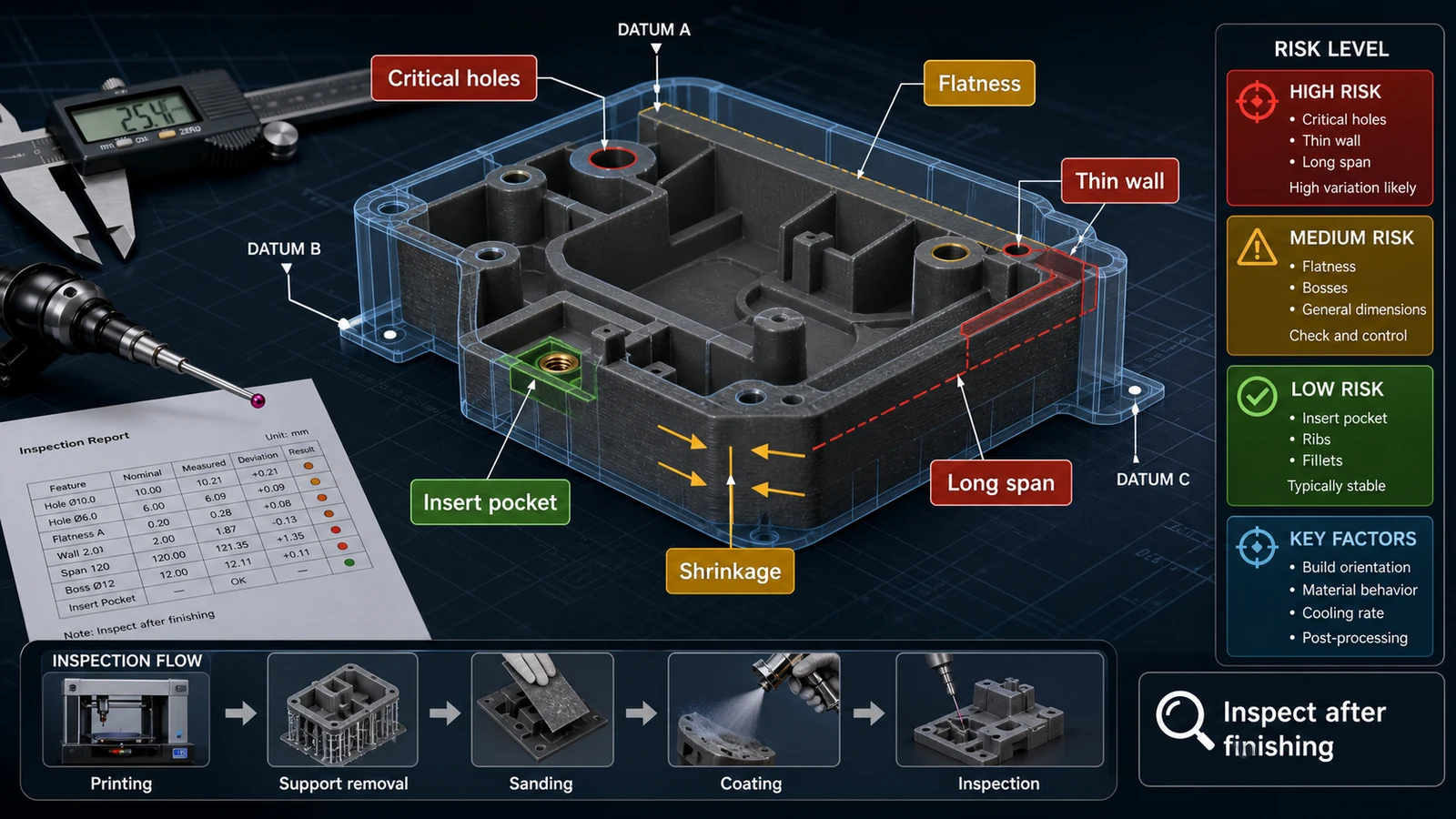
Tolerance must be selective. Asking for tight tolerance everywhere can increase cost without improving function, while leaving holes, bosses, snap fits or mating surfaces undefined can create assembly failure. The best RFQ tells the supplier which features matter and which areas can follow normal process capability.
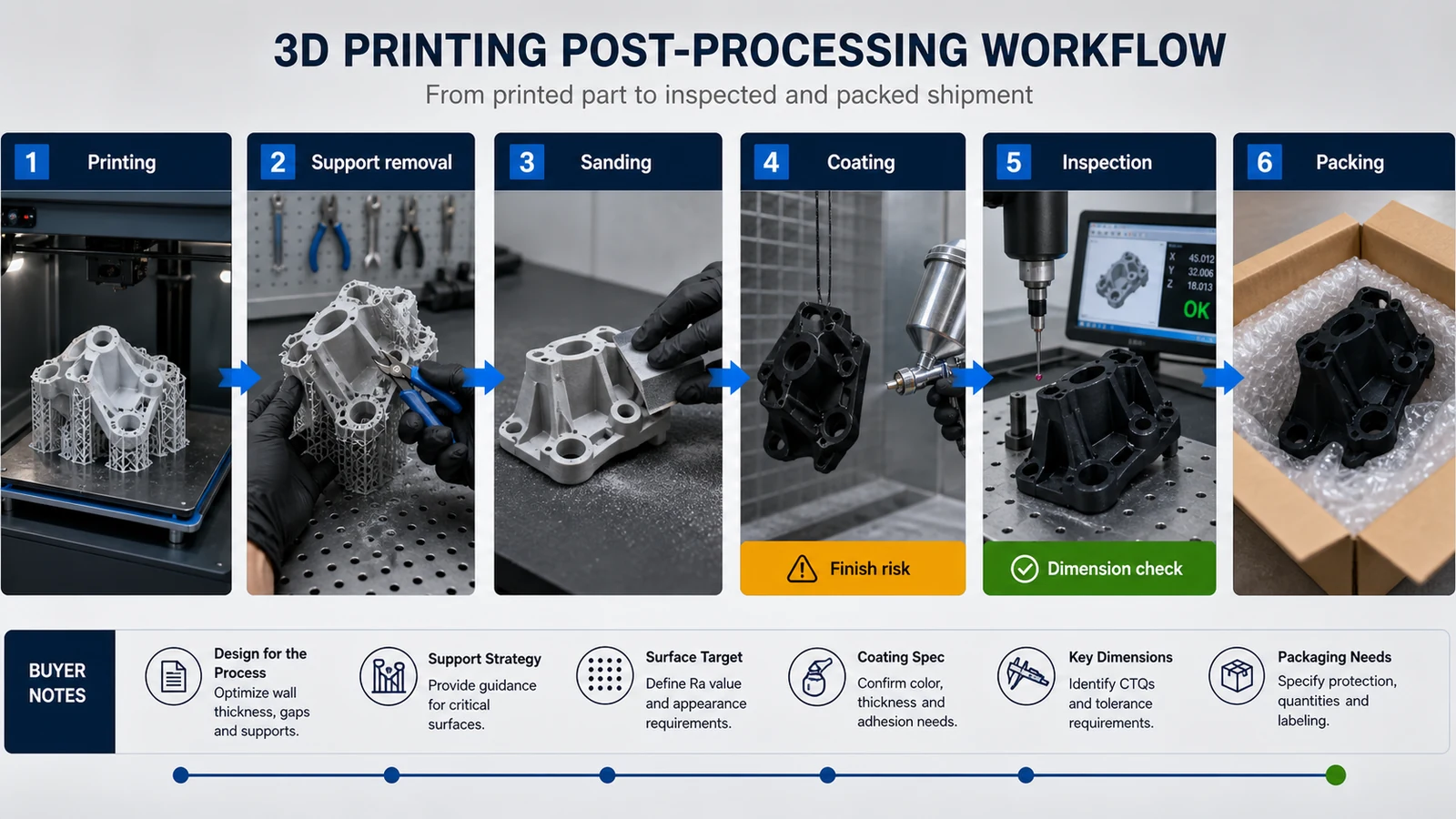
A good supplier review should mention risks before production starts: build orientation, support removal, shrinkage, warpage, thin walls, surface finishing, tapped holes, inserts, packing and revision control. This is where procurement work becomes engineering risk control rather than only price comparison.
Key Decision Checklist
- Confirm the part purpose: visual model, fit check, fixture, functional test, thermal check, fluid path validation, or low-volume end-use part.
- Send usable CAD data with correct units, version control, part separation and a 2D drawing for critical dimensions.
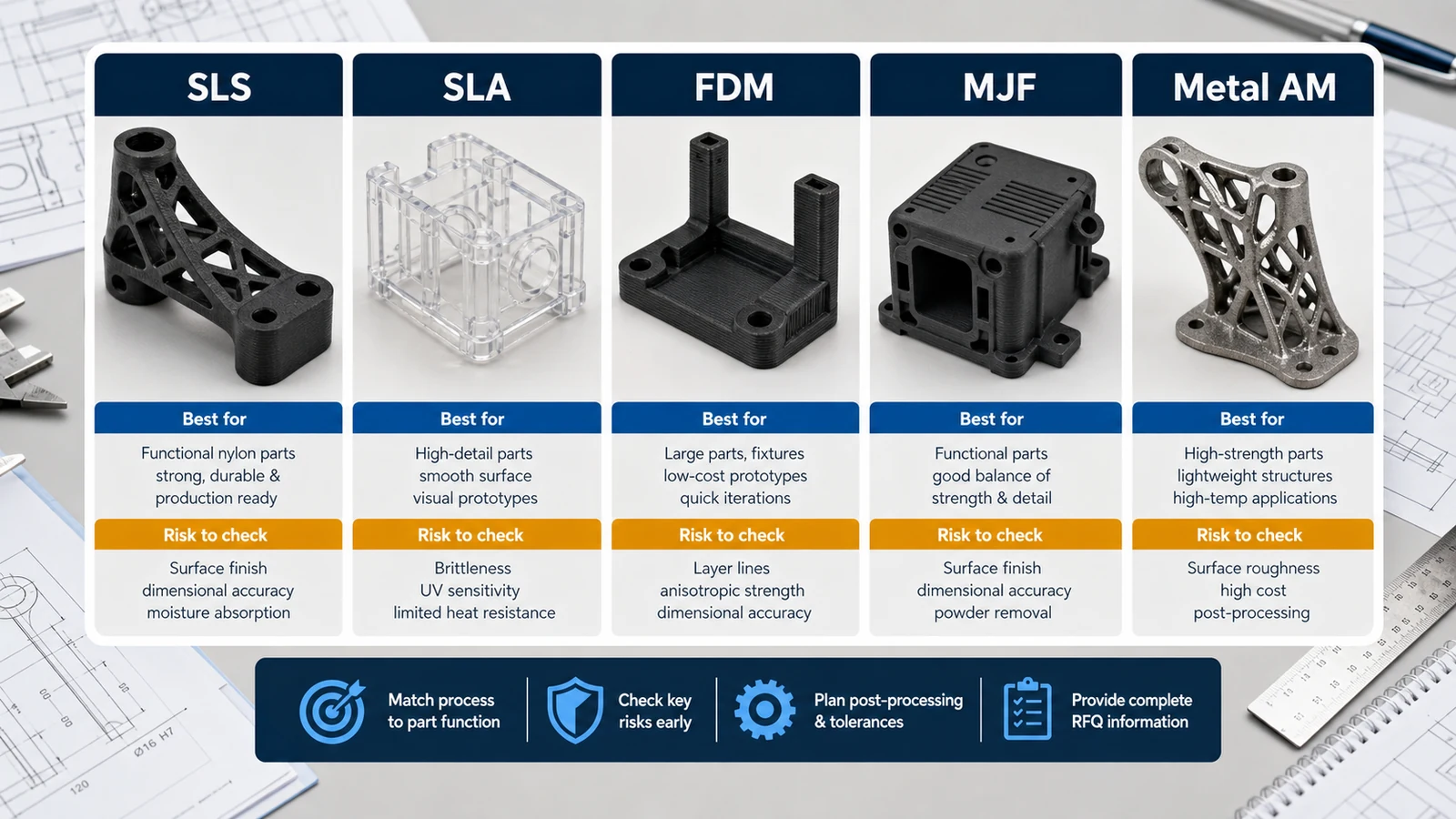
- Choose the printing process by function: SLS or MJF for nylon functional parts, SLA for fine detail, FDM for larger simple parts, and metal printing only where the application justifies cost.
- Define material requirements with temperature, stiffness, chemical exposure, color, transparency, flame or electrical notes if relevant.
- Mark tolerance-critical areas, thread standards, insert positions, cosmetic faces and surfaces that need sanding, painting or machining.
- Include quantity, delivery batches, inspection needs, packaging expectations and whether the prototype may later move to CNC machining or injection molding.
| RFQ item | Recommended detail | Why it affects the quote |
|---|---|---|
| 3D file | STEP plus STL or 3MF when available | Helps check geometry, units and manufacturability before quoting |
| 2D drawing | Critical dimensions, threads, tolerance notes and inspection points | Prevents over-quoting and protects assembly-critical features |
| Application | Prototype purpose, load, temperature, exposure and cosmetic expectations | Guides process and material choice |
| Quantity | Prototype quantity, repeat orders and possible annual demand | Affects nesting, finishing setup, inspection and process transition |
| Finish | Raw, sanded, dyed, painted, coated or machined surfaces | Changes cost, lead time and final fit |
| Testing | Fit check, load test, heat test, surface inspection or dimensional report | Clarifies what the supplier must verify before shipment |
Why 3D Printing Procurement Is Not Only About Fast Lead Time
Fast delivery is useful, but speed should not hide the engineering decision behind a 3D printed part. A procurement engineer may receive a request that says, print this part quickly. The buyer still needs to know whether the engineer wants to check shape, assembly fit, handling, screw engagement, airflow, liquid path, fixture location, or short-term field use. Those purposes point to different processes and materials.
For example, an SLA resin part can show fine surface detail and support a visual review, but it may not prove the same snap-fit behavior as a nylon part. An FDM PETG fixture can be economical for a large simple tool, but the visible layer direction may matter under load. SLS or MJF nylon can be more suitable for functional prototypes, but surface texture and hole accuracy still require review. Metal 3D printing can solve complex geometry, yet it should not be selected only because the final part is metal.
Procurement teams also need to protect quote comparability. If Supplier A quotes raw SLS nylon and Supplier B quotes painted SLA resin, the lower price may not represent a better offer. The buyer should define the function first, then compare process, material, finish, tolerance and inspection on the same basis. This is the difference between collecting prices and managing manufacturing risk.
| Process | Best fit | Typical buyer caution | RFQ detail to provide |
|---|---|---|---|
| SLS nylon | Functional nylon prototypes, clips, housings, fixtures and small batches | Surface is slightly grainy and small holes may need post-processing | Load direction, critical holes, finish need and quantity |
| SLA resin | Fine detail, visual models, transparent samples and cosmetic review | Some resins are brittle or less suitable for long-term heat and load | Cosmetic surface, transparency, color and handling requirement |
| FDM PETG or ABS-like materials | Large simple prototypes, fixtures, jigs and low-cost functional checks | Layer direction and visible toolpath affect strength and appearance | Build orientation preference, load path and surface expectation |
| MJF nylon | Repeatable nylon parts and bridge quantities where available | Material and finish choices should be confirmed early | Batch quantity, finish, dimensional priorities and packing method |
| Metal additive manufacturing | Complex metal geometry that is difficult to machine conventionally | Cost, surface roughness, heat treatment and machining allowance can be significant | Material standard, machining stock, heat treatment and inspection plan |
Engineering Checks Before Sending a 3D Printing RFQ
CAD model quality and file preparation
Procurement review for cad model quality and file preparation starts before the supplier calculates price. The buyer should confirm whether the STEP, STL or 3MF file represents the final geometry, has correct units, and separates parts that should not be printed as one body. This is not paperwork for its own sake; it tells the manufacturing team which features carry function, which features are cosmetic, and which assumptions must be clarified before material is ordered or production time is reserved.
The engineering reason is simple: mesh gaps, reversed normals, tiny features and wrong units can change a quote more than the selected printer. When the RFQ leaves this detail open, two suppliers can quote the same model with completely different assumptions. One may quote a fast, low-cost route that cannot meet the application, while another may add unnecessary inspection or finishing cost. A disciplined RFQ makes the quote easier to compare and reduces changes after the purchase order.
The common risk is receiving a quick quote for a geometry that later needs repair, resizing, splitting or support redesign. A small design choice can change build orientation, tooling access, fixture design, inspection method, surface protection, or packing. Buyers should avoid treating every dimension as equally critical. It is better to define the few features that control assembly, sealing, movement, or appearance, then allow standard manufacturing tolerance on non-critical areas.
For a useful supplier review, provide native CAD when possible, an exported mesh, a 2D drawing for critical dimensions, and notes on which features are functional. Debaolong custom 3D printing support can then review the data for manufacturability, flag cost drivers, and suggest a production route that matches function instead of only matching the CAD geometry. This is especially important when a prototype must later transition into CNC machining, sheet metal fabrication, injection molding, or a repeatable small-batch process.
Build orientation and support strategy
Procurement review for build orientation and support strategy starts before the supplier calculates price. The buyer should confirm which faces are cosmetic, which holes or mating faces require accuracy, and which side can accept support marks. This is not paperwork for its own sake; it tells the manufacturing team which features carry function, which features are cosmetic, and which assumptions must be clarified before material is ordered or production time is reserved.
The engineering reason is simple: orientation changes strength direction, surface texture, support removal time, dimensional accuracy and part cost. When the RFQ leaves this detail open, two suppliers can quote the same model with completely different assumptions. One may quote a fast, low-cost route that cannot meet the application, while another may add unnecessary inspection or finishing cost. A disciplined RFQ makes the quote easier to compare and reduces changes after the purchase order.
The common risk is a part that looks correct in CAD but has visible support scars, weak layers, oval holes or warped thin walls. A small design choice can change build orientation, tooling access, fixture design, inspection method, surface protection, or packing. Buyers should avoid treating every dimension as equally critical. It is better to define the few features that control assembly, sealing, movement, or appearance, then allow standard manufacturing tolerance on non-critical areas.
For a useful supplier review, provide cosmetic side notes, assembly direction, expected load direction and any areas that cannot be sanded or trimmed. Debaolong custom 3D printing support can then review the data for manufacturability, flag cost drivers, and suggest a production route that matches function instead of only matching the CAD geometry. This is especially important when a prototype must later transition into CNC machining, sheet metal fabrication, injection molding, or a repeatable small-batch process.
Material selection by application environment
Procurement review for material selection by application environment starts before the supplier calculates price. The buyer should confirm whether the part needs impact resistance, heat resistance, flexibility, stiffness, transparency, chemical resistance or threaded inserts. This is not paperwork for its own sake; it tells the manufacturing team which features carry function, which features are cosmetic, and which assumptions must be clarified before material is ordered or production time is reserved.
The engineering reason is simple: 3D printing materials with similar names can behave very differently after post-processing and during use. When the RFQ leaves this detail open, two suppliers can quote the same model with completely different assumptions. One may quote a fast, low-cost route that cannot meet the application, while another may add unnecessary inspection or finishing cost. A disciplined RFQ makes the quote easier to compare and reduces changes after the purchase order.
The common risk is choosing the cheapest or fastest material and then discovering that the part softens, cracks, creeps or fails in assembly. A small design choice can change build orientation, tooling access, fixture design, inspection method, surface protection, or packing. Buyers should avoid treating every dimension as equally critical. It is better to define the few features that control assembly, sealing, movement, or appearance, then allow standard manufacturing tolerance on non-critical areas.
For a useful supplier review, provide application temperature, load type, contact chemicals, cosmetic expectations, flame or insulation requirements if applicable, and prototype purpose. Debaolong custom 3D printing support can then review the data for manufacturability, flag cost drivers, and suggest a production route that matches function instead of only matching the CAD geometry. This is especially important when a prototype must later transition into CNC machining, sheet metal fabrication, injection molding, or a repeatable small-batch process.
Tolerance expectations and critical dimensions
Procurement review for tolerance expectations and critical dimensions starts before the supplier calculates price. The buyer should confirm which dimensions control fit, which holes need drilling or tapping after printing, and which surfaces need secondary machining. This is not paperwork for its own sake; it tells the manufacturing team which features carry function, which features are cosmetic, and which assumptions must be clarified before material is ordered or production time is reserved.
The engineering reason is simple: printed geometry can shrink, warp or show stair-stepping, so blanket tight tolerances are usually expensive and sometimes unrealistic. When the RFQ leaves this detail open, two suppliers can quote the same model with completely different assumptions. One may quote a fast, low-cost route that cannot meet the application, while another may add unnecessary inspection or finishing cost. A disciplined RFQ makes the quote easier to compare and reduces changes after the purchase order.
The common risk is over-specifying every dimension or under-specifying the few dimensions that actually control assembly. A small design choice can change build orientation, tooling access, fixture design, inspection method, surface protection, or packing. Buyers should avoid treating every dimension as equally critical. It is better to define the few features that control assembly, sealing, movement, or appearance, then allow standard manufacturing tolerance on non-critical areas.
For a useful supplier review, provide a 2D drawing with critical-to-function dimensions, mating part data, thread standards, and inspection priority. Debaolong custom 3D printing support can then review the data for manufacturability, flag cost drivers, and suggest a production route that matches function instead of only matching the CAD geometry. This is especially important when a prototype must later transition into CNC machining, sheet metal fabrication, injection molding, or a repeatable small-batch process.
Surface finish and cosmetic requirement
Procurement review for surface finish and cosmetic requirement starts before the supplier calculates price. The buyer should confirm whether the buyer expects raw printed texture, bead blasting, sanding, painting, dyeing, coating or transparent polishing. This is not paperwork for its own sake; it tells the manufacturing team which features carry function, which features are cosmetic, and which assumptions must be clarified before material is ordered or production time is reserved.
The engineering reason is simple: surface finishing can change edge sharpness, hole size, color match, lead time and inspection requirements. When the RFQ leaves this detail open, two suppliers can quote the same model with completely different assumptions. One may quote a fast, low-cost route that cannot meet the application, while another may add unnecessary inspection or finishing cost. A disciplined RFQ makes the quote easier to compare and reduces changes after the purchase order.
The common risk is a prototype that is dimensionally acceptable but visually unacceptable, or a painted part that no longer fits because the coating was not considered. A small design choice can change build orientation, tooling access, fixture design, inspection method, surface protection, or packing. Buyers should avoid treating every dimension as equally critical. It is better to define the few features that control assembly, sealing, movement, or appearance, then allow standard manufacturing tolerance on non-critical areas.
For a useful supplier review, provide color target, texture requirement, visible surface definition, masking areas, and acceptable sample reference when available. Debaolong custom 3D printing support can then review the data for manufacturability, flag cost drivers, and suggest a production route that matches function instead of only matching the CAD geometry. This is especially important when a prototype must later transition into CNC machining, sheet metal fabrication, injection molding, or a repeatable small-batch process.
Strength, heat and functional testing
Procurement review for strength, heat and functional testing starts before the supplier calculates price. The buyer should confirm whether the part is a visual model, ergonomic sample, fixture, snap-fit test, fluid path mockup, thermal test piece or loaded functional part. This is not paperwork for its own sake; it tells the manufacturing team which features carry function, which features are cosmetic, and which assumptions must be clarified before material is ordered or production time is reserved.
The engineering reason is simple: a part printed for appearance does not prove the same risk as a part printed for mechanical validation. When the RFQ leaves this detail open, two suppliers can quote the same model with completely different assumptions. One may quote a fast, low-cost route that cannot meet the application, while another may add unnecessary inspection or finishing cost. A disciplined RFQ makes the quote easier to compare and reduces changes after the purchase order.
The common risk is approving a design based on a visual sample and later finding that the production material, load path or heat exposure behaves differently. A small design choice can change build orientation, tooling access, fixture design, inspection method, surface protection, or packing. Buyers should avoid treating every dimension as equally critical. It is better to define the few features that control assembly, sealing, movement, or appearance, then allow standard manufacturing tolerance on non-critical areas.
For a useful supplier review, provide test method, load direction, temperature range, assembly cycle count, and any pass or fail conditions. Debaolong custom 3D printing support can then review the data for manufacturability, flag cost drivers, and suggest a production route that matches function instead of only matching the CAD geometry. This is especially important when a prototype must later transition into CNC machining, sheet metal fabrication, injection molding, or a repeatable small-batch process.
Quantity, repeatability and small-batch strategy
Procurement review for quantity, repeatability and small-batch strategy starts before the supplier calculates price. The buyer should confirm whether the RFQ is for one prototype, several design iterations, bridge production or repeat small-batch supply. This is not paperwork for its own sake; it tells the manufacturing team which features carry function, which features are cosmetic, and which assumptions must be clarified before material is ordered or production time is reserved.
The engineering reason is simple: quantity affects nesting, inspection sampling, finishing batch setup and whether another process becomes more economical. When the RFQ leaves this detail open, two suppliers can quote the same model with completely different assumptions. One may quote a fast, low-cost route that cannot meet the application, while another may add unnecessary inspection or finishing cost. A disciplined RFQ makes the quote easier to compare and reduces changes after the purchase order.
The common risk is using a prototype quote as a production benchmark even though the cost drivers change at higher quantity. A small design choice can change build orientation, tooling access, fixture design, inspection method, surface protection, or packing. Buyers should avoid treating every dimension as equally critical. It is better to define the few features that control assembly, sealing, movement, or appearance, then allow standard manufacturing tolerance on non-critical areas.
For a useful supplier review, provide prototype quantity, expected annual demand, delivery batches, revision control method and whether tooling may follow. Debaolong custom 3D printing support can then review the data for manufacturability, flag cost drivers, and suggest a production route that matches function instead of only matching the CAD geometry. This is especially important when a prototype must later transition into CNC machining, sheet metal fabrication, injection molding, or a repeatable small-batch process.
Transition path to CNC machining or molding
Procurement review for transition path to cnc machining or molding starts before the supplier calculates price. The buyer should confirm whether the printed part is only a development step or may become a production component later. This is not paperwork for its own sake; it tells the manufacturing team which features carry function, which features are cosmetic, and which assumptions must be clarified before material is ordered or production time is reserved.
The engineering reason is simple: features that print easily can be difficult to machine or mold, while features designed for molding may not need to be printed at full detail. When the RFQ leaves this detail open, two suppliers can quote the same model with completely different assumptions. One may quote a fast, low-cost route that cannot meet the application, while another may add unnecessary inspection or finishing cost. A disciplined RFQ makes the quote easier to compare and reduces changes after the purchase order.
The common risk is validating a geometry that cannot transition cleanly to the intended production process. A small design choice can change build orientation, tooling access, fixture design, inspection method, surface protection, or packing. Buyers should avoid treating every dimension as equally critical. It is better to define the few features that control assembly, sealing, movement, or appearance, then allow standard manufacturing tolerance on non-critical areas.
For a useful supplier review, provide intended next process, target production quantity, material expectations and features that can be simplified during prototype review. Debaolong custom 3D printing support can then review the data for manufacturability, flag cost drivers, and suggest a production route that matches function instead of only matching the CAD geometry. This is especially important when a prototype must later transition into CNC machining, sheet metal fabrication, injection molding, or a repeatable small-batch process.
Packaging and delivery protection
Procurement review for packaging and delivery protection starts before the supplier calculates price. The buyer should confirm whether thin ribs, long slender features, polished surfaces or painted faces need individual packing. This is not paperwork for its own sake; it tells the manufacturing team which features carry function, which features are cosmetic, and which assumptions must be clarified before material is ordered or production time is reserved.
The engineering reason is simple: printed parts can be damaged by vibration, rubbing, moisture or compression during shipment. When the RFQ leaves this detail open, two suppliers can quote the same model with completely different assumptions. One may quote a fast, low-cost route that cannot meet the application, while another may add unnecessary inspection or finishing cost. A disciplined RFQ makes the quote easier to compare and reduces changes after the purchase order.
The common risk is good parts arriving with cracked details, rubbed surfaces or bent thin features. A small design choice can change build orientation, tooling access, fixture design, inspection method, surface protection, or packing. Buyers should avoid treating every dimension as equally critical. It is better to define the few features that control assembly, sealing, movement, or appearance, then allow standard manufacturing tolerance on non-critical areas.
For a useful supplier review, provide fragile areas, cosmetic acceptance criteria, shipping method and whether the parts need labels by revision or assembly location. Debaolong custom 3D printing support can then review the data for manufacturability, flag cost drivers, and suggest a production route that matches function instead of only matching the CAD geometry. This is especially important when a prototype must later transition into CNC machining, sheet metal fabrication, injection molding, or a repeatable small-batch process.
Cost, Lead Time and Quote Comparison Logic
The cheapest 3D printing quote is not always the lowest total cost. If a part arrives in the wrong material, has support marks on the visible face, or needs rework because holes were not called out, the buyer pays again through delay, re-quotation, inspection time and design confusion. Total cost includes engineering review, material suitability, post-processing, inspection and the ability to repeat the order.
Cost normally moves with part volume, machine occupancy, build orientation, support quantity, material, finish, labor for support removal or sanding, inspection time and packing. Large dense parts consume more machine space and material. Thin delicate features may require slower handling. Painted parts add preparation and curing time. Tapped holes, inserts or machined faces move the job from simple printing into a hybrid manufacturing route.
Lead time should be discussed as a controlled timeline, not a promise detached from quality. A fast raw print may be possible, but finishing, curing, coating, dimensional reporting and careful packing can become the true schedule driver. Procurement teams should ask which steps are included in the quoted lead time and which steps are assumptions.
| RFQ area | Buyer should confirm | Typical risk | Useful supplier input |
|---|---|---|---|
| CAD model quality and file preparation | whether the STEP, STL or 3MF file represents the final geometry, has correct units, and separates parts that should not be printed as one body | receiving a quick quote for a geometry that later needs repair, resizing, splitting or support redesign | native CAD when possible, an exported mesh, a 2D drawing for critical dimensions, and notes on which features are functional |
| Build orientation and support strategy | which faces are cosmetic, which holes or mating faces require accuracy, and which side can accept support marks | a part that looks correct in CAD but has visible support scars, weak layers, oval holes or warped thin walls | cosmetic side notes, assembly direction, expected load direction and any areas that cannot be sanded or trimmed |
| Material selection by application environment | whether the part needs impact resistance, heat resistance, flexibility, stiffness, transparency, chemical resistance or threaded inserts | choosing the cheapest or fastest material and then discovering that the part softens, cracks, creeps or fails in assembly | application temperature, load type, contact chemicals, cosmetic expectations, flame or insulation requirements if applicable, and prototype purpose |
| Tolerance expectations and critical dimensions | which dimensions control fit, which holes need drilling or tapping after printing, and which surfaces need secondary machining | over-specifying every dimension or under-specifying the few dimensions that actually control assembly | a 2D drawing with critical-to-function dimensions, mating part data, thread standards, and inspection priority |
| Surface finish and cosmetic requirement | whether the buyer expects raw printed texture, bead blasting, sanding, painting, dyeing, coating or transparent polishing | a prototype that is dimensionally acceptable but visually unacceptable, or a painted part that no longer fits because the coating was not considered | color target, texture requirement, visible surface definition, masking areas, and acceptable sample reference when available |
| Strength, heat and functional testing | whether the part is a visual model, ergonomic sample, fixture, snap-fit test, fluid path mockup, thermal test piece or loaded functional part | approving a design based on a visual sample and later finding that the production material, load path or heat exposure behaves differently | test method, load direction, temperature range, assembly cycle count, and any pass or fail conditions |
| Quantity, repeatability and small-batch strategy | whether the RFQ is for one prototype, several design iterations, bridge production or repeat small-batch supply | using a prototype quote as a production benchmark even though the cost drivers change at higher quantity | prototype quantity, expected annual demand, delivery batches, revision control method and whether tooling may follow |
| Transition path to CNC machining or molding | whether the printed part is only a development step or may become a production component later | validating a geometry that cannot transition cleanly to the intended production process | intended next process, target production quantity, material expectations and features that can be simplified during prototype review |
Inspection, Packing and Delivery Expectations
Inspection for 3D printed parts should match the purpose of the part. A visual model may need cosmetic review and basic size confirmation. A fixture may need flatness, hole location and insert strength. A snap-fit prototype may need repeated assembly cycles. A fluid or thermal test piece may need surface sealing, dimensional checks and application-specific review.
The supplier cannot inspect every printed surface as if it were a precision machined part unless the RFQ asks for that level of work and accepts the cost. Buyers should identify critical features and choose a practical inspection method. Calipers, pin gauges, thread gauges, surface comparison, fit checks, simple fixtures or CMM checks can all be useful, but each should be tied to a reason.
| Inspection or review point | Why it matters | What to provide |
|---|---|---|
| Critical dimensions | Controls fit with mating parts | 2D drawing with tolerance and datum notes |
| Threaded holes or inserts | Printed threads may not carry load reliably | Thread standard, insert type and pull-out expectation |
| Cosmetic faces | Support marks and sanding direction affect appearance | Visible side and acceptable finish sample |
| Functional load | Layer direction and material affect strength | Load direction, use cycle and pass condition |
| Packing | Thin features and coated surfaces can be damaged in shipping | Fragile zones, labeling and packaging expectation |
Practical Procurement Scenarios
Scenario 1: Early Design Validation
In early design validation, the procurement engineer should use cad model quality and file preparation as a decision point rather than a checklist item. The practical question is whether the supplier has enough information to judge whether the STEP, STL or 3MF file represents the final geometry, has correct units, and separates parts that should not be printed as one body. When this is unclear, the quote may look complete, but the manufacturing route can still contain hidden assumptions about tolerance, fixture access, finishing, inspection or later production conversion.
The buyer can reduce risk by asking the supplier to explain the manufacturing consequence of the requirement. For this area, the reason is that mesh gaps, reversed normals, tiny features and wrong units can change a quote more than the selected printer. If the supplier identifies receiving a quick quote for a geometry that later needs repair, resizing, splitting or support redesign, the buyer should not treat it as a sales objection. It is a signal that the RFQ needs clearer engineering boundaries before cost and lead time are reliable.
A strong RFQ response should convert the concern into an action: confirm the drawing note, adjust a non-critical feature, separate cosmetic and functional surfaces, define the inspection method, or approve a manufacturable alternative. The most useful buyer input is native CAD when possible, an exported mesh, a 2D drawing for critical dimensions, and notes on which features are functional. This keeps the conversation focused on fit, function, repeatability and delivery, not only on unit price.
Scenario 2: Buyer-Side Quote Comparison
In buyer-side quote comparison, the procurement engineer should use build orientation and support strategy as a decision point rather than a checklist item. The practical question is whether the supplier has enough information to judge which faces are cosmetic, which holes or mating faces require accuracy, and which side can accept support marks. When this is unclear, the quote may look complete, but the manufacturing route can still contain hidden assumptions about tolerance, fixture access, finishing, inspection or later production conversion.
The buyer can reduce risk by asking the supplier to explain the manufacturing consequence of the requirement. For this area, the reason is that orientation changes strength direction, surface texture, support removal time, dimensional accuracy and part cost. If the supplier identifies a part that looks correct in CAD but has visible support scars, weak layers, oval holes or warped thin walls, the buyer should not treat it as a sales objection. It is a signal that the RFQ needs clearer engineering boundaries before cost and lead time are reliable.
A strong RFQ response should convert the concern into an action: confirm the drawing note, adjust a non-critical feature, separate cosmetic and functional surfaces, define the inspection method, or approve a manufacturable alternative. The most useful buyer input is cosmetic side notes, assembly direction, expected load direction and any areas that cannot be sanded or trimmed. This keeps the conversation focused on fit, function, repeatability and delivery, not only on unit price.
Scenario 3: Small-Batch Launch Support
In small-batch launch support, the procurement engineer should use material selection by application environment as a decision point rather than a checklist item. The practical question is whether the supplier has enough information to judge whether the part needs impact resistance, heat resistance, flexibility, stiffness, transparency, chemical resistance or threaded inserts. When this is unclear, the quote may look complete, but the manufacturing route can still contain hidden assumptions about tolerance, fixture access, finishing, inspection or later production conversion.
The buyer can reduce risk by asking the supplier to explain the manufacturing consequence of the requirement. For this area, the reason is that 3D printing materials with similar names can behave very differently after post-processing and during use. If the supplier identifies choosing the cheapest or fastest material and then discovering that the part softens, cracks, creeps or fails in assembly, the buyer should not treat it as a sales objection. It is a signal that the RFQ needs clearer engineering boundaries before cost and lead time are reliable.
A strong RFQ response should convert the concern into an action: confirm the drawing note, adjust a non-critical feature, separate cosmetic and functional surfaces, define the inspection method, or approve a manufacturable alternative. The most useful buyer input is application temperature, load type, contact chemicals, cosmetic expectations, flame or insulation requirements if applicable, and prototype purpose. This keeps the conversation focused on fit, function, repeatability and delivery, not only on unit price.
Scenario 4: Production Transition Review
In production transition review, the procurement engineer should use tolerance expectations and critical dimensions as a decision point rather than a checklist item. The practical question is whether the supplier has enough information to judge which dimensions control fit, which holes need drilling or tapping after printing, and which surfaces need secondary machining. When this is unclear, the quote may look complete, but the manufacturing route can still contain hidden assumptions about tolerance, fixture access, finishing, inspection or later production conversion.
The buyer can reduce risk by asking the supplier to explain the manufacturing consequence of the requirement. For this area, the reason is that printed geometry can shrink, warp or show stair-stepping, so blanket tight tolerances are usually expensive and sometimes unrealistic. If the supplier identifies over-specifying every dimension or under-specifying the few dimensions that actually control assembly, the buyer should not treat it as a sales objection. It is a signal that the RFQ needs clearer engineering boundaries before cost and lead time are reliable.
A strong RFQ response should convert the concern into an action: confirm the drawing note, adjust a non-critical feature, separate cosmetic and functional surfaces, define the inspection method, or approve a manufacturable alternative. The most useful buyer input is a 2D drawing with critical-to-function dimensions, mating part data, thread standards, and inspection priority. This keeps the conversation focused on fit, function, repeatability and delivery, not only on unit price.
Scenario 5: Incoming Inspection Planning
In incoming inspection planning, the procurement engineer should use surface finish and cosmetic requirement as a decision point rather than a checklist item. The practical question is whether the supplier has enough information to judge whether the buyer expects raw printed texture, bead blasting, sanding, painting, dyeing, coating or transparent polishing. When this is unclear, the quote may look complete, but the manufacturing route can still contain hidden assumptions about tolerance, fixture access, finishing, inspection or later production conversion.
The buyer can reduce risk by asking the supplier to explain the manufacturing consequence of the requirement. For this area, the reason is that surface finishing can change edge sharpness, hole size, color match, lead time and inspection requirements. If the supplier identifies a prototype that is dimensionally acceptable but visually unacceptable, or a painted part that no longer fits because the coating was not considered, the buyer should not treat it as a sales objection. It is a signal that the RFQ needs clearer engineering boundaries before cost and lead time are reliable.
A strong RFQ response should convert the concern into an action: confirm the drawing note, adjust a non-critical feature, separate cosmetic and functional surfaces, define the inspection method, or approve a manufacturable alternative. The most useful buyer input is color target, texture requirement, visible surface definition, masking areas, and acceptable sample reference when available. This keeps the conversation focused on fit, function, repeatability and delivery, not only on unit price.
Common RFQ Mistakes That Create Rework
Sending only an STL with no application context
A mesh file can show shape, but it does not tell the supplier which surfaces matter, what load the part sees, or how the part will be inspected. This often leads to a fast quote that must be corrected later.
Choosing a process by appearance alone
A smooth SLA part may look impressive, but it may not represent the performance of a nylon functional part. Buyers should match process to the question they are trying to answer.
Applying tight tolerance to every feature
3D printing is not CNC machining. Tight tolerance should be reserved for critical holes, mating surfaces, datum features and assembly interfaces. Unnecessary tolerance can increase cost without improving the prototype.
Forgetting finishing thickness
Paint, coating and sanding can change edges and hole size. If a part must fit after finishing, the RFQ should say which dimensions are inspected before and after finishing.
Treating prototype approval as production approval
A printed prototype can validate geometry, but it may not validate injection molding shrinkage, CNC machining access or sheet metal bending constraints. The next process should be discussed before final design freeze.
How to Communicate With a Manufacturing Supplier
Good supplier communication turns a basic quotation into a manufacturability review. Instead of asking only for price, a procurement engineer can ask which process the supplier recommends, which dimensions are risky, whether holes should be drilled or tapped after printing, whether the finish affects fit, and whether a different process would be better at the expected quantity.
It is also useful to ask what assumptions the supplier used. Did the quote assume raw surface, no inserts, no painting, standard packing and general tolerance? If yes, those assumptions should appear in the purchase record. If the engineering team later requests a painted cosmetic sample or a load-bearing insert, the buyer can explain why the price and schedule changed.
Revision control matters. Printed prototypes often move through several design changes. A clear RFQ should state part number, revision, file date and whether old versions should be discarded. This avoids mixing parts from different builds during engineering review or customer samples.
Debaolong Engineering Note
Debaolong can review custom 3D printed parts for process choice, material suitability, wall thickness, hole and insert strategy, finish risk and inspection planning. When the part may later move to CNC machining or injection molding, Debaolong can also flag design features that should be adjusted before the prototype becomes the reference for production.
FAQ
What files are needed for an accurate 3D printing quote?
Send a STEP file if possible, an STL or 3MF mesh, and a 2D drawing for critical dimensions, threads, material notes, finish and inspection requirements. Application context is as important as geometry.
How do I choose between SLS and SLA?
Use SLS or similar nylon processes when functional strength and durable prototypes are more important. Use SLA when fine detail, smooth surface or visual presentation is the main purpose. The final choice depends on load, temperature, finish and tolerance.
Can 3D printed parts hold tight tolerances?
Some features can be controlled closely, especially with secondary machining or drilling, but printed parts should not be specified like fully machined parts unless the critical features justify the cost.
Should I request painting or coating for a prototype?
Request finishing when cosmetic review, color match or surface protection matters. Confirm whether dimensions are inspected before or after finishing because coating thickness and sanding can change fit.
When should a 3D printed part move to CNC machining or injection molding?
Move to CNC machining when the part needs production material properties, tighter tolerance or machined surfaces. Move toward injection molding when quantity justifies tooling and the design is ready for mold DFM review.
What information helps Debaolong review a 3D printing RFQ?
Provide CAD files, drawing notes, material targets, quantity, function, load direction, heat exposure, finish, critical dimensions, inspection needs and whether the part is only a prototype or a bridge to production.
Request a Manufacturing Quote
Send drawings, CAD files, material requirements, quantity, surface finish, tolerance notes, inspection requirements and application context. Shenzhen Debaolong Seiko Co., Ltd. can review manufacturability and support prototypes, small batches and production-ready custom manufacturing for overseas engineering and procurement teams.