
Primary Keywords
- CNC machining tolerance
- ISO 2768 tolerance standard
- precision machining tolerance
- CNC dimensional accuracy
- tolerance control manufacturing
1. Introduction
Dimensional tolerance is one of the most critical parameters in precision manufacturing.
In CNC machining, tolerance specifications determine:
- assembly compatibility
- structural reliability
- product performance
Many engineering drawings reference ISO 2768 as a general tolerance standard. However, precision components often require tighter tolerances than general machining standards.
Understanding the difference between general tolerance standards and precision engineering requirements is essential for successful manufacturing.
2. What is ISO 2768?
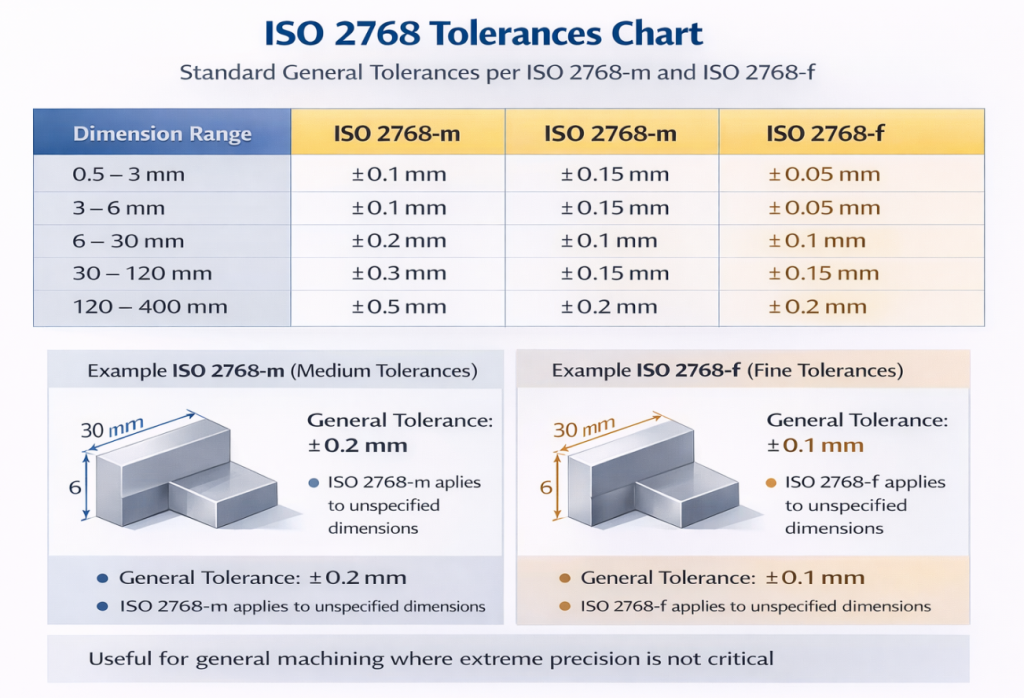
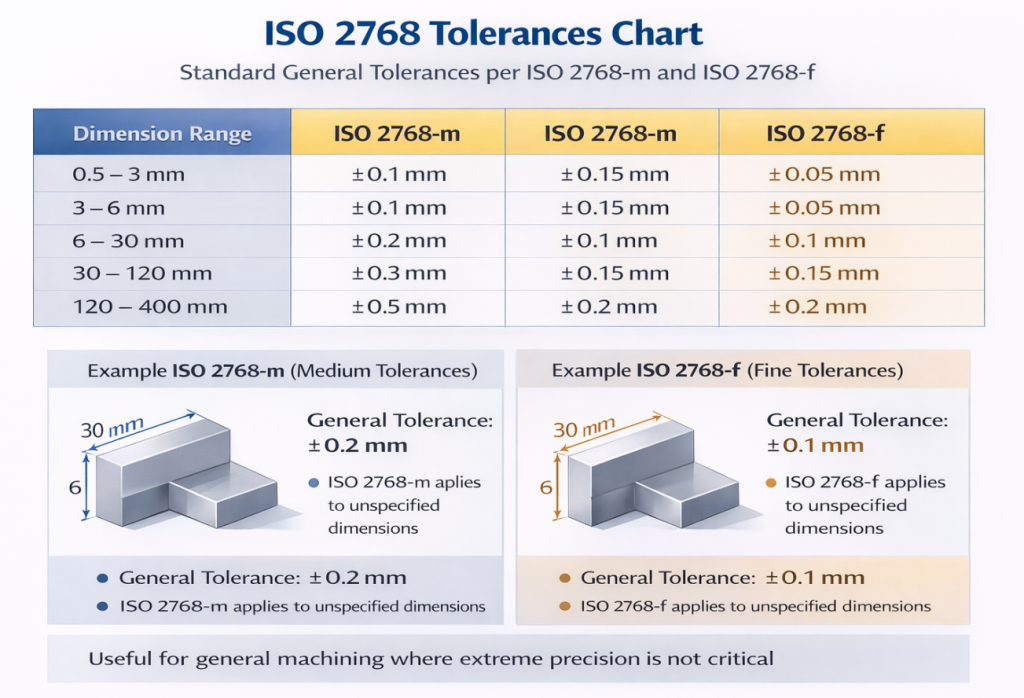
ISO 2768 is an international standard defining general tolerances for linear and angular dimensions when specific tolerances are not individually indicated on engineering drawings.
It simplifies drawing requirements by allowing unspecified dimensions to follow predefined tolerance classes.
The standard is commonly divided into:
- ISO 2768-m (medium)
- ISO 2768-f (fine)
These classes provide default tolerance ranges depending on the dimension length.
3. Typical ISO 2768 Linear Tolerance Ranges
| Dimension Range | ISO 2768-m | ISO 2768-f |
|---|---|---|
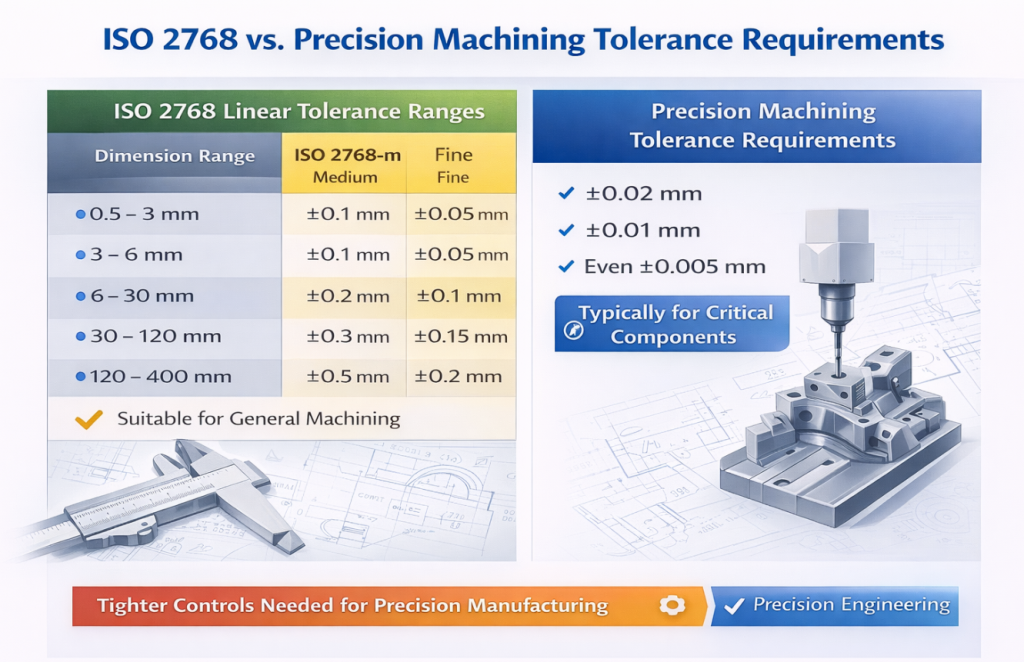
| 0.5 – 3 mm | ±0.1 mm | ±0.05 mm |
| 3 – 6 mm | ±0.1 mm | ±0.05 mm |
| 6 – 30 mm | ±0.2 mm | ±0.1 mm |
| 30 – 120 mm | ±0.3 mm | ±0.15 mm |
| 120 – 400 mm | ±0.5 mm | ±0.2 mm |
These ranges are suitable for general industrial parts where extreme precision is not required.
4. Why Precision CNC Machining Requires Tighter Tolerances
In high-performance engineering sectors, tolerance requirements are often significantly smaller than ISO 2768 limits.
Typical precision machining tolerances include:
- ±0.02 mm
- ±0.01 mm
- even ±0.005 mm for critical components
Such precision is necessary for applications such as:
- aerospace components
- robotics systems
- optical assemblies
- high-speed mechanical systems
These applications require strict dimensional consistency and repeatability.
5. Factors Affecting CNC Machining Tolerance
Achieving tight tolerances depends on multiple engineering variables.
Machine rigidity
High structural stiffness reduces vibration and tool deflection.
Thermal stability
Temperature variation affects dimensional accuracy.
Tool wear
Cutting tools gradually degrade during production.
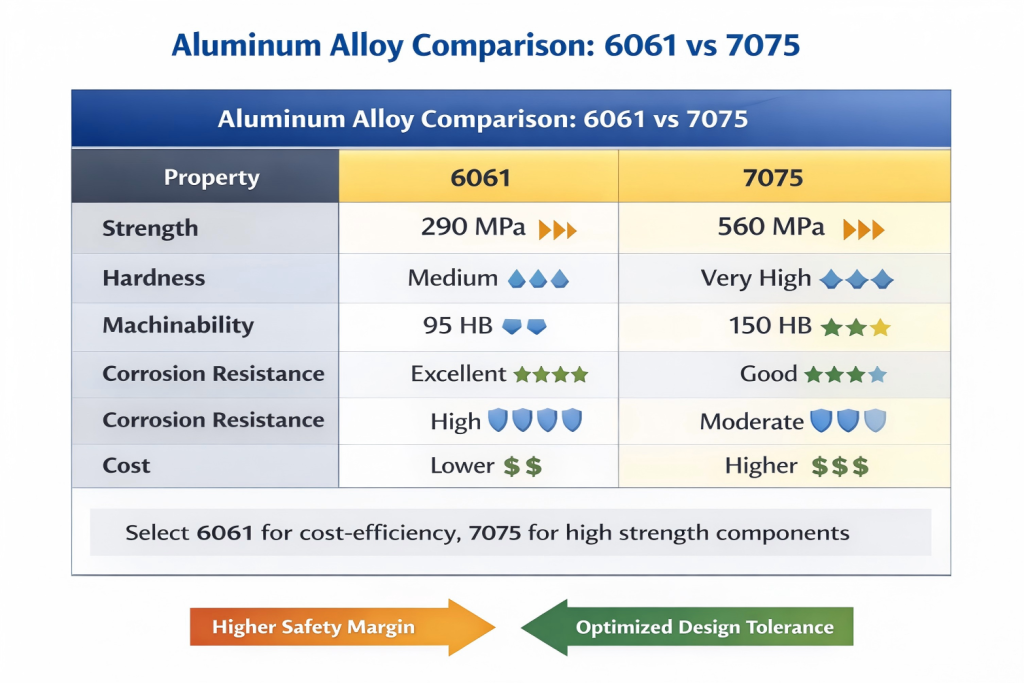
Material behavior
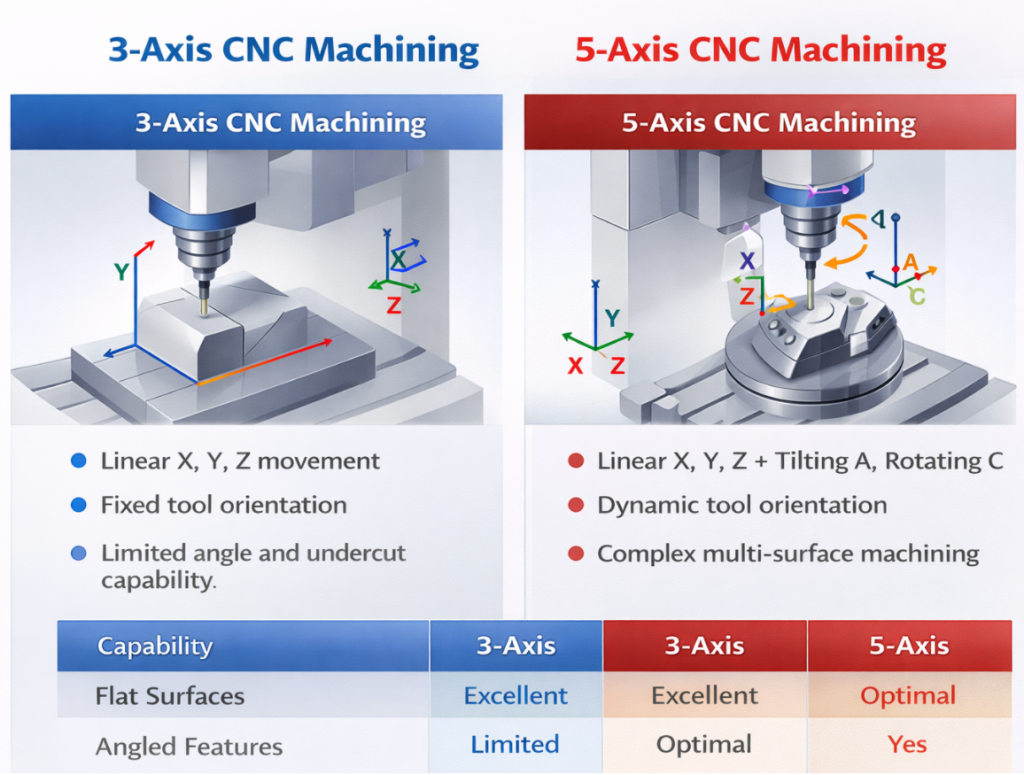
Different materials respond differently to cutting forces.
For example:
Aluminum alloys are generally easier to maintain tight tolerances compared with stainless steel due to lower cutting resistance.
6. Tolerance Stack-Up in Assembly
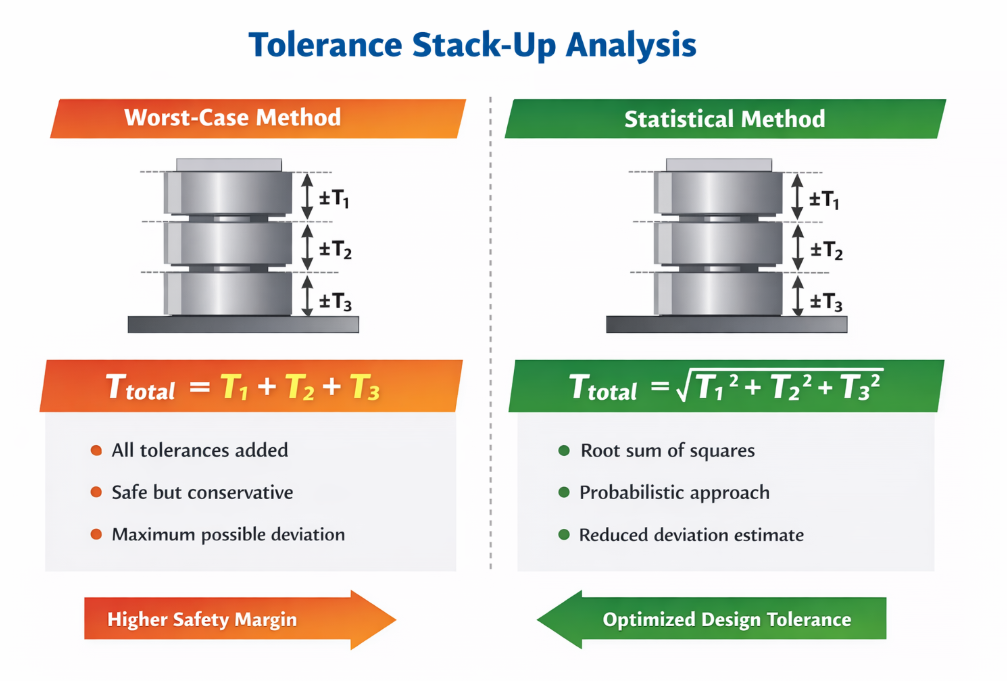
Tolerance stack-up refers to the cumulative dimensional variation resulting from multiple components within an assembly.
Even small deviations can accumulate and affect final product alignment.
For example:
If five components each have ±0.02 mm tolerance, total assembly variation may reach ±0.1 mm.
Engineering teams must consider tolerance allocation across the entire assembly structure.
7. Engineering Strategy for Precision Manufacturing
Precision machining projects typically follow these strategies:
• Critical dimensions receive individual tolerance specifications
• Non-critical dimensions follow ISO 2768
• Datum references are clearly defined
• Inspection plans verify dimensional stability
This approach balances manufacturing efficiency with precision requirements.
8. Inspection and Quality Verification
To verify tight tolerances, precision manufacturers use advanced metrology equipment.
Common inspection systems include:
- CMM coordinate measuring machines
- optical measurement systems
- digital micrometers and gauges
Quality control procedures ensure that dimensional deviations remain within specified limits.
9. Conclusion
ISO 2768 provides a useful baseline for general machining tolerances.
However, modern precision manufacturing frequently requires tighter tolerances to meet engineering performance demands.
Effective tolerance control depends on:
- proper drawing specification
- advanced machining capability
- accurate inspection methods
Understanding tolerance standards helps engineers achieve reliable and repeatable manufacturing results.