

Injection molding DFM helps buyers identify wall thickness, draft angle, gate location, weld line, parting line, ejector mark, sink mark, warpage and cosmetic risks before tooling begins. These details decide mold cost, sample correction time and production quality. A plastic part that looks complete in CAD can still be difficult to mold if thick sections, sharp transitions, hidden undercuts or visible gate marks are not reviewed. This guide explains practical DFM checks procurement engineers should confirm with Shenzhen Debaolong Seiko Co., Ltd. before approving custom plastic tooling.
Useful related resources include injection molding support, custom 3D printing services, precision CNC machining, manufacturing material options, and manufacturing engineering knowledge center.
Executive Summary for Procurement Engineers
The most expensive injection molding mistakes usually happen before tooling starts. DFM review is the opportunity to adjust geometry while changes are still faster and cheaper.
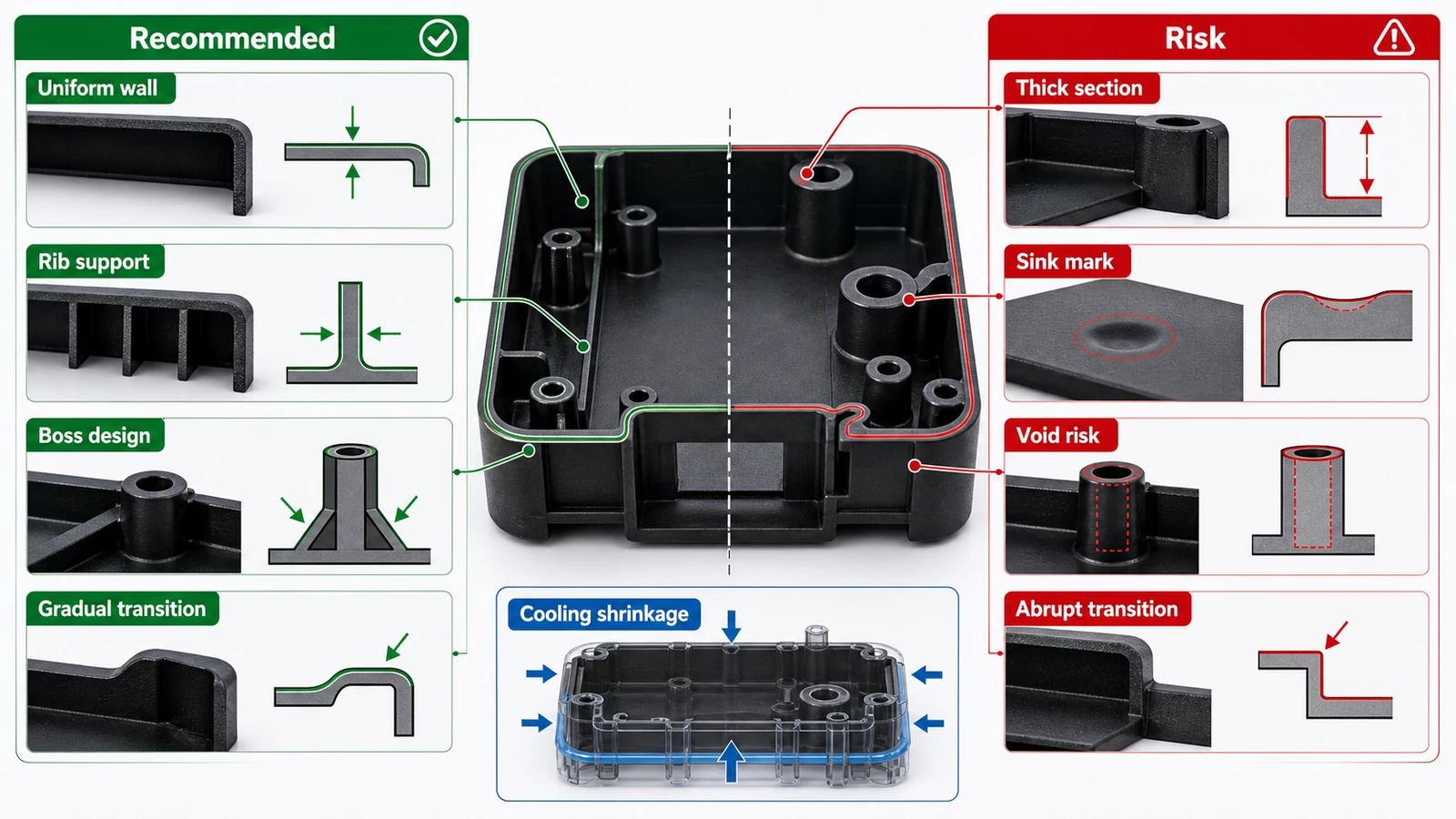
Uniform wall thickness is one of the strongest quality controls. Thick sections, abrupt transitions and unsupported bosses can create sink marks, voids, warpage and long cycle times.
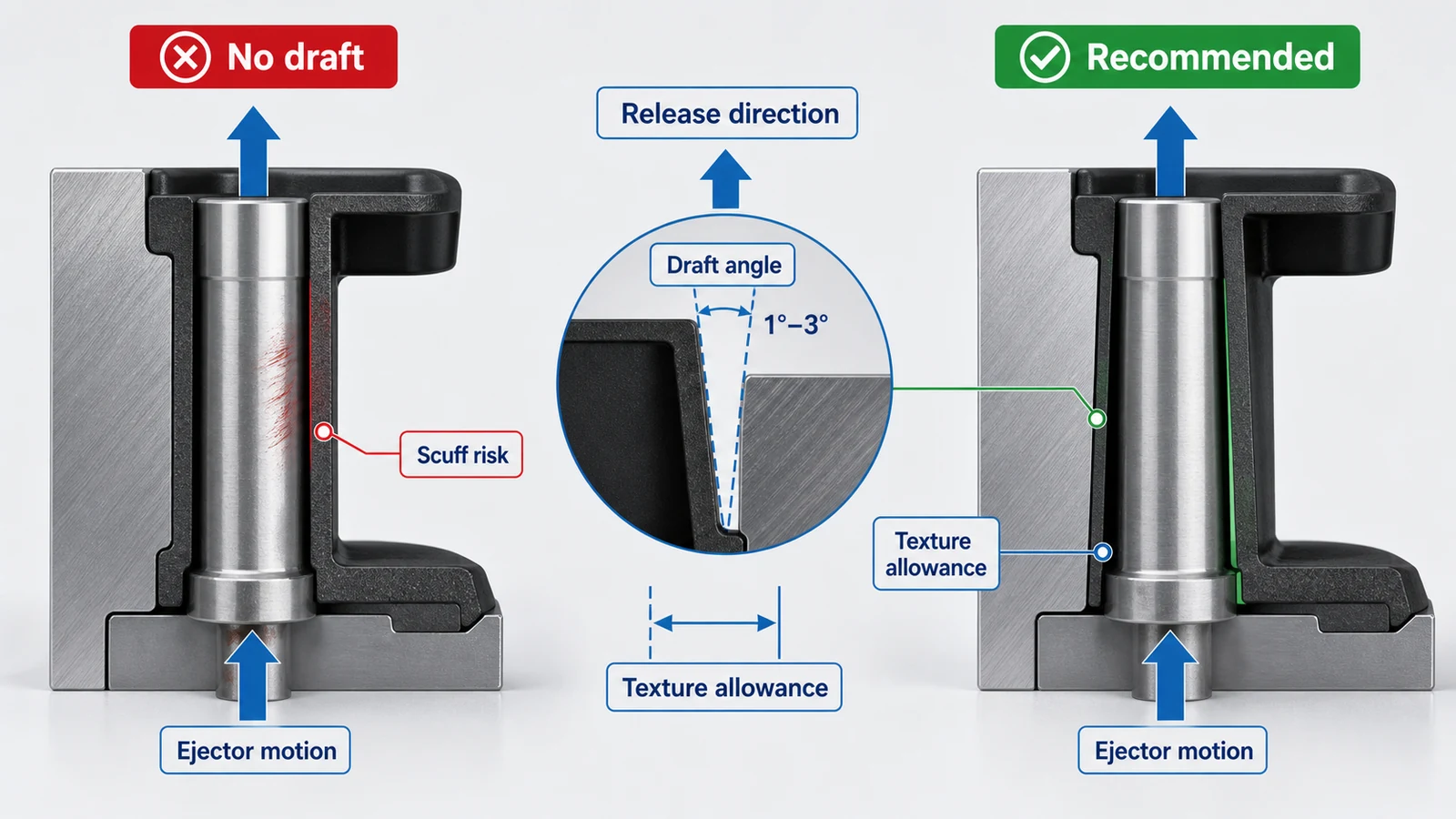
Draft angle should be reviewed on all mold-opening surfaces, including ribs, bosses and textured walls. Insufficient draft can cause sticking, scuffing and tool changes.
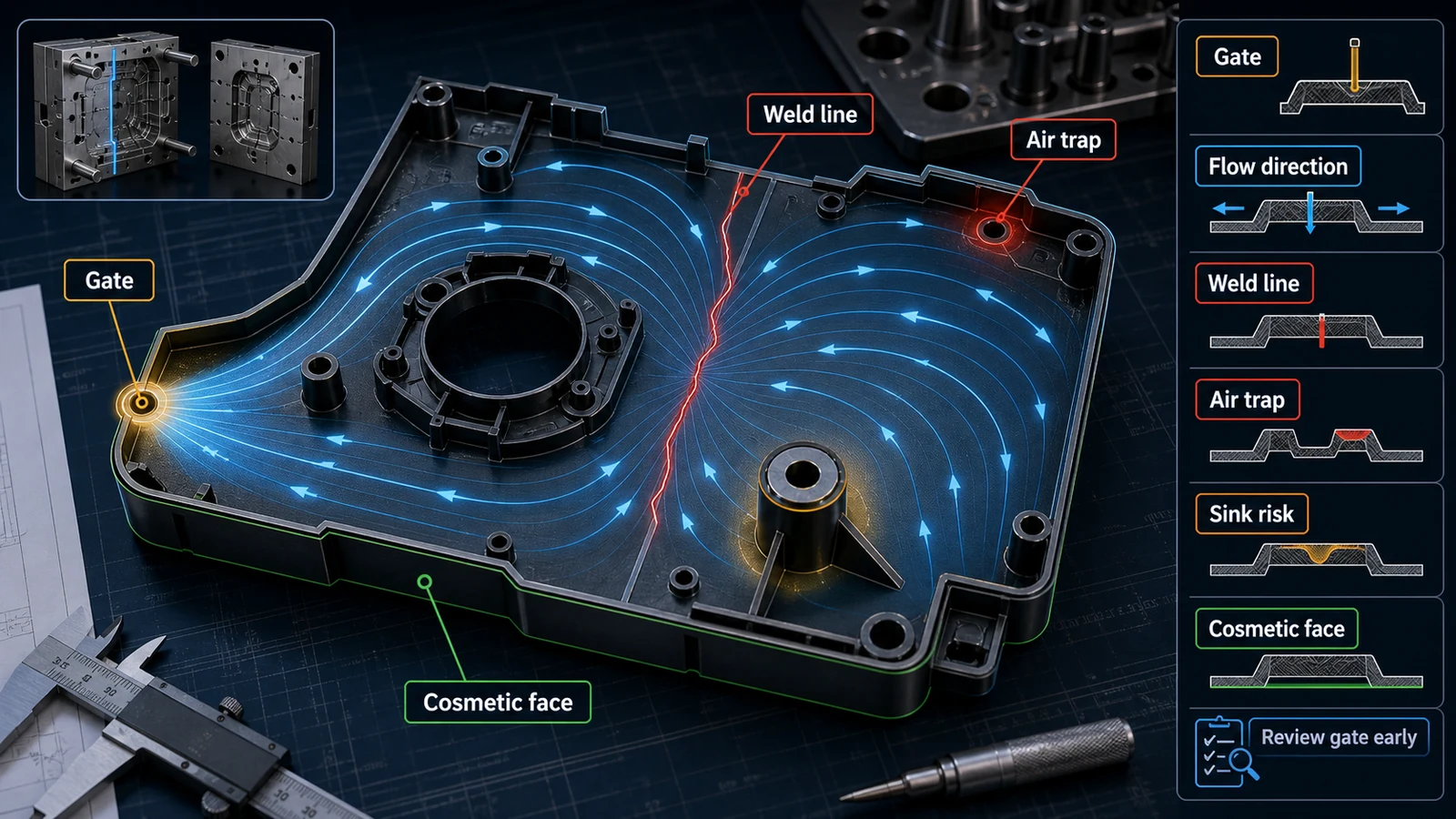
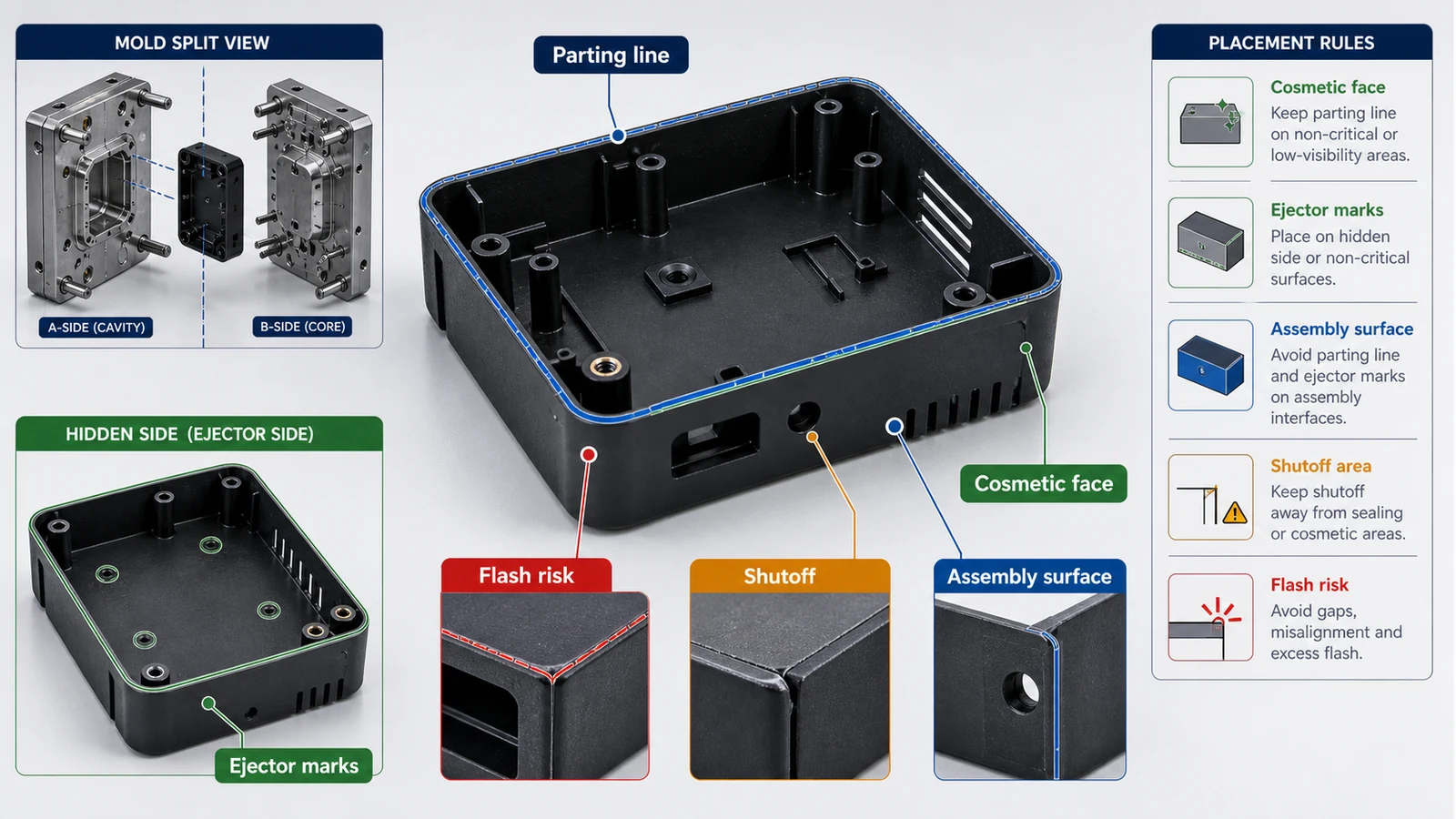
Gate location, weld line position, air traps, parting line and ejector marks should be planned around function and appearance. Tooling marks are normal, but their location must be acceptable.
Buyers should ask for DFM feedback before comparing final tooling price because slider actions, lifters, texture, polishing, correction loops and inspection can change the real cost.
Key Decision Checklist
- Review nominal wall thickness, thick sections, ribs, bosses and transitions before tooling.
- Confirm draft direction and draft amount for walls, texture, ribs and bosses.
- Discuss gate location, flow path, weld line, air trap and cosmetic mark expectations.
- Define parting line, ejector pin marks, slider marks and areas where flash cannot be accepted.
- Check inserts, threads, snap fits, ultrasonic welding, heat staking and assembly stresses.
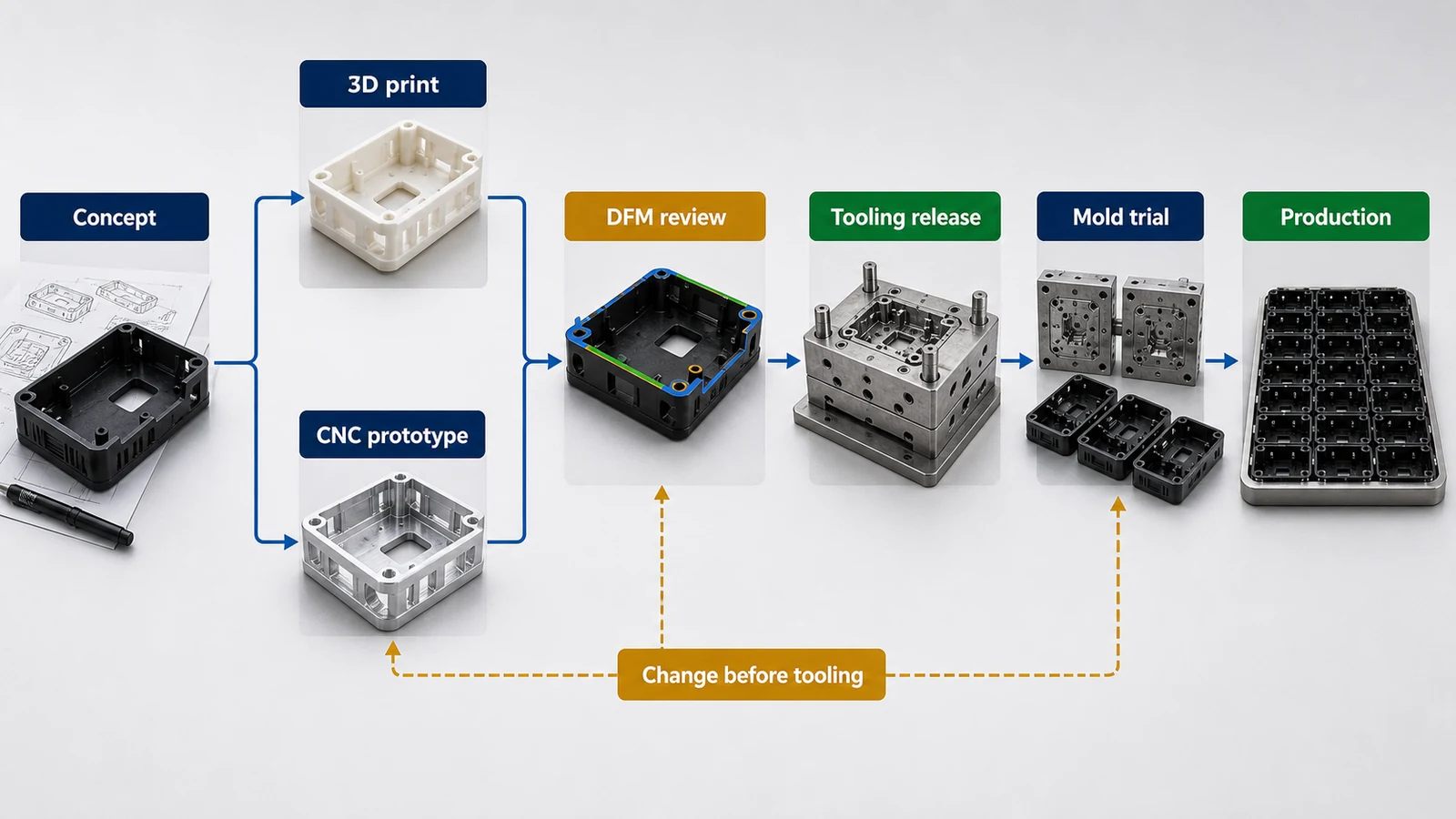
- Validate whether CNC machining or 3D printing should be used before mold tooling if the design is not stable.
| RFQ item | Recommended detail | Why it affects the quote |
|---|---|---|
| Wall thickness | Nominal wall, thick zones, ribs and bosses | Controls sink, warp, cycle time and shrinkage |
| Draft | Draft angle by release direction and texture | Controls ejection quality and mold cost |
| Gate location | Acceptable gate mark and flow path | Controls filling, weld lines and appearance |
| Parting and ejection | Parting line, ejector marks, slider areas | Controls cosmetics, flash and tool complexity |
| Assembly features | Inserts, snap fits, threads and load conditions | Controls boss design, material choice and inspection |
| Prototype decision | Need for CNC or 3D printed validation before tooling | Reduces mold correction risk |
Why DFM Prevents Expensive Mold Changes
Injection molding turns design decisions into steel. Once the mold is built, changing gate location, adding draft, moving a parting line or correcting thick walls can be slow and expensive. DFM review gives the buyer and supplier a chance to question the geometry while the cost of change is still reasonable.
The goal is not to make every plastic part look the same. The goal is to understand which requirements are functional and which details can be adjusted to improve molding. A visible cover may prioritize cosmetic gate placement and texture. A hidden bracket may prioritize strength and dimensional stability. A housing with snap fits may need material and rib design review more than surface appearance.
Procurement engineers should ask for DFM comments before treating a tooling price as final. A supplier may discover that the part needs sliders, lifters, extra polishing, texture control or a different gate strategy. It is better to know that before purchase order release than during the first mold trial.
| DFM risk | Design symptom | Likely production issue | Buyer action |
|---|---|---|---|
| Thick wall | Heavy sections or abrupt transitions | Sink marks, voids and long cycle time | Core out material or redesign ribs |
| No draft | Straight vertical walls or textured surfaces | Sticking, scuff marks and tool changes | Add draft or confirm acceptable release direction |
| Poor gate location | Gate on cosmetic or load-critical area | Visible mark, weak weld line or poor filling | Approve gate zone before tooling |
| Bad parting line | Line crosses visible or sealing surface | Flash, mismatch or cosmetic rejection | Define A-surface and mating surfaces |
| Weak bosses | Tall bosses without support or thick base | Cracking, sink or screw failure | Add ribs, adjust wall and confirm fastener load |
Detailed Injection Molding DFM Checks
Production volume and tooling strategy
Procurement review for production volume and tooling strategy starts before the supplier calculates price. The buyer should confirm prototype need, expected annual demand, life of tool, part revision risk and whether soft tooling or production tooling is appropriate. This is not paperwork for its own sake; it tells the manufacturing team which features carry function, which features are cosmetic, and which assumptions must be clarified before material is ordered or production time is reserved.
The engineering reason is simple: mold cost is justified by quantity, but early design uncertainty can make premature tooling expensive. When the RFQ leaves this detail open, two suppliers can quote the same model with completely different assumptions. One may quote a fast, low-cost route that cannot meet the application, while another may add unnecessary inspection or finishing cost. A disciplined RFQ makes the quote easier to compare and reduces changes after the purchase order.
The common risk is paying for a mold before the part design, material, texture or assembly behavior is stable. A small design choice can change build orientation, tooling access, fixture design, inspection method, surface protection, or packing. Buyers should avoid treating every dimension as equally critical. It is better to define the few features that control assembly, sealing, movement, or appearance, then allow standard manufacturing tolerance on non-critical areas.
For a useful supplier review, provide prototype history, target quantity, annual demand, life expectation, launch timing and expected design freeze point. Debaolong injection molding DFM support can then review the data for manufacturability, flag cost drivers, and suggest a production route that matches function instead of only matching the CAD geometry. This is especially important when a prototype must later transition into CNC machining, sheet metal fabrication, injection molding, or a repeatable small-batch process.
Plastic material selection
Procurement review for plastic material selection starts before the supplier calculates price. The buyer should confirm mechanical strength, heat resistance, chemical exposure, flexibility, transparency, color, flame requirement and dimensional stability. This is not paperwork for its own sake; it tells the manufacturing team which features carry function, which features are cosmetic, and which assumptions must be clarified before material is ordered or production time is reserved.
The engineering reason is simple: material shrinkage, flow, stiffness and surface behavior affect mold design and final tolerance. When the RFQ leaves this detail open, two suppliers can quote the same model with completely different assumptions. One may quote a fast, low-cost route that cannot meet the application, while another may add unnecessary inspection or finishing cost. A disciplined RFQ makes the quote easier to compare and reduces changes after the purchase order.
The common risk is selecting a familiar resin name that does not match the actual use environment or cosmetic requirement. A small design choice can change build orientation, tooling access, fixture design, inspection method, surface protection, or packing. Buyers should avoid treating every dimension as equally critical. It is better to define the few features that control assembly, sealing, movement, or appearance, then allow standard manufacturing tolerance on non-critical areas.
For a useful supplier review, provide target material, acceptable alternatives, application temperature, load, exposure, color and regulatory or customer requirements if applicable. Debaolong injection molding DFM support can then review the data for manufacturability, flag cost drivers, and suggest a production route that matches function instead of only matching the CAD geometry. This is especially important when a prototype must later transition into CNC machining, sheet metal fabrication, injection molding, or a repeatable small-batch process.
Wall thickness and uniformity
Procurement review for wall thickness and uniformity starts before the supplier calculates price. The buyer should confirm nominal wall, thick sections, abrupt transitions, ribs, bosses and areas near cosmetic surfaces. This is not paperwork for its own sake; it tells the manufacturing team which features carry function, which features are cosmetic, and which assumptions must be clarified before material is ordered or production time is reserved.
The engineering reason is simple: uneven wall thickness creates sink marks, voids, warpage, long cycle time and unpredictable shrinkage. When the RFQ leaves this detail open, two suppliers can quote the same model with completely different assumptions. One may quote a fast, low-cost route that cannot meet the application, while another may add unnecessary inspection or finishing cost. A disciplined RFQ makes the quote easier to compare and reduces changes after the purchase order.
The common risk is a part that looks acceptable in CAD but shows sink marks, short shots, warp or high molding stress. A small design choice can change build orientation, tooling access, fixture design, inspection method, surface protection, or packing. Buyers should avoid treating every dimension as equally critical. It is better to define the few features that control assembly, sealing, movement, or appearance, then allow standard manufacturing tolerance on non-critical areas.
For a useful supplier review, provide critical cosmetic surfaces, allowable wall changes, strength requirement and areas where geometry can be cored out. Debaolong injection molding DFM support can then review the data for manufacturability, flag cost drivers, and suggest a production route that matches function instead of only matching the CAD geometry. This is especially important when a prototype must later transition into CNC machining, sheet metal fabrication, injection molding, or a repeatable small-batch process.
Draft angle and release direction
Procurement review for draft angle and release direction starts before the supplier calculates price. The buyer should confirm draft on walls, ribs, bosses, texture surfaces and undercuts relative to mold opening direction. This is not paperwork for its own sake; it tells the manufacturing team which features carry function, which features are cosmetic, and which assumptions must be clarified before material is ordered or production time is reserved.
The engineering reason is simple: insufficient draft causes ejection difficulty, scuff marks, longer cycle time and tooling complexity. When the RFQ leaves this detail open, two suppliers can quote the same model with completely different assumptions. One may quote a fast, low-cost route that cannot meet the application, while another may add unnecessary inspection or finishing cost. A disciplined RFQ makes the quote easier to compare and reduces changes after the purchase order.
The common risk is tool changes after mold trial because the part sticks, scratches or cannot release cleanly. A small design choice can change build orientation, tooling access, fixture design, inspection method, surface protection, or packing. Buyers should avoid treating every dimension as equally critical. It is better to define the few features that control assembly, sealing, movement, or appearance, then allow standard manufacturing tolerance on non-critical areas.
For a useful supplier review, provide preferred cosmetic side, texture requirement, release direction and features that cannot change. Debaolong injection molding DFM support can then review the data for manufacturability, flag cost drivers, and suggest a production route that matches function instead of only matching the CAD geometry. This is especially important when a prototype must later transition into CNC machining, sheet metal fabrication, injection molding, or a repeatable small-batch process.
Gate location and flow path
Procurement review for gate location and flow path starts before the supplier calculates price. The buyer should confirm where plastic enters, how flow reaches thin areas, whether weld lines appear on cosmetic or load-bearing zones and how gate vestige is handled. This is not paperwork for its own sake; it tells the manufacturing team which features carry function, which features are cosmetic, and which assumptions must be clarified before material is ordered or production time is reserved.
The engineering reason is simple: gate location controls filling, pressure, weld line risk, appearance and trimming effort. When the RFQ leaves this detail open, two suppliers can quote the same model with completely different assumptions. One may quote a fast, low-cost route that cannot meet the application, while another may add unnecessary inspection or finishing cost. A disciplined RFQ makes the quote easier to compare and reduces changes after the purchase order.
The common risk is visible gate marks, weak weld lines, short shots, air traps or unbalanced filling. A small design choice can change build orientation, tooling access, fixture design, inspection method, surface protection, or packing. Buyers should avoid treating every dimension as equally critical. It is better to define the few features that control assembly, sealing, movement, or appearance, then allow standard manufacturing tolerance on non-critical areas.
For a useful supplier review, provide cosmetic face, load areas, assembly surfaces, acceptable gate mark location and material flow concerns. Debaolong injection molding DFM support can then review the data for manufacturability, flag cost drivers, and suggest a production route that matches function instead of only matching the CAD geometry. This is especially important when a prototype must later transition into CNC machining, sheet metal fabrication, injection molding, or a repeatable small-batch process.
Parting line, ejector marks and cosmetic surfaces
Procurement review for parting line, ejector marks and cosmetic surfaces starts before the supplier calculates price. The buyer should confirm parting line location, ejector pin marks, slider marks, texture break and visible areas. This is not paperwork for its own sake; it tells the manufacturing team which features carry function, which features are cosmetic, and which assumptions must be clarified before material is ordered or production time is reserved.
The engineering reason is simple: tooling marks are normal in molded parts but must be placed where they do not affect function or appearance. When the RFQ leaves this detail open, two suppliers can quote the same model with completely different assumptions. One may quote a fast, low-cost route that cannot meet the application, while another may add unnecessary inspection or finishing cost. A disciplined RFQ makes the quote easier to compare and reduces changes after the purchase order.
The common risk is unexpected lines, marks or flash on surfaces that customers see or that mate with other components. A small design choice can change build orientation, tooling access, fixture design, inspection method, surface protection, or packing. Buyers should avoid treating every dimension as equally critical. It is better to define the few features that control assembly, sealing, movement, or appearance, then allow standard manufacturing tolerance on non-critical areas.
For a useful supplier review, provide A-surface definition, mating surfaces, acceptable mark zones and cosmetic acceptance criteria. Debaolong injection molding DFM support can then review the data for manufacturability, flag cost drivers, and suggest a production route that matches function instead of only matching the CAD geometry. This is especially important when a prototype must later transition into CNC machining, sheet metal fabrication, injection molding, or a repeatable small-batch process.
Inserts, threads, snap fits and assembly
Procurement review for inserts, threads, snap fits and assembly starts before the supplier calculates price. The buyer should confirm metal inserts, threaded bosses, heat staking, ultrasonic welding, snap-fit deflection and assembly load. This is not paperwork for its own sake; it tells the manufacturing team which features carry function, which features are cosmetic, and which assumptions must be clarified before material is ordered or production time is reserved.
The engineering reason is simple: assembly features can drive material choice, boss design, tooling actions and inspection requirements. When the RFQ leaves this detail open, two suppliers can quote the same model with completely different assumptions. One may quote a fast, low-cost route that cannot meet the application, while another may add unnecessary inspection or finishing cost. A disciplined RFQ makes the quote easier to compare and reduces changes after the purchase order.
The common risk is boss cracking, weak threads, snap-fit fatigue or assembly interference after shrinkage. A small design choice can change build orientation, tooling access, fixture design, inspection method, surface protection, or packing. Buyers should avoid treating every dimension as equally critical. It is better to define the few features that control assembly, sealing, movement, or appearance, then allow standard manufacturing tolerance on non-critical areas.
For a useful supplier review, provide fastener standard, torque, insert type, assembly method, mating part data and cycle expectations. Debaolong injection molding DFM support can then review the data for manufacturability, flag cost drivers, and suggest a production route that matches function instead of only matching the CAD geometry. This is especially important when a prototype must later transition into CNC machining, sheet metal fabrication, injection molding, or a repeatable small-batch process.
Sampling, mold trial and inspection
Procurement review for sampling, mold trial and inspection starts before the supplier calculates price. The buyer should confirm T0 or first trial goals, sample quantity, dimensional report, visual review, fit test and correction loop. This is not paperwork for its own sake; it tells the manufacturing team which features carry function, which features are cosmetic, and which assumptions must be clarified before material is ordered or production time is reserved.
The engineering reason is simple: the first molded sample validates tooling, shrinkage, appearance and process stability. When the RFQ leaves this detail open, two suppliers can quote the same model with completely different assumptions. One may quote a fast, low-cost route that cannot meet the application, while another may add unnecessary inspection or finishing cost. A disciplined RFQ makes the quote easier to compare and reduces changes after the purchase order.
The common risk is approving production before the part has been reviewed against function, appearance and drawing requirements. A small design choice can change build orientation, tooling access, fixture design, inspection method, surface protection, or packing. Buyers should avoid treating every dimension as equally critical. It is better to define the few features that control assembly, sealing, movement, or appearance, then allow standard manufacturing tolerance on non-critical areas.
For a useful supplier review, provide sample review plan, critical dimensions, assembly test, cosmetic standard and approval process. Debaolong injection molding DFM support can then review the data for manufacturability, flag cost drivers, and suggest a production route that matches function instead of only matching the CAD geometry. This is especially important when a prototype must later transition into CNC machining, sheet metal fabrication, injection molding, or a repeatable small-batch process.
Cost, Lead Time and Quote Comparison Logic
DFM affects cost through mold complexity, machining time, sliders, lifters, texture, polishing, cooling, cycle time and correction risk. A small undercut may require a mold action. A cosmetic gate requirement may need a more complex flow strategy. A thick wall may slow cycle time for every part produced.
The cheapest mold is not always the lowest-risk mold. A simpler mold may be acceptable for a hidden technical component, but a cosmetic enclosure or tight assembly part may need better planning. Buyers should ask what design choices are driving mold cost and which changes could reduce risk without hurting function.
Lead time is also controlled by DFM quality. Parts with predictable draft, wall thickness and gate strategy move more smoothly through mold design and trial. Parts with unresolved DFM issues often spend time in correction loops after first samples.
| RFQ area | Buyer should confirm | Typical risk | Useful supplier input |
|---|---|---|---|
| Production volume and tooling strategy | prototype need, expected annual demand, life of tool, part revision risk and whether soft tooling or production tooling is appropriate | paying for a mold before the part design, material, texture or assembly behavior is stable | prototype history, target quantity, annual demand, life expectation, launch timing and expected design freeze point |
| Plastic material selection | mechanical strength, heat resistance, chemical exposure, flexibility, transparency, color, flame requirement and dimensional stability | selecting a familiar resin name that does not match the actual use environment or cosmetic requirement | target material, acceptable alternatives, application temperature, load, exposure, color and regulatory or customer requirements if applicable |
| Wall thickness and uniformity | nominal wall, thick sections, abrupt transitions, ribs, bosses and areas near cosmetic surfaces | a part that looks acceptable in CAD but shows sink marks, short shots, warp or high molding stress | critical cosmetic surfaces, allowable wall changes, strength requirement and areas where geometry can be cored out |
| Draft angle and release direction | draft on walls, ribs, bosses, texture surfaces and undercuts relative to mold opening direction | tool changes after mold trial because the part sticks, scratches or cannot release cleanly | preferred cosmetic side, texture requirement, release direction and features that cannot change |
| Gate location and flow path | where plastic enters, how flow reaches thin areas, whether weld lines appear on cosmetic or load-bearing zones and how gate vestige is handled | visible gate marks, weak weld lines, short shots, air traps or unbalanced filling | cosmetic face, load areas, assembly surfaces, acceptable gate mark location and material flow concerns |
| Parting line, ejector marks and cosmetic surfaces | parting line location, ejector pin marks, slider marks, texture break and visible areas | unexpected lines, marks or flash on surfaces that customers see or that mate with other components | A-surface definition, mating surfaces, acceptable mark zones and cosmetic acceptance criteria |
| Inserts, threads, snap fits and assembly | metal inserts, threaded bosses, heat staking, ultrasonic welding, snap-fit deflection and assembly load | boss cracking, weak threads, snap-fit fatigue or assembly interference after shrinkage | fastener standard, torque, insert type, assembly method, mating part data and cycle expectations |
| Sampling, mold trial and inspection | T0 or first trial goals, sample quantity, dimensional report, visual review, fit test and correction loop | approving production before the part has been reviewed against function, appearance and drawing requirements | sample review plan, critical dimensions, assembly test, cosmetic standard and approval process |
Inspection, Packing and Delivery Expectations
Inspection for molding DFM should focus on the risks that DFM identified. If sink marks were a concern, visual and dimensional checks should include those surfaces. If gate location was sensitive, sample review should check gate vestige and weld line position. If snap fits were critical, assembly cycling may matter more than a simple dimensional report.
Buyers should define approval criteria before sample review. The first sample should not be judged only by whether it looks close to CAD. It should be checked against critical dimensions, functional tests, cosmetic surfaces, material, color, texture and assembly behavior.
| Inspection or review point | Why it matters | What to provide |
|---|---|---|
| Wall and sink review | Confirms thick sections do not create unacceptable marks | Cosmetic zones and acceptable sink criteria |
| Draft and ejection review | Checks for drag marks, scuffs and release problems | Release direction and texture notes |
| Gate and weld line review | Confirms marks and weld lines are acceptable | Approved gate zone and load or cosmetic areas |
| Parting line and flash | Protects visible and mating surfaces | A-surface, seal or assembly interface notes |
| Assembly feature test | Confirms snap fits, inserts and threads work | Mating parts, torque and cycle expectations |
Practical Procurement Scenarios
Scenario 1: Early Design Validation
In early design validation, the procurement engineer should use production volume and tooling strategy as a decision point rather than a checklist item. The practical question is whether the supplier has enough information to judge prototype need, expected annual demand, life of tool, part revision risk and whether soft tooling or production tooling is appropriate. When this is unclear, the quote may look complete, but the manufacturing route can still contain hidden assumptions about tolerance, fixture access, finishing, inspection or later production conversion.
The buyer can reduce risk by asking the supplier to explain the manufacturing consequence of the requirement. For this area, the reason is that mold cost is justified by quantity, but early design uncertainty can make premature tooling expensive. If the supplier identifies paying for a mold before the part design, material, texture or assembly behavior is stable, the buyer should not treat it as a sales objection. It is a signal that the RFQ needs clearer engineering boundaries before cost and lead time are reliable.
A strong RFQ response should convert the concern into an action: confirm the drawing note, adjust a non-critical feature, separate cosmetic and functional surfaces, define the inspection method, or approve a manufacturable alternative. The most useful buyer input is prototype history, target quantity, annual demand, life expectation, launch timing and expected design freeze point. This keeps the conversation focused on fit, function, repeatability and delivery, not only on unit price.
Scenario 2: Buyer-Side Quote Comparison
In buyer-side quote comparison, the procurement engineer should use plastic material selection as a decision point rather than a checklist item. The practical question is whether the supplier has enough information to judge mechanical strength, heat resistance, chemical exposure, flexibility, transparency, color, flame requirement and dimensional stability. When this is unclear, the quote may look complete, but the manufacturing route can still contain hidden assumptions about tolerance, fixture access, finishing, inspection or later production conversion.
The buyer can reduce risk by asking the supplier to explain the manufacturing consequence of the requirement. For this area, the reason is that material shrinkage, flow, stiffness and surface behavior affect mold design and final tolerance. If the supplier identifies selecting a familiar resin name that does not match the actual use environment or cosmetic requirement, the buyer should not treat it as a sales objection. It is a signal that the RFQ needs clearer engineering boundaries before cost and lead time are reliable.
A strong RFQ response should convert the concern into an action: confirm the drawing note, adjust a non-critical feature, separate cosmetic and functional surfaces, define the inspection method, or approve a manufacturable alternative. The most useful buyer input is target material, acceptable alternatives, application temperature, load, exposure, color and regulatory or customer requirements if applicable. This keeps the conversation focused on fit, function, repeatability and delivery, not only on unit price.
Scenario 3: Small-Batch Launch Support
In small-batch launch support, the procurement engineer should use wall thickness and uniformity as a decision point rather than a checklist item. The practical question is whether the supplier has enough information to judge nominal wall, thick sections, abrupt transitions, ribs, bosses and areas near cosmetic surfaces. When this is unclear, the quote may look complete, but the manufacturing route can still contain hidden assumptions about tolerance, fixture access, finishing, inspection or later production conversion.
The buyer can reduce risk by asking the supplier to explain the manufacturing consequence of the requirement. For this area, the reason is that uneven wall thickness creates sink marks, voids, warpage, long cycle time and unpredictable shrinkage. If the supplier identifies a part that looks acceptable in CAD but shows sink marks, short shots, warp or high molding stress, the buyer should not treat it as a sales objection. It is a signal that the RFQ needs clearer engineering boundaries before cost and lead time are reliable.
A strong RFQ response should convert the concern into an action: confirm the drawing note, adjust a non-critical feature, separate cosmetic and functional surfaces, define the inspection method, or approve a manufacturable alternative. The most useful buyer input is critical cosmetic surfaces, allowable wall changes, strength requirement and areas where geometry can be cored out. This keeps the conversation focused on fit, function, repeatability and delivery, not only on unit price.
Scenario 4: Production Transition Review
In production transition review, the procurement engineer should use draft angle and release direction as a decision point rather than a checklist item. The practical question is whether the supplier has enough information to judge draft on walls, ribs, bosses, texture surfaces and undercuts relative to mold opening direction. When this is unclear, the quote may look complete, but the manufacturing route can still contain hidden assumptions about tolerance, fixture access, finishing, inspection or later production conversion.
The buyer can reduce risk by asking the supplier to explain the manufacturing consequence of the requirement. For this area, the reason is that insufficient draft causes ejection difficulty, scuff marks, longer cycle time and tooling complexity. If the supplier identifies tool changes after mold trial because the part sticks, scratches or cannot release cleanly, the buyer should not treat it as a sales objection. It is a signal that the RFQ needs clearer engineering boundaries before cost and lead time are reliable.
A strong RFQ response should convert the concern into an action: confirm the drawing note, adjust a non-critical feature, separate cosmetic and functional surfaces, define the inspection method, or approve a manufacturable alternative. The most useful buyer input is preferred cosmetic side, texture requirement, release direction and features that cannot change. This keeps the conversation focused on fit, function, repeatability and delivery, not only on unit price.
Scenario 5: Incoming Inspection Planning
In incoming inspection planning, the procurement engineer should use gate location and flow path as a decision point rather than a checklist item. The practical question is whether the supplier has enough information to judge where plastic enters, how flow reaches thin areas, whether weld lines appear on cosmetic or load-bearing zones and how gate vestige is handled. When this is unclear, the quote may look complete, but the manufacturing route can still contain hidden assumptions about tolerance, fixture access, finishing, inspection or later production conversion.
The buyer can reduce risk by asking the supplier to explain the manufacturing consequence of the requirement. For this area, the reason is that gate location controls filling, pressure, weld line risk, appearance and trimming effort. If the supplier identifies visible gate marks, weak weld lines, short shots, air traps or unbalanced filling, the buyer should not treat it as a sales objection. It is a signal that the RFQ needs clearer engineering boundaries before cost and lead time are reliable.
A strong RFQ response should convert the concern into an action: confirm the drawing note, adjust a non-critical feature, separate cosmetic and functional surfaces, define the inspection method, or approve a manufacturable alternative. The most useful buyer input is cosmetic face, load areas, assembly surfaces, acceptable gate mark location and material flow concerns. This keeps the conversation focused on fit, function, repeatability and delivery, not only on unit price.
Common RFQ Mistakes That Create Rework
Approving CAD geometry without wall thickness review
CAD can hide thick material masses that create sink and warpage. Wall analysis should happen before mold design.
Adding texture without increasing draft
Textured surfaces often need additional draft. Without it, parts may scuff or stick during ejection.
Leaving gate location to tooling after purchase order
Gate marks and weld lines affect appearance and strength. Buyers should approve gate zones before tooling begins.
Ignoring ejector marks
Ejector marks are normal, but they should be placed away from critical cosmetic and mating surfaces whenever possible.
Using 3D printing approval as full molding approval
Printed prototypes can validate shape, but they do not prove molded shrinkage, gate effects, sink, warpage or parting line appearance.
How to Communicate With a Manufacturing Supplier
A DFM conversation should be specific. Ask which surfaces need draft, which walls are too thick, where the gate may be placed, whether sliders are needed, which areas may show parting lines and what sample corrections are most likely.
Buyers should also separate must-have requirements from preferences. A cosmetic face may be non-negotiable, while a hidden rib or boss can often be adjusted. This gives the supplier room to reduce mold risk without weakening the design.
When the design is not frozen, ask whether a CNC machined or 3D printed prototype should be made before tooling. It may not prove every molding behavior, but it can reveal assembly, ergonomics and interface issues before mold investment.
Debaolong Engineering Note
Debaolong can review injection molding DFM for wall thickness, draft, ribs, bosses, gate and flow risk, parting line, ejector marks, inserts, snap fits, texture and sample inspection. This helps buyers make tooling decisions with clearer manufacturing risk visibility.
FAQ
Why does wall thickness matter in injection molding?
Uneven wall thickness can cause sink marks, voids, warpage, long cycle time and inconsistent shrinkage. Uniform walls and proper rib design help stabilize molding.
How much draft angle is needed?
Draft depends on material, depth, texture and surface requirements. The supplier should review the release direction and recommend draft before tooling.
Why is gate location important?
Gate location affects filling, weld lines, gate marks, pressure, appearance and trimming. Buyers should approve gate zones before mold design is finalized.
What are ejector marks?
Ejector marks are impressions left by pins that push the part out of the mold. They are normal but should be placed away from important cosmetic or mating surfaces when possible.
When should CNC or 3D printing be used before injection molding?
Use prototypes when fit, ergonomics, assembly or customer approval is still uncertain. Prototype validation can reduce the risk of expensive mold changes.
Can Debaolong help identify molding DFM risks?
Yes. Debaolong can review CAD files and drawings for molding risks and suggest practical questions or changes before tooling begins.
Request a Manufacturing Quote
Send drawings, CAD files, material requirements, quantity, surface finish, tolerance notes, inspection requirements and application context. Shenzhen Debaolong Seiko Co., Ltd. can review manufacturability and support prototypes, small batches and production-ready custom manufacturing for overseas engineering and procurement teams.