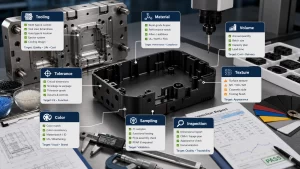


Procurement engineers should check tooling strategy, production volume, plastic material, wall thickness, draft angle, gate location, parting line, ejector marks, surface texture, tolerance, sampling and inspection before ordering injection molded parts. Injection molding is different from prototype sourcing because mold decisions lock cost and design risk into production. A low tooling quote is not useful if the part later needs mold changes, cosmetic repair or material replacement. This guide explains what overseas buyers should prepare before asking Shenzhen Debaolong Seiko Co., Ltd. to review custom plastic injection molding projects.
Useful related resources include injection molding support, custom 3D printing services, precision CNC machining, manufacturing material options, and manufacturing engineering knowledge center.
Executive Summary for Procurement Engineers
Injection molding procurement starts with the business case for tooling. Quantity, design stability, material choice, launch schedule and future demand decide whether mold investment makes sense.
The buyer should provide a 3D model, 2D drawing, material requirement, color, texture, cosmetic surfaces, annual volume, sample approval plan and critical dimensions. Without this information, mold cost and production risk are difficult to judge.
DFM details such as draft angle, wall thickness, ribs, bosses, gate location, parting line and ejector marks should be reviewed before tooling starts. Changes after mold steel is cut are slower and more expensive.
Tolerance and shrinkage must be treated realistically. Plastic parts move with material, wall thickness, mold temperature, process settings and geometry. Critical features should be marked and inspected deliberately.
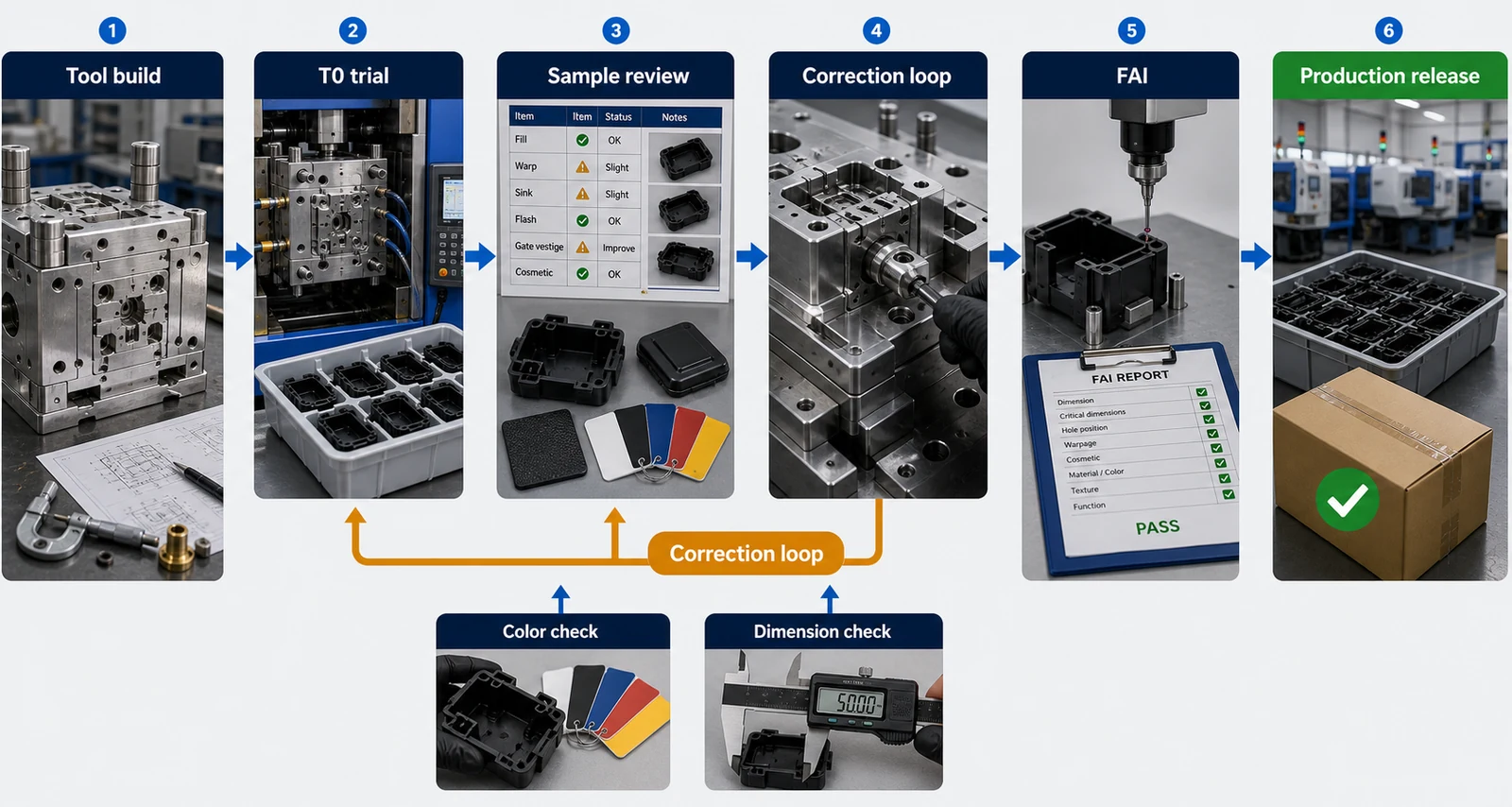
Sampling should be planned as an engineering decision, not only a delivery milestone. First shots help confirm tooling, appearance, shrinkage, assembly fit and whether corrections are needed before production release.
Key Decision Checklist
- Confirm production volume, tool life expectation, design freeze status and launch schedule.
- Send 3D CAD, 2D drawing, material target, color, texture, cosmetic side and critical dimensions.
- Review wall thickness, ribs, bosses, draft angle, undercuts, snap fits and assembly features.
- Discuss gate location, parting line, ejector marks, inserts, overmolding and possible secondary operations.
- Define sampling, first article review, dimensional report, visual inspection and assembly testing.
- Compare quotes by mold scope, material, cavity count, sample plan, correction policy and production assumptions.
| RFQ item | Recommended detail | Why it affects the quote |
|---|---|---|
| CAD and drawing | 3D model plus 2D drawing with critical dimensions | Mold design depends on geometry, shrinkage and inspection priorities |
| Volume | Prototype need, first order, annual demand and tool life | Affects mold material, cavity count and unit cost |
| Material | Target resin, alternatives, color and application environment | Controls shrinkage, flow, strength and surface behavior |
| Cosmetics | A-surface, texture, color, gate mark and ejector mark limits | Prevents visible tooling marks in unacceptable areas |
| Sampling | T0 goal, sample quantity, dimensional report and approval method | Clarifies how tooling corrections are evaluated |
| Assembly | Mating parts, inserts, threads, snap fits and load expectations | Identifies mold features and testing requirements |
Why Injection Molding Procurement Is Different From Prototype Sourcing
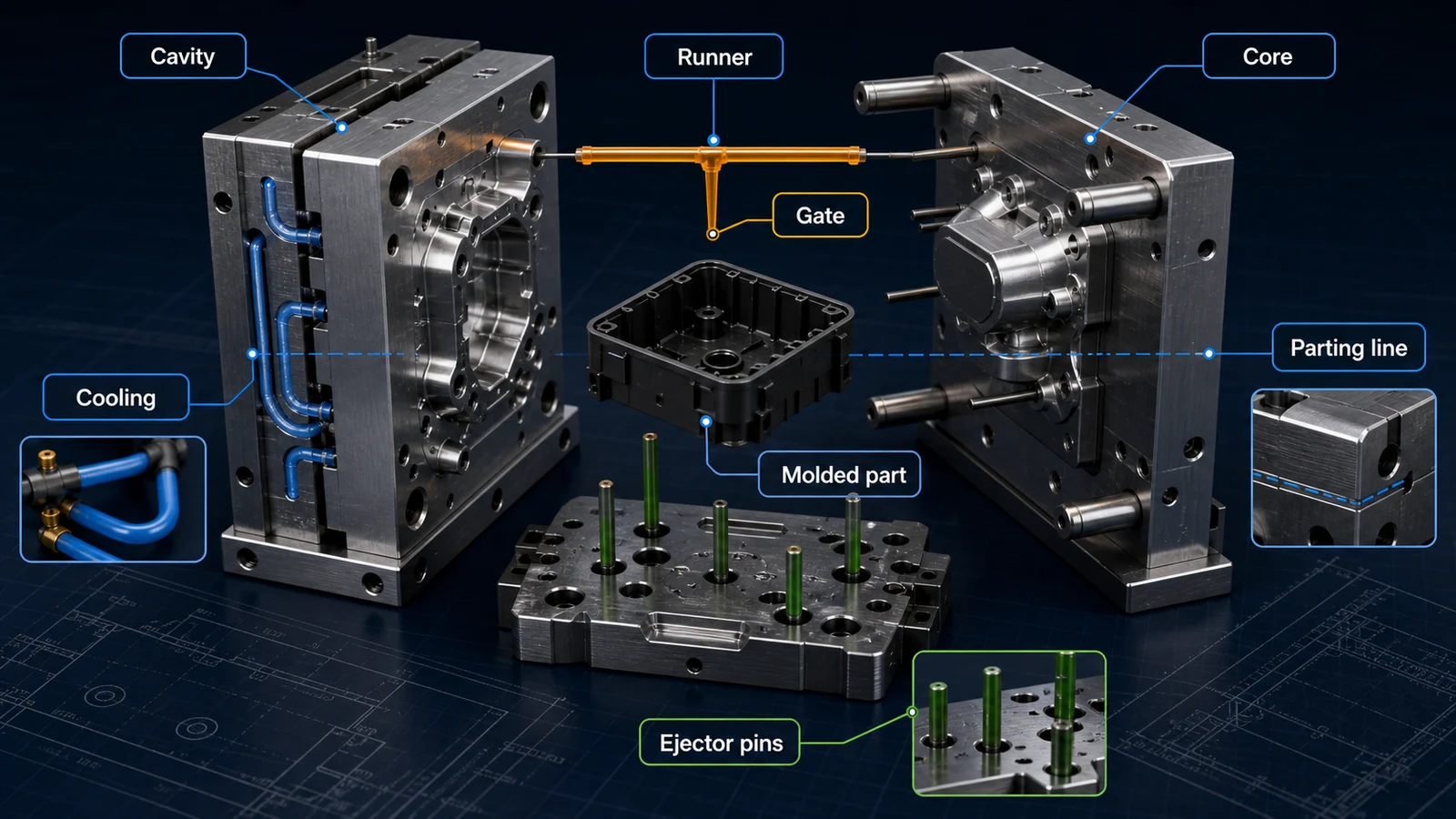
A prototype quote often covers one part or a small batch. An injection molding quote includes a tool that must produce repeatable parts. That tool contains decisions about shrinkage, cavity layout, gate location, ejection, cooling, sliders, parting line, surface texture and maintenance. Once steel is cut, design changes become more expensive.
Procurement engineers therefore need to evaluate both mold cost and production risk. A low mold price can become costly if the design has insufficient draft, thick walls, sink marks, weak bosses or a cosmetic gate location. A higher quote may include more careful mold design, better sampling support and clearer correction planning. The buyer should compare scope, not only price.
The RFQ should also explain whether the project is ready for tooling. If the part has not been tested, a CNC machined or 3D printed prototype may still be useful before mold investment. If the geometry is stable and volume justifies tooling, molding can deliver repeatable parts at a lower unit cost over time.
| Procurement area | What to confirm | Why it affects molding | Buyer decision |
|---|---|---|---|
| Tooling strategy | Soft tool, prototype tool or production tool | Controls mold cost, life and correction plan | Match tool to volume and design maturity |
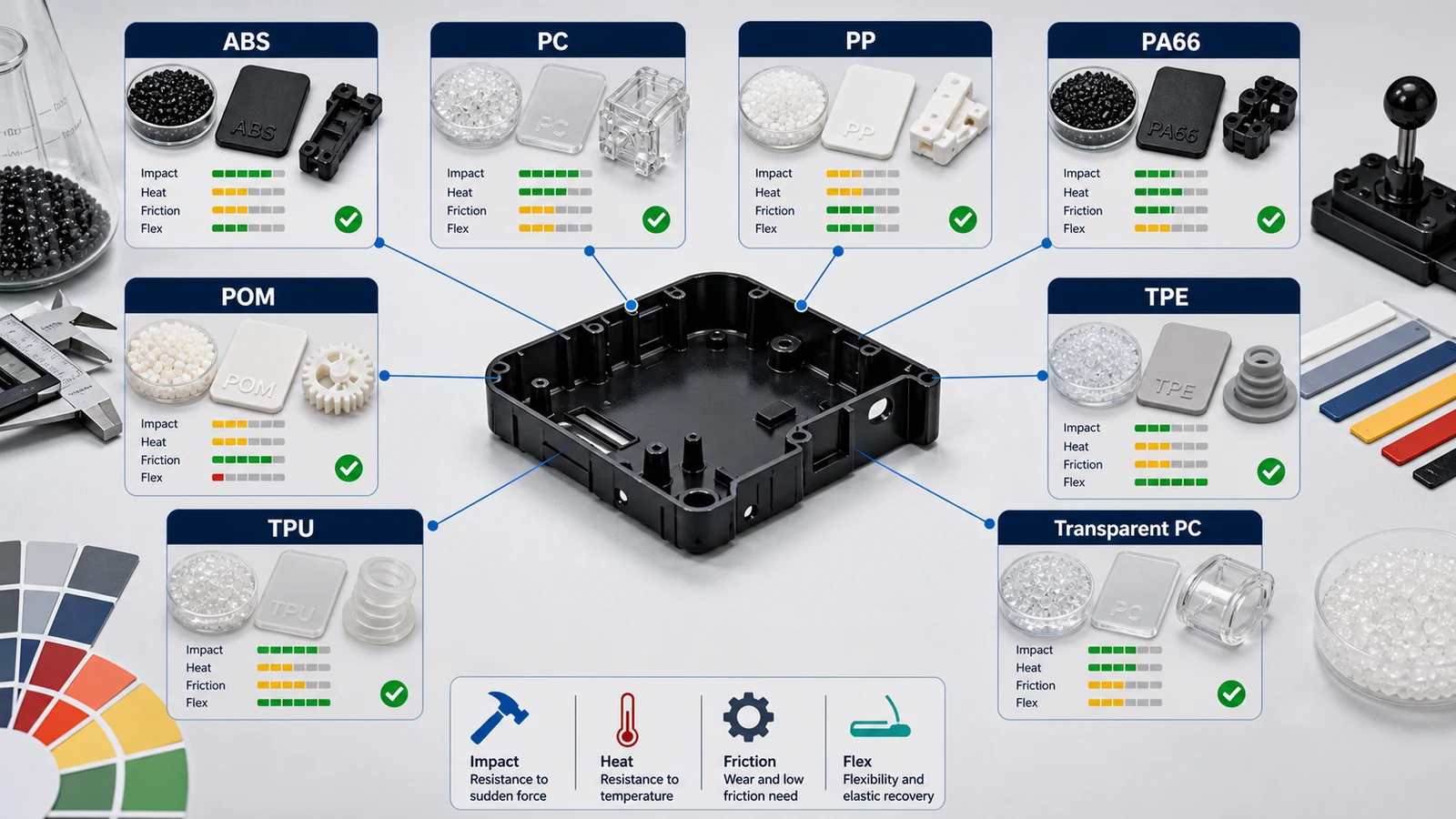
| Material | ABS, PC, PP, PA66, POM, TPE, TPU or transparent PC | Changes shrinkage, flow, strength and surface | Choose by environment and function |
| DFM | Draft, wall thickness, ribs, bosses and undercuts | Affects mold complexity and part quality | Review before cutting steel |
| Cosmetics | Texture, color, gate vestige and ejector marks | Controls visible acceptance | Define A-surface and mark zones |
| Sampling | T0 samples, inspection report and corrections | Validates tool and part before production | Plan approval criteria |
Engineering Checks Before Ordering Injection Molded Parts
Production volume and tooling strategy
Procurement review for production volume and tooling strategy starts before the supplier calculates price. The buyer should confirm prototype need, expected annual demand, life of tool, part revision risk and whether soft tooling or production tooling is appropriate. This is not paperwork for its own sake; it tells the manufacturing team which features carry function, which features are cosmetic, and which assumptions must be clarified before material is ordered or production time is reserved.
The engineering reason is simple: mold cost is justified by quantity, but early design uncertainty can make premature tooling expensive. When the RFQ leaves this detail open, two suppliers can quote the same model with completely different assumptions. One may quote a fast, low-cost route that cannot meet the application, while another may add unnecessary inspection or finishing cost. A disciplined RFQ makes the quote easier to compare and reduces changes after the purchase order.
The common risk is paying for a mold before the part design, material, texture or assembly behavior is stable. A small design choice can change build orientation, tooling access, fixture design, inspection method, surface protection, or packing. Buyers should avoid treating every dimension as equally critical. It is better to define the few features that control assembly, sealing, movement, or appearance, then allow standard manufacturing tolerance on non-critical areas.
For a useful supplier review, provide prototype history, target quantity, annual demand, life expectation, launch timing and expected design freeze point. Debaolong injection molding support can then review the data for manufacturability, flag cost drivers, and suggest a production route that matches function instead of only matching the CAD geometry. This is especially important when a prototype must later transition into CNC machining, sheet metal fabrication, injection molding, or a repeatable small-batch process.
Plastic material selection
Procurement review for plastic material selection starts before the supplier calculates price. The buyer should confirm mechanical strength, heat resistance, chemical exposure, flexibility, transparency, color, flame requirement and dimensional stability. This is not paperwork for its own sake; it tells the manufacturing team which features carry function, which features are cosmetic, and which assumptions must be clarified before material is ordered or production time is reserved.
The engineering reason is simple: material shrinkage, flow, stiffness and surface behavior affect mold design and final tolerance. When the RFQ leaves this detail open, two suppliers can quote the same model with completely different assumptions. One may quote a fast, low-cost route that cannot meet the application, while another may add unnecessary inspection or finishing cost. A disciplined RFQ makes the quote easier to compare and reduces changes after the purchase order.
The common risk is selecting a familiar resin name that does not match the actual use environment or cosmetic requirement. A small design choice can change build orientation, tooling access, fixture design, inspection method, surface protection, or packing. Buyers should avoid treating every dimension as equally critical. It is better to define the few features that control assembly, sealing, movement, or appearance, then allow standard manufacturing tolerance on non-critical areas.
For a useful supplier review, provide target material, acceptable alternatives, application temperature, load, exposure, color and regulatory or customer requirements if applicable. Debaolong injection molding support can then review the data for manufacturability, flag cost drivers, and suggest a production route that matches function instead of only matching the CAD geometry. This is especially important when a prototype must later transition into CNC machining, sheet metal fabrication, injection molding, or a repeatable small-batch process.
Wall thickness and uniformity
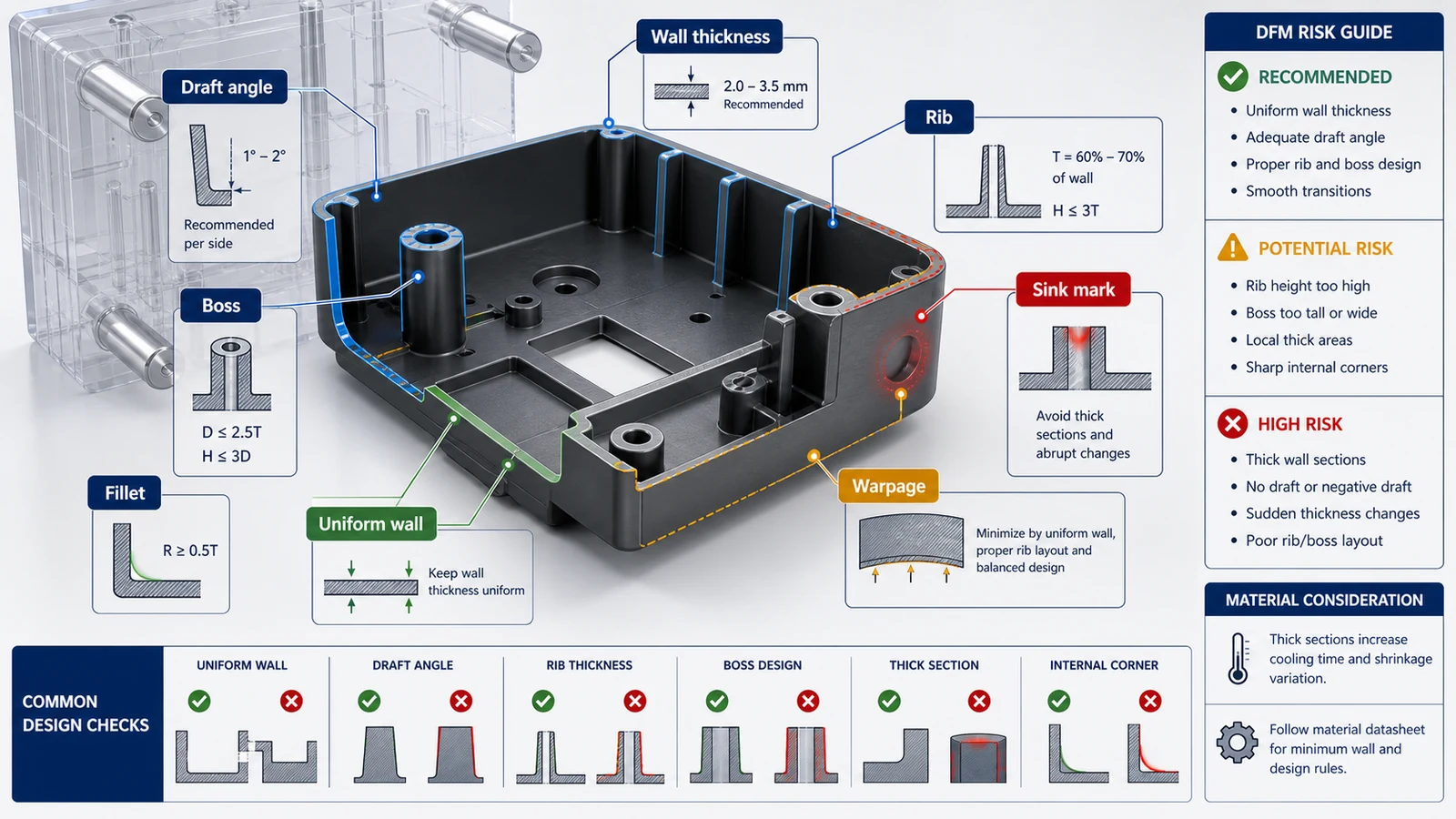
Procurement review for wall thickness and uniformity starts before the supplier calculates price. The buyer should confirm nominal wall, thick sections, abrupt transitions, ribs, bosses and areas near cosmetic surfaces. This is not paperwork for its own sake; it tells the manufacturing team which features carry function, which features are cosmetic, and which assumptions must be clarified before material is ordered or production time is reserved.
The engineering reason is simple: uneven wall thickness creates sink marks, voids, warpage, long cycle time and unpredictable shrinkage. When the RFQ leaves this detail open, two suppliers can quote the same model with completely different assumptions. One may quote a fast, low-cost route that cannot meet the application, while another may add unnecessary inspection or finishing cost. A disciplined RFQ makes the quote easier to compare and reduces changes after the purchase order.
The common risk is a part that looks acceptable in CAD but shows sink marks, short shots, warp or high molding stress. A small design choice can change build orientation, tooling access, fixture design, inspection method, surface protection, or packing. Buyers should avoid treating every dimension as equally critical. It is better to define the few features that control assembly, sealing, movement, or appearance, then allow standard manufacturing tolerance on non-critical areas.
For a useful supplier review, provide critical cosmetic surfaces, allowable wall changes, strength requirement and areas where geometry can be cored out. Debaolong injection molding support can then review the data for manufacturability, flag cost drivers, and suggest a production route that matches function instead of only matching the CAD geometry. This is especially important when a prototype must later transition into CNC machining, sheet metal fabrication, injection molding, or a repeatable small-batch process.
Draft angle and release direction
Procurement review for draft angle and release direction starts before the supplier calculates price. The buyer should confirm draft on walls, ribs, bosses, texture surfaces and undercuts relative to mold opening direction. This is not paperwork for its own sake; it tells the manufacturing team which features carry function, which features are cosmetic, and which assumptions must be clarified before material is ordered or production time is reserved.
The engineering reason is simple: insufficient draft causes ejection difficulty, scuff marks, longer cycle time and tooling complexity. When the RFQ leaves this detail open, two suppliers can quote the same model with completely different assumptions. One may quote a fast, low-cost route that cannot meet the application, while another may add unnecessary inspection or finishing cost. A disciplined RFQ makes the quote easier to compare and reduces changes after the purchase order.
The common risk is tool changes after mold trial because the part sticks, scratches or cannot release cleanly. A small design choice can change build orientation, tooling access, fixture design, inspection method, surface protection, or packing. Buyers should avoid treating every dimension as equally critical. It is better to define the few features that control assembly, sealing, movement, or appearance, then allow standard manufacturing tolerance on non-critical areas.
For a useful supplier review, provide preferred cosmetic side, texture requirement, release direction and features that cannot change. Debaolong injection molding support can then review the data for manufacturability, flag cost drivers, and suggest a production route that matches function instead of only matching the CAD geometry. This is especially important when a prototype must later transition into CNC machining, sheet metal fabrication, injection molding, or a repeatable small-batch process.
Gate location and flow path
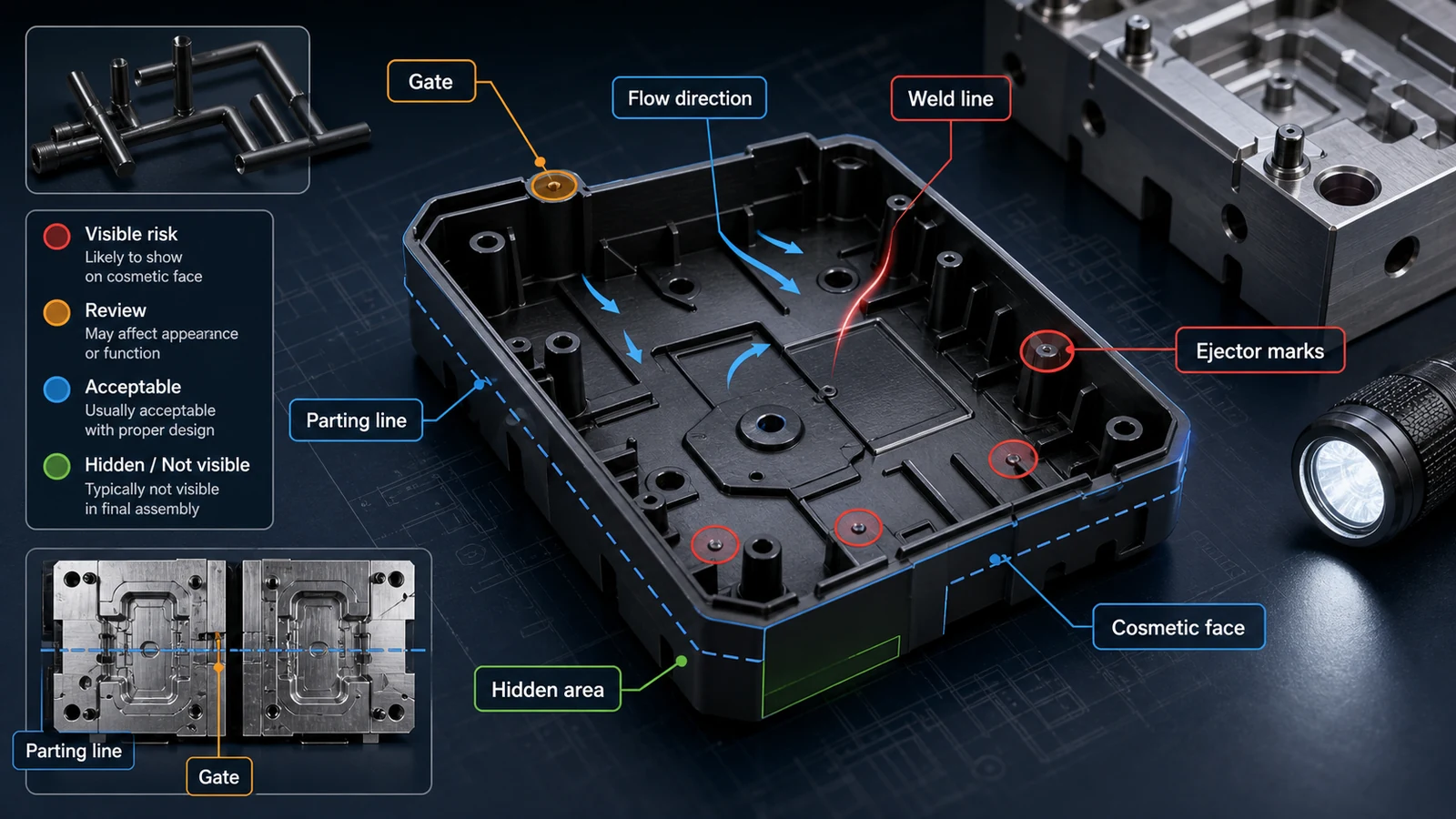
Procurement review for gate location and flow path starts before the supplier calculates price. The buyer should confirm where plastic enters, how flow reaches thin areas, whether weld lines appear on cosmetic or load-bearing zones and how gate vestige is handled. This is not paperwork for its own sake; it tells the manufacturing team which features carry function, which features are cosmetic, and which assumptions must be clarified before material is ordered or production time is reserved.
The engineering reason is simple: gate location controls filling, pressure, weld line risk, appearance and trimming effort. When the RFQ leaves this detail open, two suppliers can quote the same model with completely different assumptions. One may quote a fast, low-cost route that cannot meet the application, while another may add unnecessary inspection or finishing cost. A disciplined RFQ makes the quote easier to compare and reduces changes after the purchase order.
The common risk is visible gate marks, weak weld lines, short shots, air traps or unbalanced filling. A small design choice can change build orientation, tooling access, fixture design, inspection method, surface protection, or packing. Buyers should avoid treating every dimension as equally critical. It is better to define the few features that control assembly, sealing, movement, or appearance, then allow standard manufacturing tolerance on non-critical areas.
For a useful supplier review, provide cosmetic face, load areas, assembly surfaces, acceptable gate mark location and material flow concerns. Debaolong injection molding support can then review the data for manufacturability, flag cost drivers, and suggest a production route that matches function instead of only matching the CAD geometry. This is especially important when a prototype must later transition into CNC machining, sheet metal fabrication, injection molding, or a repeatable small-batch process.
Parting line, ejector marks and cosmetic surfaces
Procurement review for parting line, ejector marks and cosmetic surfaces starts before the supplier calculates price. The buyer should confirm parting line location, ejector pin marks, slider marks, texture break and visible areas. This is not paperwork for its own sake; it tells the manufacturing team which features carry function, which features are cosmetic, and which assumptions must be clarified before material is ordered or production time is reserved.
The engineering reason is simple: tooling marks are normal in molded parts but must be placed where they do not affect function or appearance. When the RFQ leaves this detail open, two suppliers can quote the same model with completely different assumptions. One may quote a fast, low-cost route that cannot meet the application, while another may add unnecessary inspection or finishing cost. A disciplined RFQ makes the quote easier to compare and reduces changes after the purchase order.
The common risk is unexpected lines, marks or flash on surfaces that customers see or that mate with other components. A small design choice can change build orientation, tooling access, fixture design, inspection method, surface protection, or packing. Buyers should avoid treating every dimension as equally critical. It is better to define the few features that control assembly, sealing, movement, or appearance, then allow standard manufacturing tolerance on non-critical areas.
For a useful supplier review, provide A-surface definition, mating surfaces, acceptable mark zones and cosmetic acceptance criteria. Debaolong injection molding support can then review the data for manufacturability, flag cost drivers, and suggest a production route that matches function instead of only matching the CAD geometry. This is especially important when a prototype must later transition into CNC machining, sheet metal fabrication, injection molding, or a repeatable small-batch process.
Inserts, threads, snap fits and assembly
Procurement review for inserts, threads, snap fits and assembly starts before the supplier calculates price. The buyer should confirm metal inserts, threaded bosses, heat staking, ultrasonic welding, snap-fit deflection and assembly load. This is not paperwork for its own sake; it tells the manufacturing team which features carry function, which features are cosmetic, and which assumptions must be clarified before material is ordered or production time is reserved.
The engineering reason is simple: assembly features can drive material choice, boss design, tooling actions and inspection requirements. When the RFQ leaves this detail open, two suppliers can quote the same model with completely different assumptions. One may quote a fast, low-cost route that cannot meet the application, while another may add unnecessary inspection or finishing cost. A disciplined RFQ makes the quote easier to compare and reduces changes after the purchase order.
The common risk is boss cracking, weak threads, snap-fit fatigue or assembly interference after shrinkage. A small design choice can change build orientation, tooling access, fixture design, inspection method, surface protection, or packing. Buyers should avoid treating every dimension as equally critical. It is better to define the few features that control assembly, sealing, movement, or appearance, then allow standard manufacturing tolerance on non-critical areas.
For a useful supplier review, provide fastener standard, torque, insert type, assembly method, mating part data and cycle expectations. Debaolong injection molding support can then review the data for manufacturability, flag cost drivers, and suggest a production route that matches function instead of only matching the CAD geometry. This is especially important when a prototype must later transition into CNC machining, sheet metal fabrication, injection molding, or a repeatable small-batch process.
Sampling, mold trial and inspection
Procurement review for sampling, mold trial and inspection starts before the supplier calculates price. The buyer should confirm T0 or first trial goals, sample quantity, dimensional report, visual review, fit test and correction loop. This is not paperwork for its own sake; it tells the manufacturing team which features carry function, which features are cosmetic, and which assumptions must be clarified before material is ordered or production time is reserved.
The engineering reason is simple: the first molded sample validates tooling, shrinkage, appearance and process stability. When the RFQ leaves this detail open, two suppliers can quote the same model with completely different assumptions. One may quote a fast, low-cost route that cannot meet the application, while another may add unnecessary inspection or finishing cost. A disciplined RFQ makes the quote easier to compare and reduces changes after the purchase order.
The common risk is approving production before the part has been reviewed against function, appearance and drawing requirements. A small design choice can change build orientation, tooling access, fixture design, inspection method, surface protection, or packing. Buyers should avoid treating every dimension as equally critical. It is better to define the few features that control assembly, sealing, movement, or appearance, then allow standard manufacturing tolerance on non-critical areas.
For a useful supplier review, provide sample review plan, critical dimensions, assembly test, cosmetic standard and approval process. Debaolong injection molding support can then review the data for manufacturability, flag cost drivers, and suggest a production route that matches function instead of only matching the CAD geometry. This is especially important when a prototype must later transition into CNC machining, sheet metal fabrication, injection molding, or a repeatable small-batch process.
Cost, Lead Time and Quote Comparison Logic
Injection molding cost has two parts: tooling investment and molded part production. Tooling cost depends on part size, complexity, material, cavity count, sliders, lifters, inserts, texture, polishing, cooling and expected life. Unit cost depends on resin, cycle time, scrap risk, labor, inspection, packaging and production quantity.
A buyer should be cautious when a quote is much lower than others. It may assume a simpler mold, lower mold life, limited sampling, no texture, no difficult slider, no material certification support, or minimal correction work. Those assumptions may be acceptable for a prototype tool, but they should be visible.
Lead time includes mold design, material ordering, machining, fitting, polishing, assembly, first trial, sample review and correction. If the part requires texture, inserts, transparent finish or tight appearance standards, buyers should allow time for review and adjustment rather than treating the first shot as production release.
| RFQ area | Buyer should confirm | Typical risk | Useful supplier input |
|---|---|---|---|
| Production volume and tooling strategy | prototype need, expected annual demand, life of tool, part revision risk and whether soft tooling or production tooling is appropriate | paying for a mold before the part design, material, texture or assembly behavior is stable | prototype history, target quantity, annual demand, life expectation, launch timing and expected design freeze point |
| Plastic material selection | mechanical strength, heat resistance, chemical exposure, flexibility, transparency, color, flame requirement and dimensional stability | selecting a familiar resin name that does not match the actual use environment or cosmetic requirement | target material, acceptable alternatives, application temperature, load, exposure, color and regulatory or customer requirements if applicable |
| Wall thickness and uniformity | nominal wall, thick sections, abrupt transitions, ribs, bosses and areas near cosmetic surfaces | a part that looks acceptable in CAD but shows sink marks, short shots, warp or high molding stress | critical cosmetic surfaces, allowable wall changes, strength requirement and areas where geometry can be cored out |
| Draft angle and release direction | draft on walls, ribs, bosses, texture surfaces and undercuts relative to mold opening direction | tool changes after mold trial because the part sticks, scratches or cannot release cleanly | preferred cosmetic side, texture requirement, release direction and features that cannot change |
| Gate location and flow path | where plastic enters, how flow reaches thin areas, whether weld lines appear on cosmetic or load-bearing zones and how gate vestige is handled | visible gate marks, weak weld lines, short shots, air traps or unbalanced filling | cosmetic face, load areas, assembly surfaces, acceptable gate mark location and material flow concerns |
| Parting line, ejector marks and cosmetic surfaces | parting line location, ejector pin marks, slider marks, texture break and visible areas | unexpected lines, marks or flash on surfaces that customers see or that mate with other components | A-surface definition, mating surfaces, acceptable mark zones and cosmetic acceptance criteria |
| Inserts, threads, snap fits and assembly | metal inserts, threaded bosses, heat staking, ultrasonic welding, snap-fit deflection and assembly load | boss cracking, weak threads, snap-fit fatigue or assembly interference after shrinkage | fastener standard, torque, insert type, assembly method, mating part data and cycle expectations |
| Sampling, mold trial and inspection | T0 or first trial goals, sample quantity, dimensional report, visual review, fit test and correction loop | approving production before the part has been reviewed against function, appearance and drawing requirements | sample review plan, critical dimensions, assembly test, cosmetic standard and approval process |
Inspection, Packing and Delivery Expectations
Inspection for injection molded parts should include both dimensional and visual review. Dimensional checks confirm critical fit, hole location, snap features, flatness and assembly interfaces. Visual checks confirm color, texture, gate marks, sink marks, weld lines, flash, ejector marks and scratches.
The buyer should define which dimensions are critical and how they are measured. Plastic parts can vary with conditioning, cooling time and measurement method. A clear drawing and approval process help the supplier prepare meaningful samples and avoid arguments about non-critical dimensions.
| Inspection or review point | Why it matters | What to provide |
|---|---|---|
| First sample dimensions | Confirms shrinkage and tooling accuracy | Critical dimensions and datum references |
| Cosmetic review | Confirms visible surfaces, color and texture | A-surface definition and acceptance standard |
| Gate and ejector marks | Controls appearance and mating surfaces | Allowed mark zones and trim requirement |
| Assembly fit | Proves snap fits, inserts and mating parts | Mating components and test method |
| Production release | Confirms corrections before volume production | Approval process and inspection sampling |
Practical Procurement Scenarios
Scenario 1: Early Design Validation
In early design validation, the procurement engineer should use production volume and tooling strategy as a decision point rather than a checklist item. The practical question is whether the supplier has enough information to judge prototype need, expected annual demand, life of tool, part revision risk and whether soft tooling or production tooling is appropriate. When this is unclear, the quote may look complete, but the manufacturing route can still contain hidden assumptions about tolerance, fixture access, finishing, inspection or later production conversion.
The buyer can reduce risk by asking the supplier to explain the manufacturing consequence of the requirement. For this area, the reason is that mold cost is justified by quantity, but early design uncertainty can make premature tooling expensive. If the supplier identifies paying for a mold before the part design, material, texture or assembly behavior is stable, the buyer should not treat it as a sales objection. It is a signal that the RFQ needs clearer engineering boundaries before cost and lead time are reliable.
A strong RFQ response should convert the concern into an action: confirm the drawing note, adjust a non-critical feature, separate cosmetic and functional surfaces, define the inspection method, or approve a manufacturable alternative. The most useful buyer input is prototype history, target quantity, annual demand, life expectation, launch timing and expected design freeze point. This keeps the conversation focused on fit, function, repeatability and delivery, not only on unit price.
Scenario 2: Buyer-Side Quote Comparison
In buyer-side quote comparison, the procurement engineer should use plastic material selection as a decision point rather than a checklist item. The practical question is whether the supplier has enough information to judge mechanical strength, heat resistance, chemical exposure, flexibility, transparency, color, flame requirement and dimensional stability. When this is unclear, the quote may look complete, but the manufacturing route can still contain hidden assumptions about tolerance, fixture access, finishing, inspection or later production conversion.
The buyer can reduce risk by asking the supplier to explain the manufacturing consequence of the requirement. For this area, the reason is that material shrinkage, flow, stiffness and surface behavior affect mold design and final tolerance. If the supplier identifies selecting a familiar resin name that does not match the actual use environment or cosmetic requirement, the buyer should not treat it as a sales objection. It is a signal that the RFQ needs clearer engineering boundaries before cost and lead time are reliable.
A strong RFQ response should convert the concern into an action: confirm the drawing note, adjust a non-critical feature, separate cosmetic and functional surfaces, define the inspection method, or approve a manufacturable alternative. The most useful buyer input is target material, acceptable alternatives, application temperature, load, exposure, color and regulatory or customer requirements if applicable. This keeps the conversation focused on fit, function, repeatability and delivery, not only on unit price.
Scenario 3: Small-Batch Launch Support
In small-batch launch support, the procurement engineer should use wall thickness and uniformity as a decision point rather than a checklist item. The practical question is whether the supplier has enough information to judge nominal wall, thick sections, abrupt transitions, ribs, bosses and areas near cosmetic surfaces. When this is unclear, the quote may look complete, but the manufacturing route can still contain hidden assumptions about tolerance, fixture access, finishing, inspection or later production conversion.
The buyer can reduce risk by asking the supplier to explain the manufacturing consequence of the requirement. For this area, the reason is that uneven wall thickness creates sink marks, voids, warpage, long cycle time and unpredictable shrinkage. If the supplier identifies a part that looks acceptable in CAD but shows sink marks, short shots, warp or high molding stress, the buyer should not treat it as a sales objection. It is a signal that the RFQ needs clearer engineering boundaries before cost and lead time are reliable.
A strong RFQ response should convert the concern into an action: confirm the drawing note, adjust a non-critical feature, separate cosmetic and functional surfaces, define the inspection method, or approve a manufacturable alternative. The most useful buyer input is critical cosmetic surfaces, allowable wall changes, strength requirement and areas where geometry can be cored out. This keeps the conversation focused on fit, function, repeatability and delivery, not only on unit price.
Scenario 4: Production Transition Review
In production transition review, the procurement engineer should use draft angle and release direction as a decision point rather than a checklist item. The practical question is whether the supplier has enough information to judge draft on walls, ribs, bosses, texture surfaces and undercuts relative to mold opening direction. When this is unclear, the quote may look complete, but the manufacturing route can still contain hidden assumptions about tolerance, fixture access, finishing, inspection or later production conversion.
The buyer can reduce risk by asking the supplier to explain the manufacturing consequence of the requirement. For this area, the reason is that insufficient draft causes ejection difficulty, scuff marks, longer cycle time and tooling complexity. If the supplier identifies tool changes after mold trial because the part sticks, scratches or cannot release cleanly, the buyer should not treat it as a sales objection. It is a signal that the RFQ needs clearer engineering boundaries before cost and lead time are reliable.
A strong RFQ response should convert the concern into an action: confirm the drawing note, adjust a non-critical feature, separate cosmetic and functional surfaces, define the inspection method, or approve a manufacturable alternative. The most useful buyer input is preferred cosmetic side, texture requirement, release direction and features that cannot change. This keeps the conversation focused on fit, function, repeatability and delivery, not only on unit price.
Scenario 5: Incoming Inspection Planning
In incoming inspection planning, the procurement engineer should use gate location and flow path as a decision point rather than a checklist item. The practical question is whether the supplier has enough information to judge where plastic enters, how flow reaches thin areas, whether weld lines appear on cosmetic or load-bearing zones and how gate vestige is handled. When this is unclear, the quote may look complete, but the manufacturing route can still contain hidden assumptions about tolerance, fixture access, finishing, inspection or later production conversion.
The buyer can reduce risk by asking the supplier to explain the manufacturing consequence of the requirement. For this area, the reason is that gate location controls filling, pressure, weld line risk, appearance and trimming effort. If the supplier identifies visible gate marks, weak weld lines, short shots, air traps or unbalanced filling, the buyer should not treat it as a sales objection. It is a signal that the RFQ needs clearer engineering boundaries before cost and lead time are reliable.
A strong RFQ response should convert the concern into an action: confirm the drawing note, adjust a non-critical feature, separate cosmetic and functional surfaces, define the inspection method, or approve a manufacturable alternative. The most useful buyer input is cosmetic face, load areas, assembly surfaces, acceptable gate mark location and material flow concerns. This keeps the conversation focused on fit, function, repeatability and delivery, not only on unit price.
Common RFQ Mistakes That Create Rework
Starting tooling before design validation
If the part has not been tested for fit, material or function, mold changes may be needed later. Prototype validation can reduce tooling risk.
Ignoring draft angle
Insufficient draft can cause sticking, scuff marks, longer cycles and tool changes. Draft should be checked on ribs, bosses, walls and textured surfaces.
Using wall thickness from the CAD model without DFM review
Thick sections and abrupt transitions can create sink marks, voids and warpage. Uniform wall and coring should be reviewed before mold design.
Not defining cosmetic surfaces
Gate marks, ejector marks and parting lines are normal, but they should not appear in critical visible or mating areas without approval.
Comparing mold prices without scope
A tooling quote should explain cavity count, mold material, sliders, sampling, texture, corrections and production assumptions. Price alone can hide risk.
How to Communicate With a Manufacturing Supplier
A productive injection molding RFQ asks the supplier to comment on DFM before final price approval. Buyers should ask where draft is missing, where wall thickness may sink, where the gate should be placed, whether sliders are required, and which surfaces may show marks.
The buyer should also ask what information is still missing. Common gaps include material grade, color standard, texture reference, annual volume, insert details, critical dimensions and sample approval method. Filling those gaps before tooling reduces later changes.
When the project is early, buyers can ask whether CNC machining or 3D printing should be used before molding. A small investment in prototype validation can prevent expensive mold corrections and make the injection molding quote more reliable.
Debaolong Engineering Note
Debaolong can review injection molded part RFQs for tooling strategy, material selection, DFM, surface texture, gate and parting line risk, sampling plan and inspection priorities. The goal is to help buyers avoid premature tooling decisions and prepare clearer quote packages.
FAQ
What files are needed for an injection molding quote?
Send a 3D CAD model, 2D drawing, material requirement, quantity, finish, color, texture, critical dimensions, cosmetic surface notes and expected production volume.
Why does injection molding require draft angle?
Draft allows the part to release from the mold. Without enough draft, the part can stick, scuff, deform or require tool changes.
How does mold cost relate to production volume?
Higher volume can justify a more durable or multi-cavity mold because the tooling cost is spread across more parts. Low volume may need a simpler tooling strategy.
Can I use 3D printing before injection molding?
Yes. 3D printing or CNC machining can help validate fit, ergonomics and assembly before investing in tooling, although printed parts do not fully represent molded shrinkage.
What should be checked during mold trial?
Check critical dimensions, shrinkage, gate marks, ejector marks, sink, warpage, color, texture, assembly fit and whether corrections are needed before production release.
Can Debaolong support injection molding DFM review?
Yes. Debaolong can review plastic part design, material, tooling risk, sampling and production assumptions before quoting or launching tooling.
Request a Manufacturing Quote
Send drawings, CAD files, material requirements, quantity, surface finish, tolerance notes, inspection requirements and application context. Shenzhen Debaolong Seiko Co., Ltd. can review manufacturability and support prototypes, small batches and production-ready custom manufacturing for overseas engineering and procurement teams.