

Primary Keywords
- CNC surface finish
- Ra roughness machining
- surface roughness standard
- machining surface quality
- CNC machining surface finish guide
1. Introduction — Why Surface Finish Matters
Surface finish is a critical parameter in precision machining.
It affects not only the appearance of a component but also its functional performance.
Surface roughness influences:
- friction behavior
- sealing capability
- wear resistance
- fatigue life
- assembly fit
In high-precision industries such as robotics, aerospace, and automation equipment, surface finish requirements are often strictly specified on engineering drawings.
The most commonly used parameter for describing surface finish is Ra (Average Roughness).
2. What is Surface Roughness (Ra)?
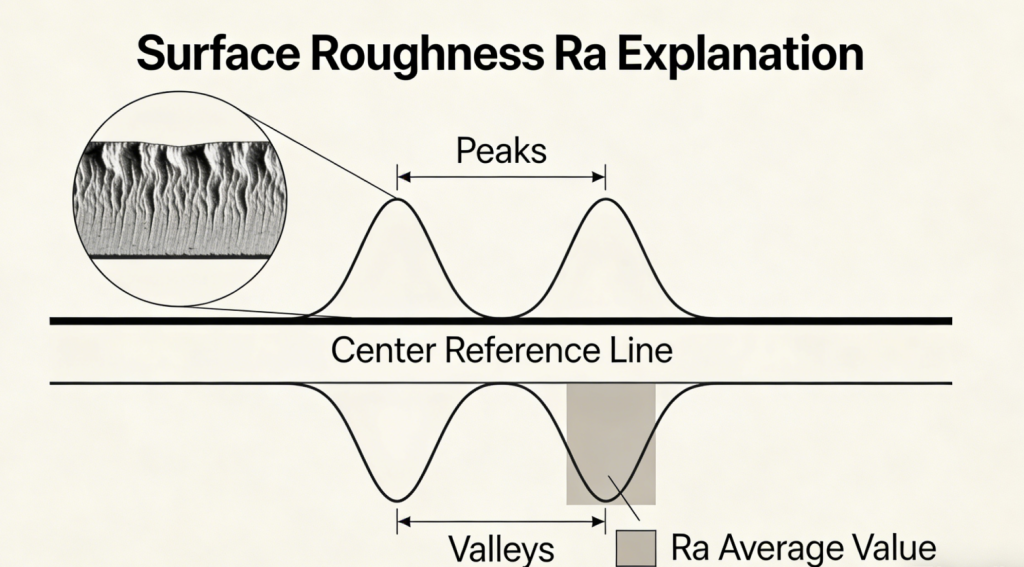
Surface roughness describes the microscopic irregularities present on a machined surface.
The Ra value represents the arithmetic average deviation of the surface profile from the mean line.
Formula concept:
Ra = average height deviation of surface peaks and valleys.
Lower Ra values indicate smoother surfaces.
Typical units:
- micrometers (µm)
- microinches (µin)
3. Typical CNC Surface Finish Levels
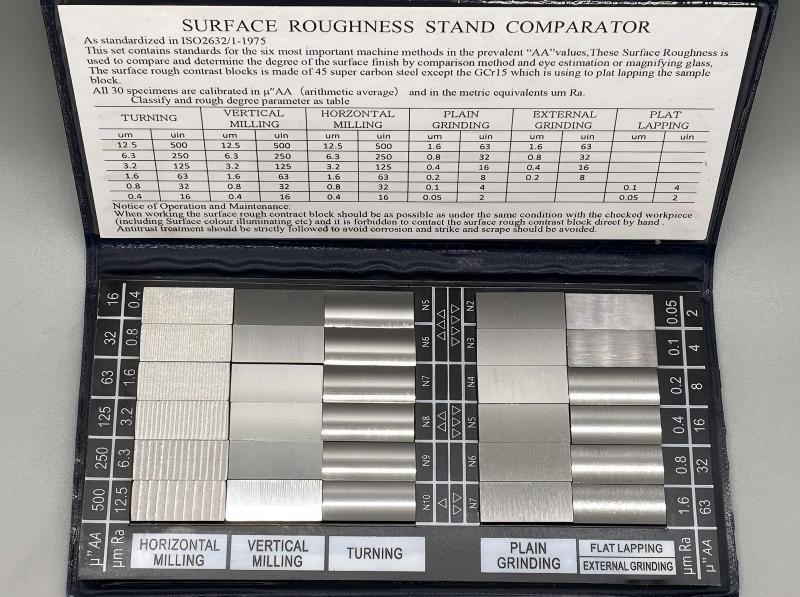
| Surface Finish | Ra Value | Typical Process |
|---|---|---|
| Rough machining | Ra 6.3 – 12.5 µm | Rough milling |
| Standard machining | Ra 3.2 µm | General CNC milling |
| Precision machining | Ra 1.6 µm | Finish milling |
| High precision finish | Ra 0.8 µm | Fine machining |
| Ultra-smooth surface | Ra 0.4 µm | Grinding / polishing |
Most CNC machined parts fall within Ra 3.2 to Ra 1.6 µm depending on application requirements.
4. Engineering Applications of Different Surface Finishes
Ra 6.3 – General Structural Parts
Typical components:
- machine frames
- structural brackets
- mounting plates
Surface quality is not critical as long as dimensional accuracy is maintained.
Ra 3.2 – Standard CNC Machining
Most common finish for:
- industrial components
- mechanical housings
- aluminum structural parts
Provides a balance between machining efficiency and acceptable appearance.
Ra 1.6 – Precision Mechanical Parts
Common for:
- bearing housings
- sliding surfaces
- assembly interfaces
This level ensures stable mechanical contact.
Ra 0.8 or lower – High Precision Applications
Used for:
- sealing surfaces
- precision optical mounts
- high-speed mechanical systems
Such finishes usually require specialized machining strategies.
5. Factors Affecting Surface Finish in CNC Machining
Surface roughness is influenced by several engineering factors.
Cutting tool geometry
Sharp cutting edges produce smoother surfaces.
Tool wear gradually increases surface roughness.
Feed rate
Higher feed rates typically increase surface roughness.
Lower feed rates improve finish quality.
Spindle speed
Higher spindle speeds often reduce cutting marks and improve surface quality.
However, excessive speed may introduce vibration.
Material properties
Different materials produce different surface characteristics.
Examples:
Aluminum alloys generally achieve smoother finishes more easily than stainless steel.
Titanium alloys require careful cutting strategies due to their toughness.
6. Tool Path Strategy and Surface Quality
Tool path planning significantly affects surface finish.
Common strategies include:
- parallel finishing
- contour machining
- spiral tool paths
Advanced CAM software optimizes tool orientation and step-over distances to minimize surface irregularities.
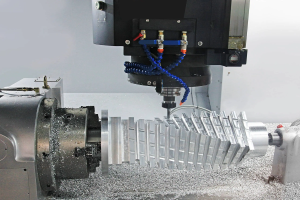
In 5-axis machining, tool orientation can further improve surface smoothness on complex geometries.
7. Surface Finish Measurement Methods
Surface roughness must be verified using precision measurement equipment.
Common inspection tools include:
Surface roughness tester
Measures Ra value directly through stylus contact with the surface profile.
Optical measurement systems
Use laser scanning or optical sensors to evaluate surface texture.
Profilometers
Provide detailed surface profile analysis for engineering verification.
These measurement systems ensure surface finish meets drawing requirements.
8. Engineering Strategy for Surface Finish Optimization
Precision manufacturers typically apply several strategies to achieve stable surface quality.
Examples include:
• optimized cutting parameters
• rigid machine structures
• high-precision tooling
• stable fixturing systems
• controlled machining environments
Consistent process control is essential for maintaining repeatable surface finish across production batches.
9. Conclusion
Surface finish plays a critical role in the functional performance of machined components.
Understanding Ra roughness standards allows engineers to balance:
- machining efficiency
- component performance
- manufacturing cost
Appropriate surface finish selection ensures reliable product performance without unnecessary manufacturing complexity.
Precision machining is not only about dimensional accuracy but also about controlling microscopic surface characteristics.
Related Engineering Guides
- CNC Machining Tolerance Standards (ISO2768)
- 5-Axis vs 3-Axis CNC Machining
- Aluminum Machining Strategy