
Two graduates of the Massachusetts Institute of Technology (MIT) have developed an innovative and engaging method aimed at reducing the amount of food waste sent to landfills. Biru Cao and Yiqing Wang’s FOODres.AI solution is an artificial intelligence (AI)-powered desktop 3D printer designed to transform food scraps into functional household items.
In the United States, up to 30-40% of the food supply is discarded. While this 3D printer is not a systemic solution to the problem of food waste, it offers individuals a creative way to minimize and reuse their own organic waste, fostering greater circularity within households.
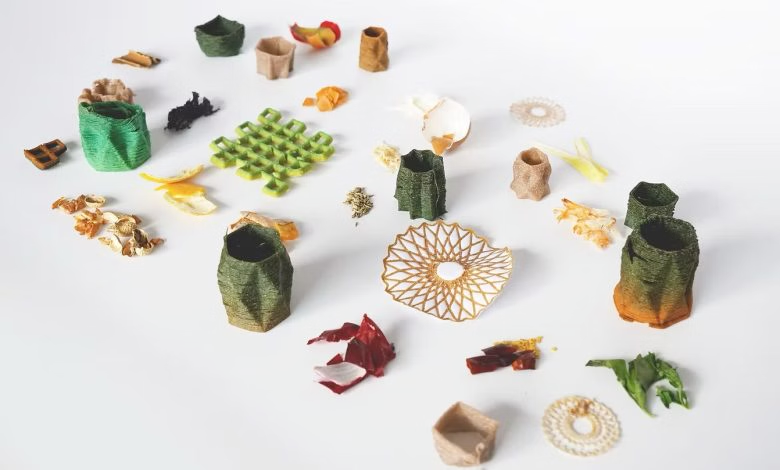
The FOODres.AI project began within the framework of MIT’s IDEAS Initiative, a social innovation challenge that invites students to develop innovative solutions to social and environmental challenges. Cao and Wang were interested in creating a technology that could effectively convert kitchen food scraps into functional products, such as coasters, pen holders, or other small decorative items.
How FOODres.AI Works
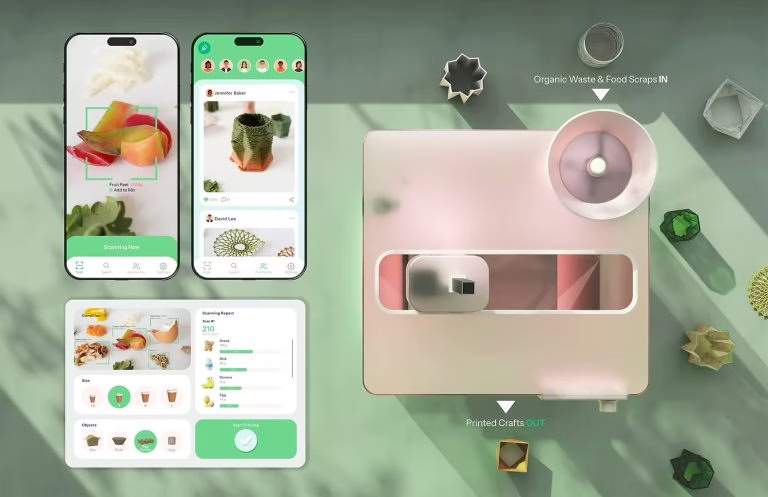
The FOODres.AI solution includes not only a desktop extrusion 3D printing system but also a mobile application powered by AI tools and a material mixing module. According to the printer’s developers: “The machine and mobile app utilize artificial intelligence to classify materials based on printable recipes via the phone’s camera. Users simply add food waste, select their desired shape and size, and print the item.”
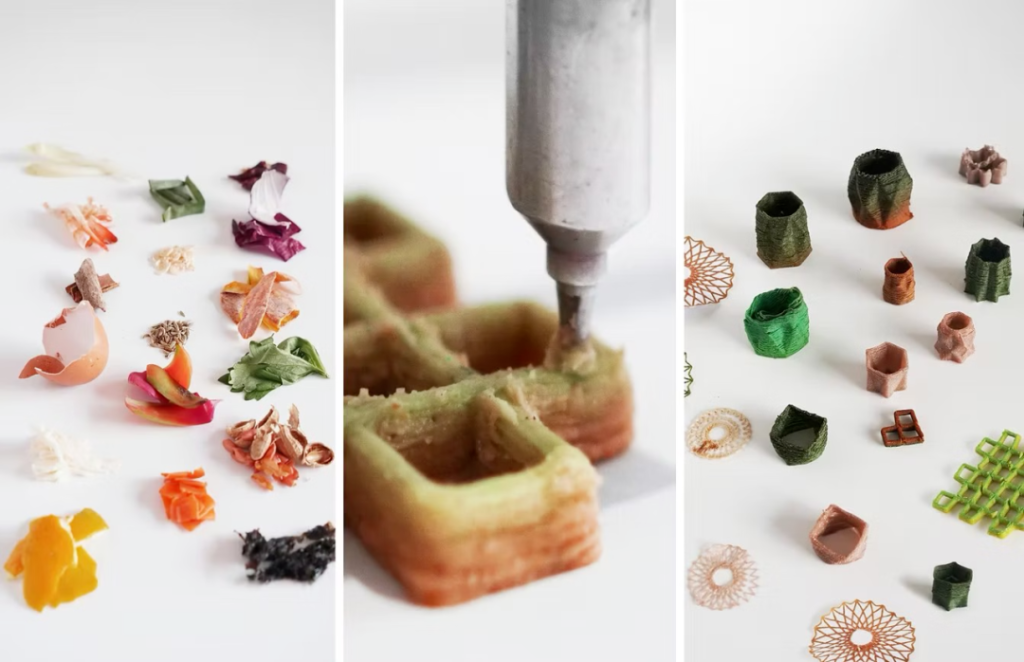
Items like onion peels and eggshells are detected by a self-trained AI model within the user’s mobile app. This tool evaluates the printability of the waste and informs the user which organic materials to place into the built-in material processing module. This module is a key component of the FOODres.AI solution: it combines food waste with natural additives to create a printable bioplastic paste. This material is then fed into the 3D printer, which uses an extruder with automatic heating and filling capabilities to deposit the material onto the build platform.
User Experience and Customization
FOODres.AI 3D Printer Transforms Food Waste into Items
Users can choose from a range of pre-designed models or create their own 3D models for printing. For the former, the two MIT graduates have built a user-friendly model library containing various items. “The interface is beginner-friendly, guiding users through detection, item selection, and printing. It also supports advanced customization, allowing users to mix materials for different colors and textures, with AI-assisted adjustments to ensure print quality. This flexibility makes the FOODres.AI printer accessible to everyone, regardless of prior 3D printing experience,” describes the project’s website.
Recognition and Impact
Ultimately, the FOODres.AI project provides an ingenious and enjoyable solution for those seeking greater circularity and looking to exercise their creative skills. The project has also gained attention in the design world, being named a Platinum Winner of the 2024-2025 A’Design Award and winning the iF Design Award in 2025.
For more information, please contact us at Debaolong Seiko. You are also welcome to upload your design to Debaolong Seiko for a quote.