
Swiss turning originated in Switzerland. It was formerly used in the watchmaking industry. As you know, watch parts are extremely small in size. Therefore, Swiss turning was initially designed for machining smaller components. Beyond watchmaking, small parts are utilized in various industries such as aerospace and electronics. This article covers comprehensive information related to Swiss turning, including its advantages, types, and more. So, let’s get started.
What is a Swiss Lathe?
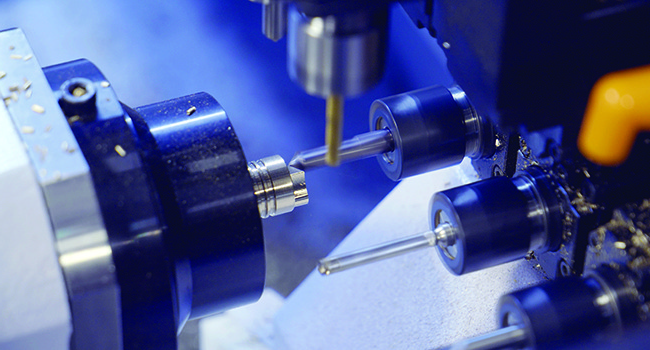
A Swiss lathe goes by several names; you can call it a Swiss-type lathe or a Swiss screw machine. Swiss lathes are used to machine small, complex parts. Equipped with multiple tools, the machine can perform several operations simultaneously. As part of Computer Numerical Control (CNC), it differs from traditional lathes. It is designed for producing small, precise, and complex components.
Understanding the Swiss Turning Process
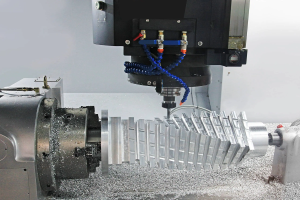
The workflow of the Swiss turning process is the opposite of traditional lathes, but the core concept remains the same. In this machine, the workpiece is held in a guide bushing and moved axially, while the cutting tools stay stationary. In a single setup, you can perform various operations, including milling, threading, and turning.
What is Swiss Turning Capability?
Swiss machines boast key features such as tight tolerances and high precision. These characteristics are critical for the durability and fault resistance of components. When a workpiece’s dimensions perfectly match the desired design and its surface finish is excellent, costs and material waste are reduced.
The Role of Precision in Swiss CNC Machines
Precision is the cornerstone of successful component applications in any field. High-precision parts prevent failures, personal injuries, and economic losses.
Why Swiss Machining Reduces Material Waste
The precision of any part or component is linked to its stability during machining. If a workpiece vibrates during cutting, it leads to dimensional errors and, in some cases, cutting tool breakage. However, with Swiss CNC machines, precision is not a concern. A key component of Swiss CNC machines—the guide bushing—supports the workpiece’s stability near the cutting tool. This stability minimizes material waste and tool deflection.
History and Evolution of Swiss Lathes
Let’s delve into the history of Swiss lathes in more detail:
Origins of Swiss Lathes in Watchmaking
In the 19th century, Switzerland’s watchmaking industry thrived. Traditional Swiss machines had low demands for part precision and durability. To address dimensional accuracy issues, Swiss engineers designed a new type of Swiss lathe equipped with a guide bushing to support workpiece stability during machining.
From Manual to CNC Swiss Lathes
In the mid-20th century, CNC Swiss lathes emerged. Early Swiss lathes were manual, requiring highly skilled operators and operating at slow production speeds. Later, automated features were introduced to CNC Swiss lathes.
Development of Swiss-Type Machines
The evolution of Swiss-type machines is tied to diverse industries and their needs. These machines vary based on features like live tools and automatic bar feeders.
Benefits of Using Swiss-Type Lathes
Here are some key advantages of using Swiss lathes:
Precision and Accuracy
The machine’s design includes a guide bushing and a sliding headstock. These components ensure the part remains 100% stable during machining, enhancing precision and accuracy.
Reduced Cycle Time and Improved Efficiency
When a workpiece is stable (e.g., no vibration), reworking is unnecessary, reducing cycle time and boosting efficiency.
Excellent Surface Finish and Tolerances
Superior surface finish and tight tolerances are vital for component durability. Swiss machining achieves exceptional surface-related properties.
How Swiss CNC Machines Boost Productivity
Swiss CNC machines are equipped with multiple cutting tools, making it easy to perform operations like drilling and milling simultaneously. These concurrent operations increase productivity and output.
Cost-Effectiveness in Mass Production
If post-turning operations are unnecessary, component production costs are significantly lower. In mass production, Swiss CNC turning ensures parts require minimal post-turning, making it cost-effective.
Limitations of Swiss-Type CNC Turning
Now, let’s explore some limitations of Swiss CNC turning:
High Initial Setup Cost of Swiss CNC Machines
Swiss CNC machines are advanced, featuring numerous functions that make them expensive. Additionally, their installation costs are high.
Material Limitations in Swiss-Type Machining
While versatile, Swiss-type machining has material restrictions. It can process various materials, including composites and polymers, but options are limited. Extremely hard and brittle materials like high-carbon steel pose challenges. These materials cause tool wear and reduce workpiece reliability.
What Materials Can Be Used in Swiss CNC Machining?
As mentioned, Swiss CNC machining works with various materials; common ones include:
- Metals: Aluminum, brass, stainless steel, titanium, copper
- Plastics: Delrin, PEEK, nylon
- Composites: Carbon fiber and glass fiber
Complexity of Operating Swiss CNC Machines
From an operation and maintenance standpoint, Swiss CNC machines are highly complex due to their advanced nature and reliance on CNC programming. They require highly skilled operators.
Swiss Turning vs. Traditional Turning
We previously mentioned traditional turning; now, let’s examine the differences in depth.
What is the Difference Between Swiss Lathes and Regular Lathes?
The primary differences lie in machine design and functionality:
Swiss Lathes
- Include a guide bushing to support the workpiece near the cutting tool
- This design’s stability simplifies machining small, complex parts with perfection
- Reduce tool deflection and dimensional errors
- Commonly used in watchmaking and electronics industries
Traditional Lathes
- Use a chuck to hold the workpiece, which rotates as the cutting tool moves
- Stability is harder to maintain for slender components
- Manual and easy to use
- Used for threading, facing, etc.
How Swiss CNC Machining Delivers Higher Precision
Swiss CNC machines are equipped with advanced features like bushing guides, high-resolution encoders, and control systems. They offer superior precision because:
- Bushing guides provide exceptional workpiece stability
- Multi-axis capabilities enable complex cutting and tight tolerances
Advantages of Swiss Turning Over Traditional Turning
| Swiss Turning | Traditional Turning |
|---|---|
| i. Achieves tight tolerances as low as 0.0001 inches | i. Suitable for medium to large components |
| ii. Offers excellent surface finish | ii. Requires post-turning for good surface finish |
| iii. Automated features reduce supervision and cycle time | iii. Requires more supervision due to manual tool changes |
| iv. Higher initial cost | iv. Lower initial cost and easily accessible |
| v. Reduces material waste | v. More material waste due to tool clearance |
The Role of the Guide Bushing in Swiss Lathes
The guide bushing is a critical component of Swiss CNC machines, supporting the workpiece near the cutting tool. This stability reduces workpiece vibration and tool deflection, ensuring high precision for small parts like watches and electronics.
Working Principle of Swiss CNC Machines
This section explains how Swiss CNC machines operate:
Swiss CNC Turning Process
The turning process is straightforward. Simply load the bar into the machine’s spindle. As the workpiece moves through the machine, the guide bushing supports it close to the cutting tool. Swiss machines have various tools, including mills and drills, making it easy to perform multiple operations simultaneously. This concurrent machining reduces cycles and material waste.
Key Components of Swiss CNC Machines
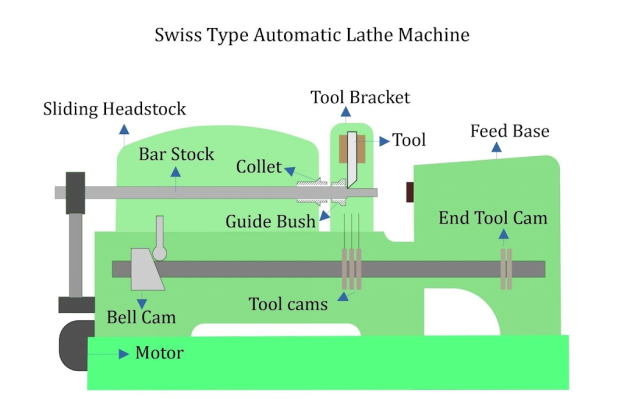
The table below lists key components of Swiss CNC machines:
| Component | Functionality |
|---|---|
| Guide Bushing | Supports the workpiece close to the cutting tool |
| Spindle | Rotates the bar stock |
| Cutting Tools | Remove excess material |
| Automatic Bar Feeder | Enables continuous operation |
Swiss Lathe Diagram and Key Components
In the diagram above, the machine contains numerous parts that ensure smooth machining with tight precision and tolerances. Among all parts, the guide bushing, feed base, bar stock, and spindle are most critical.
Capabilities of Swiss CNC Machines
Swiss CNC machines excel in various applications. For example, they can machine small parts with precision up to 0.0001 inches. They perform multiple operations simultaneously, reducing cycles and maintaining strict quality control. Due to their capabilities, they are used in critical industries like aerospace, medical, and electronics.
Applications of Swiss Precision Turned Parts
This section details applications of Swiss CNC machines:
CNC Machining in Swiss Watchmaking: Machining Swiss Screws
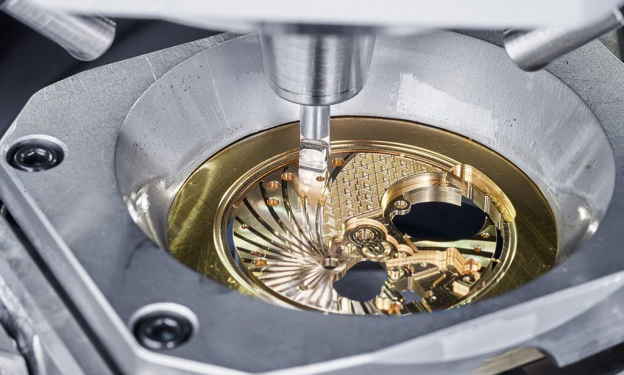
Originally made in Switzerland, Swiss machines were developed for watchmaking. Watch parts are tiny, making them difficult to machine with traditional lathes.
Aerospace Components and Medical Devices
Aerospace and medical industries have stringent safety standards. To meet these, extremely tight tolerances and high precision are required—feats achievable with Swiss-type lathes. Parts ranging from turbine blades to medical devices are machined using Swiss CNC lathes.
Automotive Industry and Small Precision Parts
Components like fuel injectors and sensors are small; Swiss CNC machines ensure their precise machining.
Swiss Machining of Swiss Turned Components
Swiss machines are ideal for Swiss turned components used across industries, from aerospace and medical to electronics and telecommunications.
Swiss Turning for High-Precision Parts
Small, complex, high-precision parts—such as medical implants, fuel injectors, and sensors—are manufactured using Swiss turning technology.
Advanced Features of Swiss CNC Lathes
The applications of Swiss CNC lathes, discussed above, are made possible by their advanced features:
Multi-Axis Swiss CNC Lathes for Complex Geometries
Swiss lathes produce intricate, delicate shapes thanks to their advanced capabilities.
How Swiss Lathes Double Productivity
Swiss machines, equipped with multiple tools, perform operations like drilling and milling simultaneously—doubling productivity.
Versatility in Producing Small Parts
Swiss lathes process various materials (metals, plastics, composites—excluding ceramics) with high precision and surface finish, making them versatile for small-part production.
Comparison of Swiss CNC Lathes with Other CNC Machines
While the initial investment in purchasing and installing Swiss lathes is high, their overall cost is lower than other CNC machines. They offer superior surface finish, higher precision, and lower long-term costs.
Choosing the Right Swiss CNC Machine for Your Application
Let’s explore how to select the right Swiss CNC machine:
Best Swiss CNC Machines for Precision Parts
For parts requiring high precision, choose a Swiss CNC machine. Consider factors like speed, material/design versatility, and precision before selecting.
Swiss Lathe vs. CNC Swiss Lathe: Which is Better?
The choice depends on the workpiece’s purpose. For small workpieces with high precision requirements, a Swiss lathe is ideal. For larger workpieces needing high precision, a CNC Swiss lathe is better.
Ready to Try Swiss Machining?
We hope this article sparks your interest in trying Swiss machining. Swiss machining is a reliable solution for small parts, so feel confident using it for critical components.
Partner with Debaolong Seiko
Debaolong Seiko is a China-based company offering top-tier machining services. Using state-of-the-art CNC machines, we ensure parts meet safety standards. We deliver services at the lowest price within the shortest turnaround time.